


Search results
Search for "palmatine" in Full Text gives 3 result(s) in Beilstein Journal of Organic Chemistry.
Synthesis of functionalized, 13-alkyl-substituted coralyne derivatives and investigation of their interactions with duplex and abasic site-containing DNA
Beilstein J. Org. Chem. 2026, 22, 1057–1066, doi:10.3762/bjoc.22.84
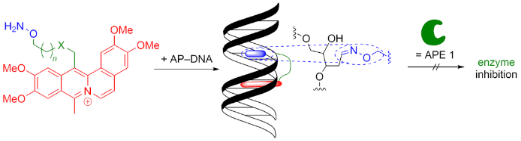
- novel DNA-binding N-hetarenes still constitutes a cornerstone in current drug development and in the search for promising drug candidates. Along these lines, the protoberberines, such as, e.g., berberine (1a), palmatine (1b), or jatrorrhizine (1c) (Figure 1), may be considered as privileged structures
- structurally closely related to the alkaloids berberine (1a) and palmatine (1b) [18] and alike these protoberberines, coralyne (2a) binds to different nucleic acids [19][20][21][22][23]. For instance, it intercalates into double-stranded DNA, along with aggregation along the DNA backbone. Coralyne (2a) also


Synthesis of a water-soluble 2,2′-biphen[4]arene and its efficient complexation and sensitive fluorescence enhancement towards palmatine and berberine
Beilstein J. Org. Chem. 2018, 14, 2236–2241, doi:10.3762/bjoc.14.198
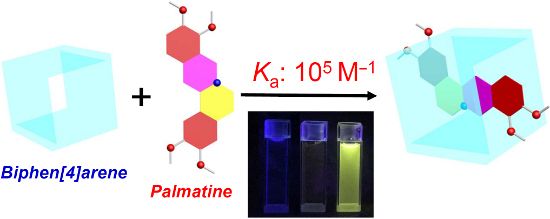
- , Shanghai 200444, P. R. China 10.3762/bjoc.14.198 Abstract A water-soluble 2,2′-biphen[4]arene (2,2’-CBP4) containing eight carboxylato moieties was synthesized and characterized. Its complexation behavior towards two alkaloids, palmatine (P) and berberine (B), was investigated by means of fluorescence and
- = (2.29 ± 0.27) × 106 M−1) is 3.9 times larger than that of P (Ka = (5.87 ± 0.24) × 105 M−1). Keywords: berberine; biphenarenes; host–guest complexes; molecular recognition; palmatine; Introduction Host–guest chemistry in water is significantly important due to its extensive applications in biology
- carboxylato moieties, 2,2’-CBP4 (Scheme 1), and its binding behavior and fluorescent spectrum characteristic towards two alkaoilds, palmatine (P) and berberine (B), in water solution. In particular, the fluorescence intensities of the two guests have been considerably enhanced after complexation. As a member


Interactions between photoacidic 3-hydroxynaphtho[1,2-b]quinolizinium and cucurbit[7]uril: Influence on acidity in the ground and excited state
Beilstein J. Org. Chem. 2017, 13, 203–212, doi:10.3762/bjoc.13.23
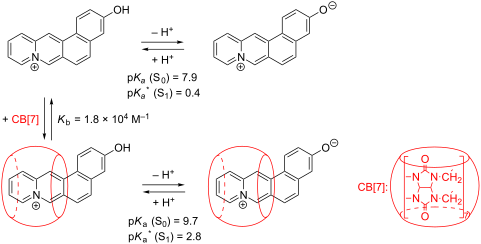
- charge providing ion–dipole interactions with the carbonyl portals of CB[7] as well as its extended π system, that was proposed to cause a higher affinity to the CB[7] due to an increased hydrophobic effect. Moreover, the naphthoquinolizinium ion resembles the quinolizinium-type alkaloids palmatine
- that can thread nicely into the binding site. Notably, the structurally resembling alkaloids berberine (8a) and palmatine (8b), that contain an angularly annelated quinolizinium unit, also bind to CB[7]. But whereas palmatine (8b) has essentially the same binding constant as 2 (Kb = 4.3 × 10⁴ M−1, in


Other Beilstein-Institut Open Science Activities



