


Search results
Search for "photoenzymatic catalysis" in Full Text gives 1 result(s) in Beilstein Journal of Organic Chemistry.
Enantioselective radical chemistry: a bright future ahead
Beilstein J. Org. Chem. 2025, 21, 2283–2296, doi:10.3762/bjoc.21.174
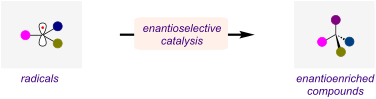
- describes several important catalytic asymmetric strategies applied to enantioselective radical reactions, including chiral Lewis acid catalysis, organocatalysis, photoredox catalysis, chiral transition-metal catalysis and photoenzymatic catalysis. The application of electrochemistry to asymmetric radical
- transformations is also discussed. Keywords: chiral Lewis acid; electrochemistry; enantioselective radical reaction; organocatalysis; photoenzymatic catalysis; photoredox; Introduction Asymmetric catalysis plays an integral role in the enantioselective synthesis of organic compounds. A wide variety of
- catalysis is discussed initially. This is followed by the recently emerging areas of transition-metal catalysis, photoenzymatic catalysis, and electrochemistry. Perspective Radical generation and reactions Synthetic methods based on free radical chemistry are some of the most efficient and powerful tools


Other Beilstein-Institut Open Science Activities



