


Search results
Search for "rhodium carbenoids" in Full Text gives 3 result(s) in Beilstein Journal of Organic Chemistry.
Rhodium-catalysed connective synthesis of diverse reactive probes bearing S(VI) electrophilic warheads
Beilstein J. Org. Chem. 2025, 21, 1924–1931, doi:10.3762/bjoc.21.150
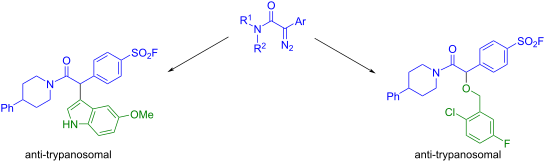
- multiplicity of reaction types between rhodium carbenoids and the many different co-substrate classes, and the catalyst-driven selectivity between these pathways. The probes were screened for activity against Trypanosma brucei, and four probes with promising anti-trypanosomal activity were identified
- the discovery of small molecule modifiers for investigating and engineering proteins. Keywords: covalent probes; molecular diversity; rhodium carbenoids; Introduction Diverse sets of reactive probes can facilitate the discovery of chemical tools and drugs that chemically modify protein targets [1][2
- -catalysed reaction between an α-diazo amide substrate bearing a warhead, and a co-substrate. The structural diversity of the probe set was increased by the multiple possible reaction modes of rhodium carbenoids, which enabled many different co-substrate classes and catalyst-driven selectivities to be


Enantioselective carbenoid insertion into C(sp3)–H bonds
Beilstein J. Org. Chem. 2016, 12, 882–902, doi:10.3762/bjoc.12.87
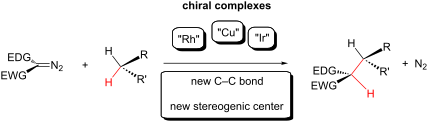
- metathesis (RCM) [68]. The insertion of the rhodium carbenoids derived from vinyl diazoacetate into the C(sp3)–H bonds of the alkenylcarbamates 97a–d yields two reaction products (Table 10). The major one (99a–d) was the result of the cyclopropanation reaction of the double bond present in 97a–d. The minor


Azirinium ylides from α-diazoketones and 2H-azirines on the route to 2H-1,4-oxazines: three-membered ring opening vs 1,5-cyclization
Beilstein J. Org. Chem. 2015, 11, 302–312, doi:10.3762/bjoc.11.35

- , rhodium carbenoids derived from α-diazocarbonyl compounds transform 2H-azirines 1 to azirinium ylides 5 (Scheme 1) which undergo facile N–C2 bond cleavage to give 2-azabuta-1,3-dienes 3. Recently we showed that the use of α-diazo-β-ketoesters 2 in these reactions, which are finished by 1,6-cyclization of


Other Beilstein-Institut Open Science Activities



