


Search results
Search for "taxifolin" in Full Text gives 2 result(s) in Beilstein Journal of Organic Chemistry.
A facile and practical method for the synthesis of trans-(±)-taxifolin and its derivatives via Darzens reaction
Beilstein J. Org. Chem. 2026, 22, 443–450, doi:10.3762/bjoc.22.31
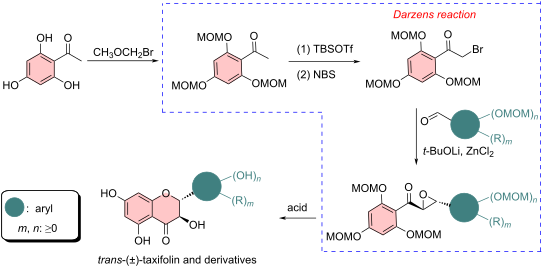
- Pharmacy, Shenzhen Technology University, Shenzhen 518118, China 10.3762/bjoc.22.31 Abstract The synthesis of racemic trans-taxifolin (trans-(±)-taxifolin) and its derivatives and subsequent chiral separation is the most prevalent chemical method to obtain enantiomerically pure taxifolin and its
- derivatives. The development of an economical and practical synthetic route to trans-(±)-taxifolin, a key precursor to the enantiomerically pure trans-taxifolin, is therefore of great importance and significance. In this work, we developed a new synthetic method for trans-(±)-taxifolin and its derivatives
- yields (20–41%) and proceeds without the use of explosive peroxides (such as H2O2), which are commonly employed in methods reported earlier. The avoidance of explosive peroxides in the present method enables safe operation, easy scale-up, and also the synthesis of taxifolin derivatives with oxidant


cis–trans Isomerization of silybins A and B
Beilstein J. Org. Chem. 2014, 10, 1047–1063, doi:10.3762/bjoc.10.105
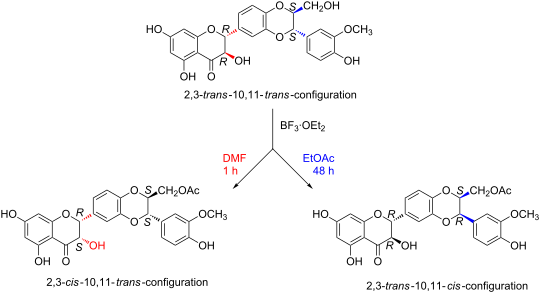
- configuration is known [1][2] and their separation was accomplished recently [3][4][5]. Both silybin isomers as well as other flavonolignans from silymarin (crude defatted extract from the fruits of S. marianum) are products of a phenolic oxidative coupling of the flavonoid taxifolin and the lignan coniferyl
- effects of local perturbations on specific stereogenic centers. Thus, the interpretation of our experimental ECD spectra is mainly based on empirical comparison and correlation to those of i) the dihydroflavonols taxifolin (15) and epitaxifolin (16) isolated from Thujopsis dolobrata [16] and ii) various
- (+)-taxifolin (2R,3R), according to its J2,3 value of 11.4 Hz and its ECD spectrum (14: θ [deg·cm2·dmol−1], CEs: 327 nm, θ = +9568; 293 nm, θ = −46824; 240 nm, Δε = +36917 deg·cm2·dmol−1; 230 nm, θ = −8890; 211 nm, θ = −63590) (Figure S3, Supporting Information File 1). Accordingly, its absolute configuration


Other Beilstein-Institut Open Science Activities



