


Search results
Search for "threonine aldolase" in Full Text gives 2 result(s) in Beilstein Journal of Organic Chemistry.
Enantioselective radical chemistry: a bright future ahead
Beilstein J. Org. Chem. 2025, 21, 2283–2296, doi:10.3762/bjoc.21.174
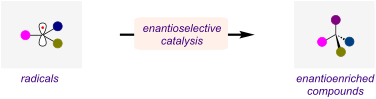
- cross-electrophile coupling of alkyl halides and nitroalkanes [76]. Yang and co-workers reported photoenzymatic asymmetric C(sp3)–C(sp3) oxidative cross-couplings between organoboron reagents and amino acids (Scheme 9) [37]. The authors used a synergistic system consisting of an engineered threonine
- aldolase, a photoredox catalyst, and an oxidizing agent. With this catalytic system, they were able to accomplish the C–H functionalization of glycine and α-branched amino acids, obtaining α-tri- and tetrasubstituted amino acids with moderate to good yields, good diastereoselectivity, and high


Flow synthesis of phenylserine using threonine aldolase immobilized on Eupergit support
Beilstein J. Org. Chem. 2013, 9, 2168–2179, doi:10.3762/bjoc.9.254
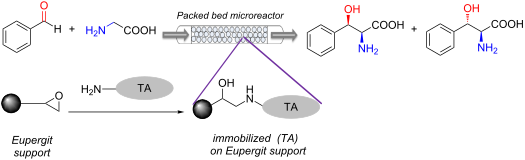
- was achieved at 20 minute residence time. Finally, the productivity of the reactor was calculated, extrapolated to parallel run units, and compared with data collected previously. Keywords: Eupergit; flow chemistry; immobilized enzyme; threonine aldolase; Introduction Enzymes are bio-based catalysts
- which is useful to reduce the cost of the process by reusing the catalyst. Conclusion To the best of our knowledge, we report the first use of immobilized threonine aldolase in a microreactor for the flow synthesis of phenylserine. So far, we achieved a maximum of about 30% yield under the typical flow
- Materials The enzyme L-allo-threonine aldolase (L-low-TA) (EC 4.1.2.48) having concentration of 3 mg/mL and activity of 0.135 U/mg has a strong preference for L-allo-threonine from Thermotoga maritima and was kindly donated by the Junior Research Group ‘‘Industrial Biotechnology’’ (University of Leipzig


Other Beilstein-Institut Open Science Activities



