


Search results
Search for "two-chamber reactor" in Full Text gives 2 result(s) in Beilstein Journal of Organic Chemistry.
Ex-situ generation of gaseous nitriles in two-chamber glassware for facile haloacetimidate synthesis
Beilstein J. Org. Chem. 2025, 21, 2465–2469, doi:10.3762/bjoc.21.188
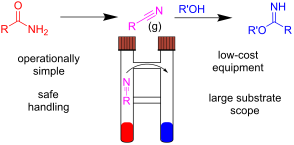
- donor; haloacetimidates; haloacetonitrile; two-chamber reactor; Introduction Trifluoroacetonitrile is an electrophilic reagent that has seen a variety of uses, mostly for incorporating trifluoromethyl groups into organic compounds [1]. As an example it has been successfully utilized for the synthesis
- of trifluoroacetonitrile and our set-up using a two-chamber reactor. Glycosyl haloacetimidates synthesized using the two-chamber method. Synthesis of arylmethylene fluoroacetimidates using the two-chamber method. Reactions in chambers A and B. Chamber A: generation of the haloacetonitrile by


Oxidative fluorination with Selectfluor: A convenient procedure for preparing hypervalent iodine(V) fluorides
Beilstein J. Org. Chem. 2024, 20, 1785–1793, doi:10.3762/bjoc.20.157
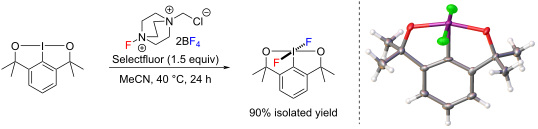
- multiple extractions into hexane under a nitrogen atmosphere in a glovebox. A similar synthetic approach to acyclic iodine(V) fluorides was developed more recently by Ismalaj and co-workers by reacting iodoarenes with 6 equivalents of KF and ex situ-generated chlorine gas within a two-chamber reactor setup


Other Beilstein-Institut Open Science Activities



