


Search results
Search for "Josephson junction" in Full Text gives 36 result(s) in Beilstein Journal of Nanotechnology.
Anomalous current–voltage characteristics of SFIFS Josephson junctions with weak ferromagnetic interlayers
Beilstein J. Nanotechnol. 2020, 11, 252–262, doi:10.3762/bjnano.11.19

- characteristic of a SNINS Josephson junction with a characteristic peak at eV ≈ 2Δ (see Figure 5a, solid black line) [101]. With an increase of the exchange field h this peak becomes smeared (see Figure 5b–d, solid black line). Increasing df and/or h produces a set of I–V curves among which the red dashed line


Unipolar magnetic field pulses as an advantageous tool for ultrafast operations in superconducting Josephson “atoms”
Beilstein J. Nanotechnol. 2019, 10, 1548–1558, doi:10.3762/bjnano.10.152
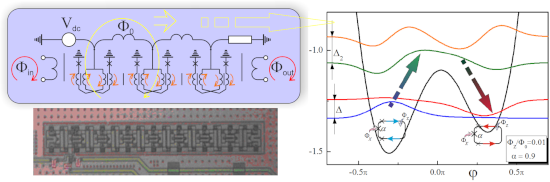
- modern quantum physics is the transfer and storage of quantum information. This is why the development of quantum logic protocols using the fast state control of promising qubits and registers is of great importance. Superconducting artificial atoms based on Josephson junction circuits underlie a number
- [3]), where Josephson energies of the elements are EJos, EJos and αEJos (α = 0.9, junctions depicted as crosses). The characteristic Josephson energy EJos is 80 times larger than the characteristic Coulomb energy of the heterostructures. φ is the generalized coordinate associated with the Josephson
- junction phases. (b) A “Not”-operation in a double-well potential of the flux-driven superconducting meta-atom (α = 1.5) is shown as a transition between the states with certain values of the magnetic moment (these states correspond to the energy levels of E1 and E2, respectively). Applied adjusting


Periodic Co/Nb pseudo spin valve for cryogenic memory
Beilstein J. Nanotechnol. 2019, 10, 833–839, doi:10.3762/bjnano.10.83

- us in the future to study the possible influence of superconductivity on the magnetic configuration via electromagnetic [38][39] or exchange [40][41] mechanisms. In conclusion, we have proposed a memory element based on a Josephson junction with a weak link composed of a periodic S/F structure that


A zero-dimensional topologically nontrivial state in a superconducting quantum dot
Beilstein J. Nanotechnol. 2018, 9, 1705–1714, doi:10.3762/bjnano.9.162

- simplest realization of such a 0D topological superconductor, i.e., a quantum dot [51][52][53][54] coupled with two superconducting leads in a magnetic Zeeman field, forming a superconductor–quantum dot–superconductor (SC–QD–SC) Josephson junction. Zero-energy modes and the corresponding CPR
- temperatures can reveal the presence of such discontinuities. Moreover, the presence of the topological transition can be probed indirectly by a measure of the critical current of the junction as a function of the Zeeman field or gate voltage. An SC–QD–SC Josephson junction realized by a two-level quantum dot


Robust topological phase in proximitized core–shell nanowires coupled to multiple superconductors
Beilstein J. Nanotechnol. 2018, 9, 1512–1526, doi:10.3762/bjnano.9.142

- superconductors. A non-zero phase difference was shown to stabilize the topological phase in a Josephson junction across a 2D electron gas with Rashba spin-orbit coupling and in-plane magnetic field [42] and in a topological insulator nanoribbon coupled with two superconductors [43]. Here, for concreteness, we


![[Graphic 30]](/bjnano/content/inline/2190-4286-9-142-i36.svg?max-width=637&scale=1.18182) ) = 0 and
) = 0 and ![[Graphic 31]](/bjnano/content/inline/2190-4286-9-142-i37.svg?max-width=637&scale=1.18182) = 0. The white areas are t...
= 0. The white areas are t...


![[Graphic 40]](/bjnano/content/inline/2190-4286-9-142-i46.svg?max-width=637&scale=1.18182) ) ≠ 0 and
) ≠ 0 and ![[Graphic 41]](/bjnano/content/inline/2190-4286-9-142-i47.svg?max-width=637&scale=1.18182) = 0. The white areas are topol...
= 0. The white areas are topol...
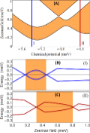
![[Graphic 50]](/bjnano/content/inline/2190-4286-9-142-i56.svg?max-width=637&scale=1.18182) ) ≠ 0 and
) ≠ 0 and ![[Graphic 51]](/bjnano/content/inline/2190-4286-9-142-i57.svg?max-width=637&scale=1.18182) 1 = 0,
1 = 0, ![[Graphic 52]](/bjnano/content/inline/2190-4286-9-142-i58.svg?max-width=637&scale=1.18182) 3 = π/2,
3 = π/2, ![[Graphic 53]](/bjnano/content/inline/2190-4286-9-142-i59.svg?max-width=637&scale=1.18182) 5 = −π/2. T...
5 = −π/2. T...

![[Graphic 65]](/bjnano/content/inline/2190-4286-9-142-i71.svg?max-width=637&scale=1.18182) ) ≠ 0 and
) ≠ 0 and ![[Graphic 66]](/bjnano/content/inline/2190-4286-9-142-i72.svg?max-width=637&scale=1.18182) 1 = π/2,
1 = π/2, ![[Graphic 67]](/bjnano/content/inline/2190-4286-9-142-i73.svg?max-width=637&scale=1.18182) 3 = −π/2,
3 = −π/2, ![[Graphic 68]](/bjnano/content/inline/2190-4286-9-142-i74.svg?max-width=637&scale=1.18182) 5 = π/2, and ...
5 = π/2, and ...
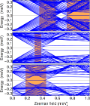
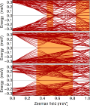


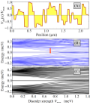
![[Graphic 79]](/bjnano/content/inline/2190-4286-9-142-i85.svg?max-width=637&scale=1.18182) = 3 of a triangular wi...
= 3 of a triangular wi...


Revealing the interference effect of Majorana fermions in a topological Josephson junction
Beilstein J. Nanotechnol. 2018, 9, 520–529, doi:10.3762/bjnano.9.50

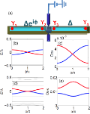
- the local density of states (DOS) in a topological Josephson junction. We show that the well-known 4π Josephson effect originates from the interference effect between two Majorana fermions (MFs) that are localized at the Josephson junction. In addition, the DOS for electrons (holes) shows the 4π
- combined to form a topological Josephson junction (Top-JJ), the period of the supercurrent is 4π if MFs exist at the ends of both wires. This is different from the trivial case without MFs. In the trivial case in which only Cooper pairs can tunnel, the period is 2π. Since MFs have only half a degree of
- of the 4π Josephson current is not consistent with the theoretical prediction [35][36][37][38][39][40][41]. To distinguish the 4π information of MFs, it is necessary to reveal additional characteristic properties of such a Josephson junction. In this paper, we study a Top-JJ composed of two


Beyond Moore’s technologies: operation principles of a superconductor alternative
Beilstein J. Nanotechnol. 2017, 8, 2689–2710, doi:10.3762/bjnano.8.269

- a deep analogy between superconducting logic cells and von Neuman cellular automata [16] where short-range interactions are predominant. The nonlinear element in superconducting circuits is the Josephson junction. It is a weak link between two superconductors, e.g., the most commonly used
- superconductor–isolator–superconductor (SIS) sandwich structure. One of the most important parameters of a Josephson junction is its critical current, Ic. This is the maximum superconducting current capable of flowing through the junction. A Josephson junction can be switched from the superconducting to the
- model with capacitance (RSJC) [18]. This model presents a Josephson junction as a parallel connection of the junction itself transmitting only the superconducting current, Is, and a resistor and a capacitor with the corresponding currents, Ir = V/R and Icap = C(∂V/∂t), where t is the time. The total


Anodization-based process for the fabrication of all niobium nitride Josephson junction structures
Beilstein J. Nanotechnol. 2017, 8, 539–546, doi:10.3762/bjnano.8.58

- surface and their stoichiometry. A multilayer superconductor/insulator/superconductor was obtained by successive depositions and patterned by means of the proposed anodization technique to obtain a NbN/AlN/NbN Josephson junction the current–voltage characteristic of which was measured in a liquid helium
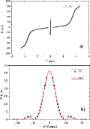
- replacement with oxygen is observed from the measurements and a rough stoichiometry can be extrapolated compatible with Nb2O5. Tunnel junctions In Figure 11a we show the current–voltage characteristic of a Josephson-junction measured at 4.2 K. The three-layer junction (NbN/AlN/NbN) is formed by three films of
- the spectra is observed that only niobium and nitrogen are present before the process. After the oxidation process the nitrogen was completely replaced with oxygen. a) Current–voltage characteristic for NbN Josephson junction and b) diffraction pattern obtained measuring Jc as function of the applied






Adiabatic superconducting cells for ultra-low-power artificial neural networks
Beilstein J. Nanotechnol. 2016, 7, 1397–1403, doi:10.3762/bjnano.7.130
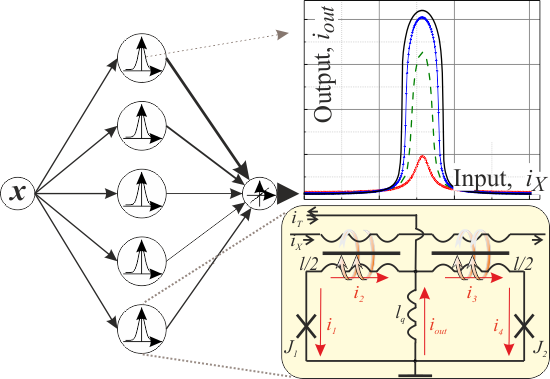
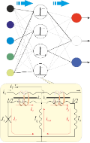
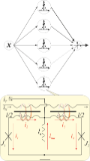
- ), making them relatively slow and hardware/power consumable. The basic element of a superconducting circuit is the nonlinear Josephson junction, which is about three orders faster than a conventional transistor. In contrast to semiconductor neurons, the superconducting one typically consists of just a few
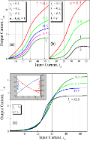
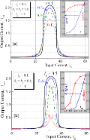
- quantron loop and the relationship between the current through the Josephson junction and its phase, φ, are as follows: One can represent output current as a parametric function [25] and then plot the nonlinear flux-to-current characteristic, as shown in Figure 1b. Note that the resulting transfer function


Magnetic reversal dynamics of a quantum system on a picosecond timescale
Beilstein J. Nanotechnol. 2015, 6, 1946–1956, doi:10.3762/bjnano.6.199
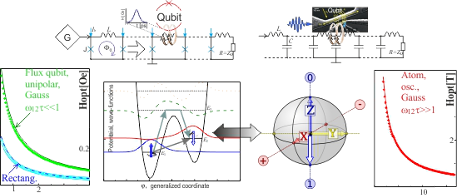
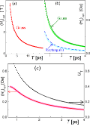
- a Josephson junction weak link, etc. [28][29][30][31][32][33][34][35][36]. This paper is organized as follows. The first subsection of the Results and Discussion describes the analytical approach for the analysis of two-level magnetic system dynamics. We provide this analysis for two-level systems




Molecular materials – towards quantum properties
Beilstein J. Nanotechnol. 2015, 6, 1485–1486, doi:10.3762/bjnano.6.153
- information schemes. As a result of their confinement, electrons in both natural atoms and in quantum dots, so-called artificial atoms, are characterized by the formation of discrete energy levels. Similarly, in the case of a Josephson junction, Cooper pairs are confined in the potential well of the Josephson



