


Search results
Search for "carbon dots" in Full Text gives 29 result(s) in Beilstein Journal of Nanotechnology.
Sugarcane juice derived carbon dot–graphitic carbon nitride composites for bisphenol A degradation under sunlight irradiation
Beilstein J. Nanotechnol. 2018, 9, 353–363, doi:10.3762/bjnano.9.35
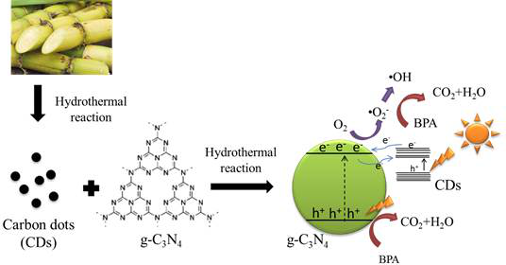
- Laboratory, Department of Environmental Science and Engineering, Indian Institute of Technology (ISM), Dhanbad 826004, Jharkhand, India 10.3762/bjnano.9.35 Abstract Carbon dots (CDs) and graphitic carbon nitride (g-C3N4) composites (CD/g-C3N4) were successfully synthesized by a hydrothermal method using
- superoxide anion radical (O2•−) and holes (h+) after performing multiple scavenging tests. Keywords: carbon dots; g-C3N4; photocatalytic degradation; sugarcane juice; sunlight; Introduction Carbon dots (CDs) predominantly consist of amorphous carbon together with nanocrystalline regions of sp2-hybridized
- carbon dots (CDs) solution. The inset shows the fluorescence of the CDs under daylight (left) and UV light irradiation at 365 nm (right). (b) The photoluminescence (PL) emission spectrum of CDs at different excitation wavelengths, (c) UV–vis diffuse reflection spectra (DRS) spectra, and (d) PL spectra of
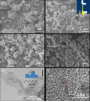


Facile fabrication of luminescent organic dots by thermolysis of citric acid in urea melt, and their use for cell staining and polyelectrolyte microcapsule labelling
Beilstein J. Nanotechnol. 2016, 7, 1905–1917, doi:10.3762/bjnano.7.182

- ), making them quite toxic. In turn, nanophosphors based on rare earth elements (REE) are less harmful, but very expensive. Today, scientists are exploring the possibility of using nanoscale fluorescent carbon dots (C-dots) instead of Q-dots and REE-based nanophosphors. C-dots possess the attractive
- ]. Bourlinos et al. [24][25] heated various citrate salts, e.g., ammonium citrate in air, up to 300 °C, to produce water-soluble carbon dots of 7 nm average diameter and a fluorescence quantum yield of 3% at 495 nm excitation [24]. Doping of citric acid-based organic dots with nitrogen greatly improves their
- temperature (up to 200 °C) causes the formation of polymerized species forming amorphous carbon dots with partial sp2 hybridization. Song et al. demonstrated [39] that the primary fluorophore of a carbon dot is an independent fluorescent molecule, or possibly a molecule linked to the surface or incorporated



Facile synthesis of water-soluble carbon nano-onions under alkaline conditions
Beilstein J. Nanotechnol. 2016, 7, 758–766, doi:10.3762/bjnano.7.67
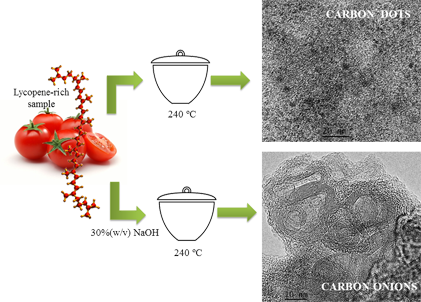
- , Damanhour, Egypt 10.3762/bjnano.7.67 Abstract Carbonization of tomatoes at 240 °C using 30% (w/v) NaOH as catalyst produced carbon onions (C-onions), while solely carbon dots (C-dots) were obtained at the same temperature in the absence of the catalyst. Other natural materials, such as carrots and tree
- versatile materials for chemical sensing of metal ions. The high content of lycopene in tomatoes may explain the formation of C-onions in alkaline media and a possible formation mechanism for such structures was outlined. Keywords: carbon dots; carbon onions; metal-ion sensing; photoluminescence; thermal
- sensors. The more popular and extensively investigated carbon-based nanomaterials include carbon dots (C-dots), fullerenes, nanotubes and graphene, while others, such as nanodiamonds and carbon onions, stayed forgotten for a long time, in spite of the fact that these carbon nanoparticles (C-NPs) were


Nanostructure sensitization of transition metal oxides for visible-light photocatalysis
Beilstein J. Nanotechnol. 2014, 5, 696–710, doi:10.3762/bjnano.5.82
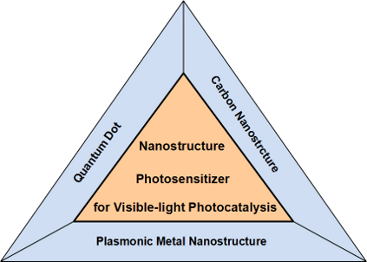
- for more detailed information [106]. Carbon nanodots are a new class of carbon nanomaterials and consist of discrete, quasipherical nanoparticles with sizes below 10 nm [107][108][109][110]. Since they have been reported on in 2004 for the first time [111], carbon dots have gradually become an
- important member in the nanocarbon family due to their benign, abundant and low-cost nature. As carbonaceous quantum dots, carbon nanodots display PL behavior dependent on their size and the excitation wavelength. In addition, carbon dots are also characterized by water solubility, chemical inertness and




Other Beilstein-Institut Open Science Activities



