Search results
Search for "chromophore" in Full Text gives 35 result(s) in Beilstein Journal of Nanotechnology.
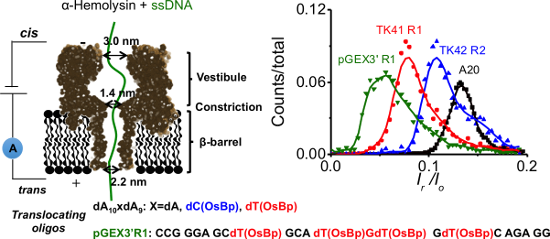
Single pyrimidine discrimination during voltage-driven translocation of osmylated oligodeoxynucleotides via the α-hemolysin nanopore
Beilstein J. Nanotechnol. 2016, 7, 91–101, doi:10.3762/bjnano.7.11
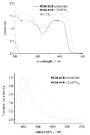
- purification/removal of the excess label [42][46]. It was also shown that the osmylation product exhibits a new chromophore in the range 300 to 320 nm [42][46] where DNA does not absorb (see below in Figure 3). This chromophore was the basis for developing a UV–vis assay to quantitatively measure the extent of



Electrical characterization of single molecule and Langmuir–Blodgett monomolecular films of a pyridine-terminated oligo(phenylene-ethynylene) derivative
Beilstein J. Nanotechnol. 2015, 6, 1145–1157, doi:10.3762/bjnano.6.116

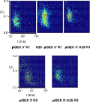
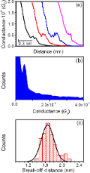
- the dipole transition moment of the chromophore. This result is in agreement with a progressive reorientation of the molecules in the Langmuir film upon compression. Langmuir–Blodgett monomolecular films of 1 were obtained by the transference of Langmuir films onto solid substrates by the vertical




A versatile strategy towards non-covalent functionalization of graphene by surface-confined supramolecular self-assembly of Janus tectons
Beilstein J. Nanotechnol. 2015, 6, 632–639, doi:10.3762/bjnano.6.64

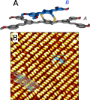
- . Face A was designed to act as a pedestal capable of steering a 2D self-assembly onto the substrate, while B is a functional entity (e.g., a chromophore). The spacer acts as a pillar ensuring the decoupling of the B face from the substrate. Moreover, if the Janus tecton is laying on the substrate via
- (x,y,z) of a chromophore above a substrate. Moreover, due to its substantial, inherent tunability, this strategy opens up a promising novel route toward functional molecular nanostructures and new perspectives towards active surfaces and interfaces on C(sp2)-based substrates. 3D tectons for non




The surface properties of nanoparticles determine the agglomeration state and the size of the particles under physiological conditions
Beilstein J. Nanotechnol. 2014, 5, 1774–1786, doi:10.3762/bjnano.5.188
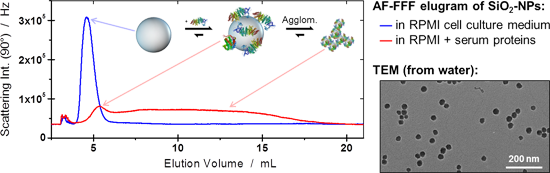
- despite the fact that they do not carry any chromophore groups. In the presence of serum proteins (red lines) a peak for the pristine NPs is observable by light scattering detection. This indicates that the single particles are not completely depleted. A shift in elution volume denotes the formation of


Donor–acceptor graphene-based hybrid materials facilitating photo-induced electron-transfer reactions
Beilstein J. Nanotechnol. 2014, 5, 1580–1589, doi:10.3762/bjnano.5.170

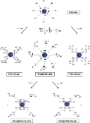
- about the electronic communication between the chromophore moiety and rGO, which lead to the fabrication of photoelectrochemical cells. The photo-induced electron-transfer properties of ZnP–rGO and RuP–rGO were evaluated by examining the photocurrent responses in thin films on indium tin oxide (ITO). In
- chromophore) and an azide-functionalized chromophore (or graphene sheet) were also shown to amplify the charge transfer [52]. An overview of common photophysical properties for some of the discussed graphene-based nanohybrids is given in Table 1. Conclusion To summarize, recent advances in the synthesis of
- functionalization. Such graphene-based donor–acceptor hybrid materials were found to possess interesting optical and photophysical properties. Charge-transfer phenomena mainly from the photoexcited organic chromophore units to the graphene layers were observed. Although the potential of these materials to be


Functionalized nanostructures for enhanced photocatalytic performance under solar light
Beilstein J. Nanotechnol. 2014, 5, 994–1004, doi:10.3762/bjnano.5.113
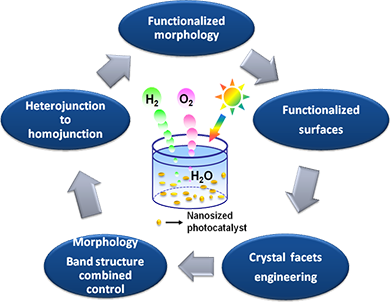
- material, the Cr–O–Ti interaction should be responsible [22]. In this case, a second metal element introduced as a donor can closely link to the first metal element by forming an oxo bridge, which is supposed to be robust chromophore induced by metal-to-metal charge-transfer (MMCT). Nanosized


Dye-doped spheres with plasmonic semi-shells: Lasing modes and scattering at realistic gain levels
Beilstein J. Nanotechnol. 2013, 4, 974–987, doi:10.3762/bjnano.4.110
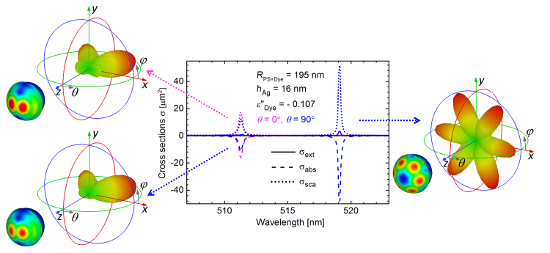
- approached from below [36]. Here, we define the extinction cross section as σex = σsc + σab, irrespectively of the sign of σab. To get realistic simulation parameters, we determined the chromophore density in dye-doped polystyrene (PS) spheres, which are commercially available from Thermo-Scientific (Waltham





Variations in the structure and reactivity of thioester functionalized self-assembled monolayers and their use for controlled surface modification
Beilstein J. Nanotechnol. 2012, 3, 213–220, doi:10.3762/bjnano.3.24

- , which is typical of conjugated carbonyl groups. We also note the wavelength dependence of the photochemistry reported herein. The longer wavelength absorption of the conjugated chromophore is clearly a first step towards a system that could be photoreacted with longer wavelength light. This would


Approaches to nanostructure control and functionalizations of polymer@silica hybrid nanograss generated by biomimetic silica mineralization on a self-assembled polyamine layer
Beilstein J. Nanotechnol. 2011, 2, 760–773, doi:10.3762/bjnano.2.84

- silica-mineralization reaction conditions. We further demonstrate the use of amine chemistry of free LPEI or LPEI occluded in LPEI@silica nanoribbons for the functionalization of the nanograss film, by selecting three representative examples, chromophore (porphyrin), metal nanoparticle (Au) and oxide


Novel acridone-modified MCM-41 type silica: Synthesis, characterization and fluorescence tuning
Beilstein J. Nanotechnol. 2011, 2, 284–292, doi:10.3762/bjnano.2.33

- ), IR and UV–vis spectroscopy, as well as 29Si and 13C CP-MAS NMR techniques. The material features a high inner surface area and a highly ordered two-dimensional hexagonal pore structure. The fluorescence properties of the organic chromophore can be tuned via complexation of its carbonyl group with
- fluorescence when measured both as a solid film and in solution, hence it is obvious that the optical properties of the material depend on the electronic structure of the acridone chromophore, the latter being significantly changed via formation of the complex as the scandium(III) ion strongly interacts with