


Search results
Search for "mucus" in Full Text gives 30 result(s) in Beilstein Journal of Nanotechnology.
Data-adaptive image-denoising for detecting and quantifying nanoparticle entry in mucosal tissues through intravital 2-photon microscopy
Beilstein J. Nanotechnol. 2014, 5, 2016–2025, doi:10.3762/bjnano.5.210
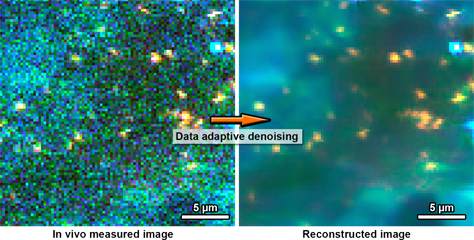
- dot nanoparticles (yellow). Some of the nanoparticles adhere to mucus (upper third in a and b), some others adhere to the apical membrane of the epithelial cells (arrows in b). The grainy structure in the lumen (encircled in a) represents photon shot noise only; it is completely removed by the


The protein corona protects against size- and dose-dependent toxicity of amorphous silica nanoparticles
Beilstein J. Nanotechnol. 2014, 5, 1380–1392, doi:10.3762/bjnano.5.151
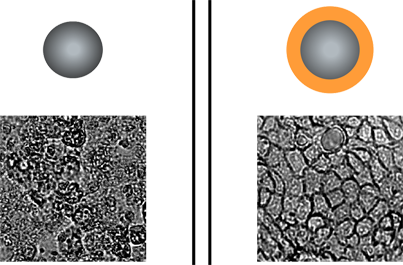
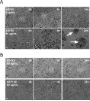
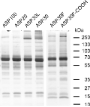
- ) and epithelial GI tract Caco-2 cells as a model to study the biological impact of particle size as well as of the protein corona. Caco-2 or mucus-producing HT-29 cells were exposed to thoroughly characterized, negatively charged ASP of different size in the absence or presence of proteins
- MTT assay (Figure 6). Similar to the lung surfactant [32], also epithelial cell of the GI tract are covered by an additional biobarrier, i.e., by mucous matrices [33]. To investigate the impact of mucus associated to GI tract cells on the observed effects, we included the mucus-secreting colorectal
- cell line HT-29 in our study. The HT-29 cell model is a widely accepted model for studying the impact of mucus associated to cells of the GI tract [33]. As shown in Figure 6C, even in the presence of cell-associated mucus the cytoprotective impact of the protein corona was preserved. Effect of the






The surface microstructure of cusps and leaflets in rabbit and mouse heart valves
Beilstein J. Nanotechnol. 2014, 5, 622–629, doi:10.3762/bjnano.5.73

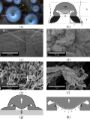
- structure is also present on the surface of the mitral valve leaflets. Namely the distribution of the nano-scale cilia structure on the micron papillae is similar to the distribution of the microstructure on the surface of the aortic valve cusps. Without treatment by heparin there is a lot of mucus attached
- , the cilia structure was destroyed, so it is not obvious. However, because of the elimination of mucus, the mastoid structure became very clear. In addition, the arrangement of the microstructure on the surface of the mitral valve leaflets can be seen as directional, and its direction is consistent



Hairy suckers: the surface microstructure and its possible functional significance in the Octopus vulgaris sucker
Beilstein J. Nanotechnol. 2014, 5, 561–565, doi:10.3762/bjnano.5.66

- this case, small ciliary tufts occur at a very low density in the side foot; whereas, they become significantly more dense in the sole foot. Similar to octopus suckers, the cilia are covered by a layer of mucus. However, in all the three cases (octopus, abalone, and clingfish), the hairs lack the
- termini contact elements as well as the presence of water and mucus between hairs and respective substrates suggest that biological structures operating underwater cannot exploit filament-like structures to generate van der Waals forces [3]. We completely agree with this idea and think that under wet
- adhesion conditions, a system consisting of hairs, mucus, and water (just like octopus suckers) could improve attachment due to following mechanisms: (i) exploiting the presence of mucus and filaments to increase the viscosity coefficient at the interface and to resist to the shear forces; and (ii
Analysis of fluid flow around a beating artificial cilium
Beilstein J. Nanotechnol. 2012, 3, 163–171, doi:10.3762/bjnano.3.16

- multicellular organisms, generation of a fluid flow above a surface is crucial for transporting an ovum in the Fallopian tubes, or for moving mucus in the respiratory tract, to name just two examples found in humans. Motion of fluid is also vital for embryonic development in vertebrates as directed flow



Other Beilstein-Institut Open Science Activities



