


Search results
Search for "nanoimprint" in Full Text gives 29 result(s) in Beilstein Journal of Nanotechnology.
Fabrication of multi-parametric platforms based on nanocone arrays for determination of cellular response
Beilstein J. Nanotechnol. 2011, 2, 545–551, doi:10.3762/bjnano.2.58
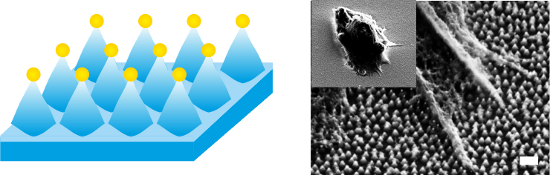
- lack of nanofabrication techniques to generate functional structures. Recent advances in nanofabrication techniques such as nanoimprint lithography (NIL) [9], nanosphere/colloidal lithography [10], dip pen lithography [11], e-beam lithography [12] have enabled and motivated biomaterial development


Towards multiple readout application of plasmonic arrays
Beilstein J. Nanotechnol. 2011, 2, 501–508, doi:10.3762/bjnano.2.54

- allowing both fluorescence and SERS detection. Finally, once optimized, plasmonic arrays produced by electron beam lithography can also be prepared through nanoimprint techniques, an inexpensive method to manufacture large quantities. Therefore, we report here on the application of such a nanorhomb array


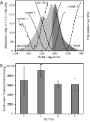
Plasmonic nanostructures fabricated using nanosphere-lithography, soft-lithography and plasma etching
Beilstein J. Nanotechnol. 2011, 2, 448–458, doi:10.3762/bjnano.2.49

- nm. Nanoimprint lithography [55][56] is another alternative technique in which a pattern is formed on top of a substrate by pressing a mold against a thin resist film, followed by reactive ion etching (RIE) of the patterned substrate. This allows patterning of reproducible structures up to a few tens





Formation of precise 2D Au particle arrays via thermally induced dewetting on pre-patterned substrates
Beilstein J. Nanotechnol. 2011, 2, 318–326, doi:10.3762/bjnano.2.37

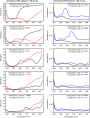
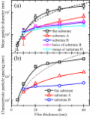
- thickness had to be adjusted in a certain thickness-window in order to achieve the precise 2D particle arrays. Keywords: Au particles; dewetting; nanoimprint lithography; nanoparticle array; Introduction An increasing amount of scientific attention is being paid to the ordered arrangement of metallic
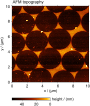
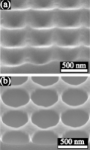
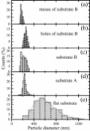
- . induced by annealing, has been studied, on both the flat substrate and two types of pre-patterned substrates (one with an array of pyramidal pits and one with an array of circular holes, made using nanoimprint lithography), and large areas of 2D ordered nanoparticle arrays were fabricated. Instead of the
- technique, which was developed by Philips Research and SUSS MicroTec, combines the advantages of both UV nanoimprint lithography techniques with rigid stamp for the best resolution and with soft stamp for the large-area (6 inch area) patterning. Thermal oxide several nanometers thick was grown on the pre





Other Beilstein-Institut Open Science Activities



