


Search results
Search for "optical bandgap" in Full Text gives 33 result(s) in Beilstein Journal of Nanotechnology.
Charge-transfer interactions between fullerenes and a mesoporous tetrathiafulvalene-based metal–organic framework
Beilstein J. Nanotechnol. 2019, 10, 1883–1893, doi:10.3762/bjnano.10.183
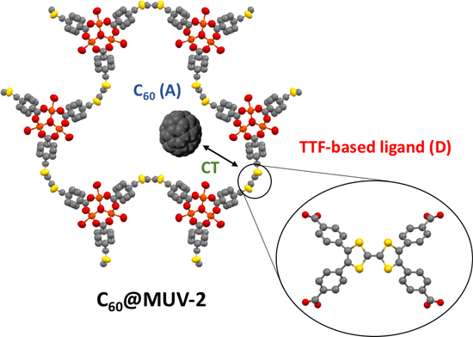
- intermolecular CT excitation between the C60 and TTF ligands, as supported by theoretical calculations (see below). The experimental optical bandgap calculated from the onset is near 1.4 eV (885 nm), which is in agreement with the calculated electrochemical bandgap (1.43 eV) since the redox potential of TTF




Zn/F-doped tin oxide nanoparticles synthesized by laser pyrolysis: structural and optical properties
Beilstein J. Nanotechnol. 2019, 10, 9–21, doi:10.3762/bjnano.10.2

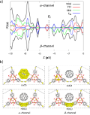
- dopant concentration). Keywords: laser pyrolysis; nanoparticles; optical bandgap; Zn/F-doped SnO2; Introduction Recently, there has been growing interest in the field of transparent conducting oxides and wide bandgap oxide nanocrystalline materials such as tin oxide (SnO2). It is generally agreed that



Lead-free hybrid perovskites for photovoltaics
Beilstein J. Nanotechnol. 2018, 9, 2209–2235, doi:10.3762/bjnano.9.207
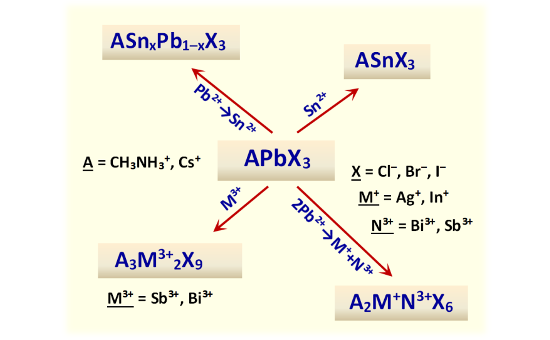
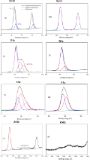
- 1.79 eV and an increase of the solar cell performance (Figure 3c) from 8.25% for the undoped Pb-HP to 11.33% for the CsSn0.1Pb0.9IBr2-based device [69]. The latter cell also exhibited a record Voc of 1.26 V amounting to ≈70% of the optical bandgap and vividly showing a high potential of such


Sb2S3 grown by ultrasonic spray pyrolysis and its application in a hybrid solar cell
Beilstein J. Nanotechnol. 2016, 7, 1662–1673, doi:10.3762/bjnano.7.158
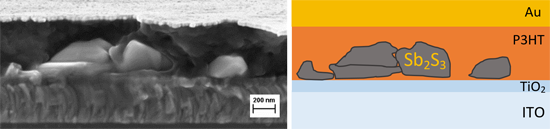
- between the Sb/S ratio in the films and the corresponding values of Eg suggest that values around 1.6 eV are expected for crystalline and stoichiometric Sb2S3 (S/Sb = 1.5) films [60]. Thus, based on the low optical bandgap of 1.6 eV, along with the S/Sb ratio of 1.53 obtained by EDX, we can deduce that




Optical absorption signature of a self-assembled dye monolayer on graphene
Beilstein J. Nanotechnol. 2016, 7, 862–868, doi:10.3762/bjnano.7.78
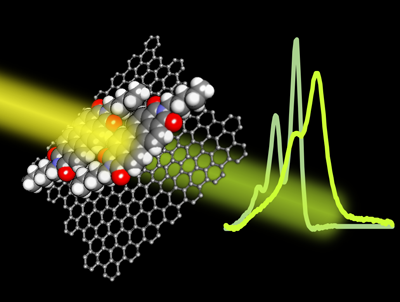
- changes of the optical bandgap. However, alkyl chains present here should reduce such interactions by maintaining the conjugated moiety at a larger distance from graphene. This is substantiated by the preservation of the absorption line-shape and the balance between vibronic contributions. This also means



An insight into the mechanism of charge-transfer of hybrid polymer:ternary/quaternary chalcopyrite colloidal nanocrystals
Beilstein J. Nanotechnol. 2014, 5, 1235–1244, doi:10.3762/bjnano.5.137
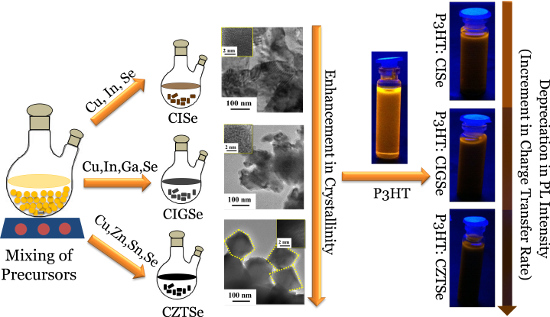
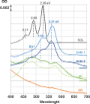
- in Figure 3C(a–c), which shows the enhancement of the optical bandgap (as calculated from the Tauc’s plot involving the absorption coefficient, α and the photon energy hν) from CISe to CZTSe. The bandgap values of pristine CISe, CIGSe and CZTSe are ≈1.03 eV, 1.1 eV and 1.15 eV, respectively (Figure


Surface passivation and optical characterization of Al2O3/a-SiCx stacks on c-Si substrates
Beilstein J. Nanotechnol. 2013, 4, 726–731, doi:10.3762/bjnano.4.82

- and glass respectively. The results of the absorbance measurements are shown in Figure 2. Other works have previously reported an optical bandgap of Eopt = 6.4 ± 0.1 eV for as-deposited and annealed ALD Al2O3 films [18]. This means that this material is transparent for wavelengths above 200 nm

Photoelectrochemical and Raman characterization of In2O3 mesoporous films sensitized by CdS nanoparticles
Beilstein J. Nanotechnol. 2013, 4, 255–261, doi:10.3762/bjnano.4.27

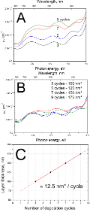
- optical bandgap of bulk CdS. The observed increase in Eg with the decreasing number of SILAR cycles can be explained by the well-known quantum-confinement effect related to the discretization of energy levels in nanoparticles and the increase in the energy gap between LUMO and HOMO levels with the


Other Beilstein-Institut Open Science Activities



