

Search results
Search for "qubits" in Full Text gives 33 result(s) in Beilstein Journal of Nanotechnology.
Interplay between pairing and correlations in spin-polarized bound states
Beilstein J. Nanotechnol. 2018, 9, 1370–1380, doi:10.3762/bjnano.9.129
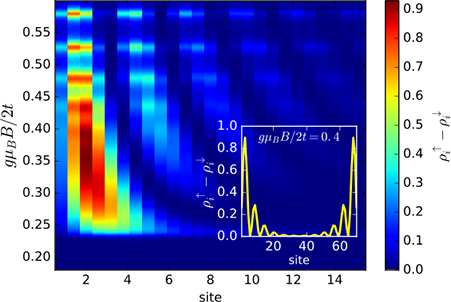
- (σ = ↓) section. This effect has to be taken into account, when designing nanostructures for a controllable spatial displacement of the Majorana modes (criticial for the realization of quantum computations with use of the Majorana-based qubits) either by electrostatic or magnetic means. Some
- an electrostatic potential. This would be important for future quantum computers using qubits based on topologically protected Majorana states. Finally, we have also confronted the Majorana quasiparticles with the subgap Kondo effect, revealing their complex relationship that can be hardly regarded


![[Graphic 23]](/bjnano/content/inline/2190-4286-9-129-i39.svg?max-width=637&scale=1.18182) obtained for |J| < Jc in the absence of spin–orbit coupling (le...
obtained for |J| < Jc in the absence of spin–orbit coupling (le...

![[Graphic 26]](/bjnano/content/inline/2190-4286-9-129-i42.svg?max-width=637&scale=1.18182) as a function of the r...
as a function of the r...



Beyond Moore’s technologies: operation principles of a superconductor alternative
Beilstein J. Nanotechnol. 2017, 8, 2689–2710, doi:10.3762/bjnano.8.269

- quantum computers. QFPs are utilized as qubits and couplers in adiabatic quantum optimization systems of D-Wave Systems [60][61]. Another reason for the current rise of interest to ASL is the Japanese JST-ALCA project “Superconductor electronics system combined with optics and spintronics” [62]. The idea
- “flying qubits” transmitting quantum information [73][76]. Yet, this idea is not implemented experimentally. Discussion We considered non-adiabatic and adiabatic logics the implementations of which are different mainly in the type of power supply: ac or dc. Each type has its own advantages and


Tuning the spin coherence time of Cu(II)−(bis)oxamato and Cu(II)−(bis)oxamidato complexes by advanced ESR pulse protocols
Beilstein J. Nanotechnol. 2017, 8, 943–955, doi:10.3762/bjnano.8.96

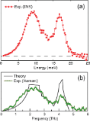
- amounts to10τc. From the point of view of potential application of electron spins as qubits, the slowing down of the spin decoherence as compared to the primary echo is certainly an interesting effect. Furthermore, for a given time interval of the observation the slowing down of the spin decoherence


A terahertz-vibration to terahertz-radiation converter based on gold nanoobjects: a feasibility study
Beilstein J. Nanotechnol. 2016, 7, 983–989, doi:10.3762/bjnano.7.90

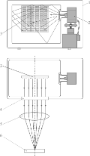
- processing systems. A working unit for quantum-information applications can be imagined in the spirit of a scheme described by Stannigel et al. [21][22], in which a nanomechanical resonator mediates interactions between the qubits and light. We suggest that gold nanobars and nanorings discussed in the


Single-molecule magnet behavior in 2,2’-bipyrimidine-bridged dilanthanide complexes
Beilstein J. Nanotechnol. 2016, 7, 126–137, doi:10.3762/bjnano.7.15
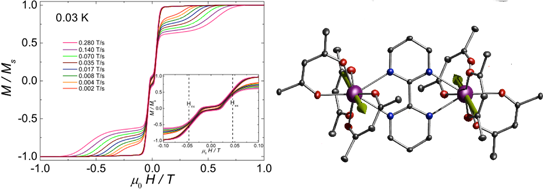
- lanthanide SMM compounds to access specific surface deposition drive the innovation towards device applications [13][14][15][16]. The design of a suitable system that includes quantum bits (qubits) and quantum gates (qugates) is the main challenge to realize quantum computing. There, the electronic spins of
- magnetically anisotropic lanthanide ions can possibly act as basic units of quantum computing, i.e., as qubits. Universal qugates may be engineered by designing one molecule with two interacting lanthanide ions [17]. We are particularly interested in generating dinuclear lanthanide complexes with a bridging


Magnetic reversal dynamics of a quantum system on a picosecond timescale
Beilstein J. Nanotechnol. 2015, 6, 1946–1956, doi:10.3762/bjnano.6.199
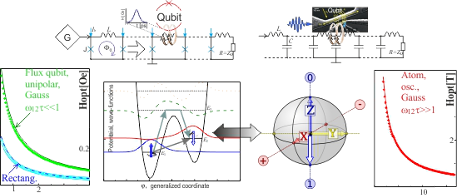
- framework of the macroscopic theory of the magnetic moment, which allows for the comparison and explanation of the quantum and classical behavior. Keywords: atomic-based qubits; magnetization reversal; quantum state control; RSFQ; superconducting qubits; Introduction The study of magnetic moment dynamics
- to a probe on the border between classical and quantum mechanics [1][2][3][4][5][6][7][8][9][10][11][12][13][14][15]. The possible gate and measurement rates estimated in relation to the decoherence processes for these qubits are within the reach of the threshold for fault-tolerant quantum computing
- operation for the superconducting flux qubits can be described as follows: the qubit is prepared in one of the magnetic basis eigenstates and then driven to the degeneracy point by an external flux applied to its loop. Therefore, the minimum time required to flip the qubit in this manner is half of the




Molecular materials – towards quantum properties
Beilstein J. Nanotechnol. 2015, 6, 1485–1486, doi:10.3762/bjnano.6.153
- bits (qubits). The used quantum correlations (e.g., entanglement, coherence) are usually observed only on the nanometer scale and have long been recognized as an information resource for quantum communication and processing. In particular, there is a considerable motivation to produce quantum computers
- complexes can be considered to be spin-qubits [2] or spin qugates [3]. Moreover, it was shown that molecule-based nuclear spins are extremely well insulated from environmental perturbations, rendering them less prone to decoherence. By means of synthetic engineering the central fine-tuning of the delicate
- trade-off between decoupling of the quantum object for low decoherence and connecting it for the electrical read-out could be achieved [2]. Quantum computing, the manipulation of data encoded in qubits instead of bits of information such as spin states of electrons or of an atomic nucleus, has been a
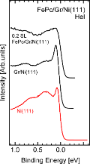
Interaction of iron phthalocyanine with the graphene/Ni(111) system
Beilstein J. Nanotechnol. 2014, 5, 308–312, doi:10.3762/bjnano.5.34

- to form ordered networks of metal atoms trapped in an organic cage, which is a suitable configuration for the realization of spin-based qubits [10]. Interesting and exemplary cases are represented by MPcs adsorbed on graphene grown on Ni(111) and Ir(111) surfaces. In fact, graphene on Ni(111) and on


Other Beilstein-Institut Open Science Activities