

Search results
Search for "spin states" in Full Text gives 28 result(s) in Beilstein Journal of Nanotechnology.
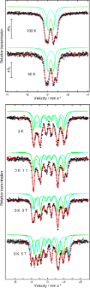
Spin relaxation in antiferromagnetic Fe–Fe dimers slowed down by anisotropic DyIII ions
Beilstein J. Nanotechnol. 2013, 4, 807–814, doi:10.3762/bjnano.4.92

- . Depending on the sign of the zero field splitting parameter, D, in 1 at 3 K the iron(III) ions will be in a ground state that could be either |±5/2> or |±1/2>. If the relaxation between the positive and negative spin states becomes slow enough, the relaxation between the different MS states may still be



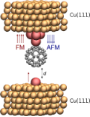
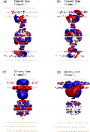
Strong spin-filtering and spin-valve effects in a molecular V–C60–V contact
Beilstein J. Nanotechnol. 2012, 3, 589–596, doi:10.3762/bjnano.3.69

- are almost fully transmitting. For the majority spins, we notice the dzx and dyz orbital nature of wavefunctions on the V adatoms contacting C60 (z chosen perpendicular to the surface). This is in accordance with the Mulliken population analysis of the majority spin states of the V tip and adatoms



Structural and magnetic properties of ternary Fe1–xMnxPt nanoalloys from first principles
Beilstein J. Nanotechnol. 2011, 2, 162–172, doi:10.3762/bjnano.2.20
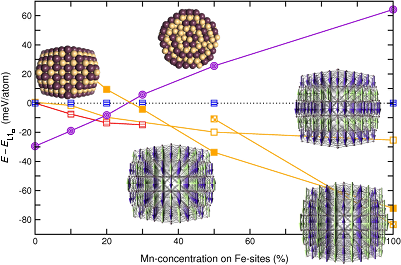
- spin states, while the 5d and the majority states remain nearly unaffected. This makes the distribution of the minority spin 3d states in the vicinity of the Fermi level a decisive factor for the evolution of the stability of the structures with composition. When replacing Fe by Co, the additional d
- electrons of Co necessarily fill up the minority channel, because the majority spin states are occupied. This shifts the contributions of Co to lower energies. The corresponding shift, however, is larger for the onion-ring icosahedron, since the density of the L10 minority 3d states encounter a steep


Other Beilstein-Institut Open Science Activities