


Search results
Search for "chemical state" in Full Text gives 53 result(s) in Beilstein Journal of Nanotechnology.
Catalytic activity of nanostructured Au: Scale effects versus bimetallic/bifunctional effects in low-temperature CO oxidation on nanoporous Au
Beilstein J. Nanotechnol. 2013, 4, 111–128, doi:10.3762/bjnano.4.13

- [17][18][19][20][21][22][23][24]. For these oxide-supported Au catalysts, various parameters, such as the gold particle size, the chemical state of the gold nanoparticles or the nature and morphology of the support material have been shown to influence the catalytic activity [19][21]. Especially the
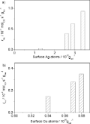
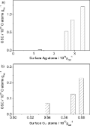
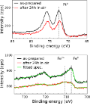
- (Ag)-2 and NPG(Ag)-4 samples, with contributions of 11% and 12% from Au3+ species, respectively. In contrast, no oxidic species were detected on the NPG(Ag)-1 sample. The Ag(3d) XP spectra were also recorded to check the existence of residual Ag and its chemical state. As shown in Figure 3b, the as


Nanostructured, mesoporous Au/TiO2 model catalysts – structure, stability and catalytic properties
Beilstein J. Nanotechnol. 2011, 2, 593–606, doi:10.3762/bjnano.2.63

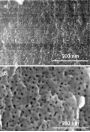
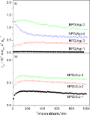
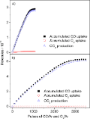
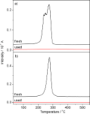
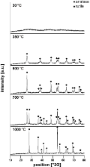
- transmission electron microscopy images and XRD results characterizing the structure and morphology of these films and the distribution and particle size of the Au nanoparticles. The chemical state of the materials was characterized by XPS, and finally the catalytic activity of these model systems was






Preparation and characterization of supported magnetic nanoparticles prepared by reverse micelles
Beilstein J. Nanotechnol. 2010, 1, 24–47, doi:10.3762/bjnano.1.5

- ) the structure of the particles and (ii) to the chemical state. Advanced analytical tools such as aberration-corrected high-resolution transmission electron microscopy (HRTEM) and related techniques as well as X-ray photoelectron spectroscopy (XPS) give important additional information on the atomic
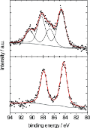
- with literature data the main peak can be assigned to the Fe3+ oxidation state [69]. Interestingly, Pt-4f levels reveal no significant indication of oxide formation, proving the chemical state of the Pt atoms remains practically unchanged during oxidation of the FePt particles. This finding is
- magnetic circular dichroism (XMCD) which provides information on (i) the chemical state of sample, (ii) element-specific magnetic moments and (iii) element-specific hysteresis loops. The results presented below were measured at beamline PM-3 of the BESSY II synchrotron facility in Berlin, Germany. The






Other Beilstein-Institut Open Science Activities



