

Search results
Search for "fluorophore" in Full Text gives 55 result(s) in Beilstein Journal of Nanotechnology.
Apertureless scanning near-field optical microscopy of sparsely labeled tobacco mosaic viruses and the intermediate filament desmin
Beilstein J. Nanotechnol. 2013, 4, 510–516, doi:10.3762/bjnano.4.60

- fluorophore give rise to a local field and fluorescence enhancement. AFM topographic imaging allows for resolutions down to the atomic scale. It can be operated in vacuum, under ambient conditions and in liquids. This makes it ideal for the investigation of a wide range of different samples. Furthermore an
- between the fluorophore dipole and the tip can lead to both, fluorescence enhancement and quenching. In summary, all these effects highly depend on several experimental parameters such as the distance between tip and fluorophore, the probe geometry and material and the polarization of the incident light
- , apertureless SNOM probes appear favorable [3][4][5][6][7]. Commonly, metallic and metallized probes expose a strong field enhancement and dipolar coupling between fluorophore and tip, which result in a remarkable increase of the observable fluorescence emission. However, the interaction between dye and tip


Combining nanoscale manipulation with macroscale relocation of single quantum dots
Beilstein J. Nanotechnol. 2012, 3, 324–328, doi:10.3762/bjnano.3.36

- (SNOM) [1][2][3] and techniques based on adaptations of single-molecule spectroscopy [4], such as fluorescence imaging with one-nanometer accuracy (FIONA) [5], stochastic optical reconstruction microscopy (STORM) [6]. These techniques require the fluorophore under observation to be isolated by distances
- [13]. The gold nanoparticle was shown to dramatically quench the optical lifetime of the QD and to completely suppress its blinking. Experimental In this work, we position a single fluorophore, a CdSe QD, with nanometre precision on a macroscopic registration template, using automated atomic force


Distance dependence of near-field fluorescence enhancement and quenching of single quantum dots
Beilstein J. Nanotechnol. 2011, 2, 645–652, doi:10.3762/bjnano.2.68

- spectroscopy, energy transfer processes between single fluorophores and fluorophore quencher pairs play an important role in the investigation of molecular distances or orientations. At distances larger than about 3 nm these effects originate predominantly from dipolar coupling. As these experiments are
- ). At close proximity to the surface (<20 nm) we found a distinct decrease of the fluorescence emission, which was completely quenched at surface contact. This finding is attributed to energy transfer between the fluorophore and the gold tip. Analogous results for colloidal gold nanoparticles and
- dipolar coupling between the incident light and the gold tip leads to a field enhancement confined at the tip apex. Secondly, we have to consider the dipolar coupling between the fluorophore and the tip, which either leads to fluorescence enhancement due to resonant coupling or fluorescence quenching as a


Towards multiple readout application of plasmonic arrays
Beilstein J. Nanotechnol. 2011, 2, 501–508, doi:10.3762/bjnano.2.54

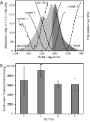
- to its complementary capture sequence. Thus, the formation of the DNA double helix was indicated by the fluorescence signal of the Cy3.5 label. The absorption and emission spectra of the fluorophore Cy3.5 and moreover the plasmonic profiles of the used gold nanorhomb arrays are depicted in Figure 5A
- to the spectral overlap of the plasmonic profile with the absorption spectrum of the dye, an enhanced excitation rate may be reached. Thus the fluorescence intensity is enhanced because the fluorophore is excited more often [32]. This mechanism may be the explanation for the signal increase seen with
- sample 1 and 2 for fluorescence measurements of Cy3.5. A further contribution to SEF is described as an enhanced decay rate that improves the quantum yield of the fluorophore and decreases the lifetime, which should allow the fluorophore to undergo more excitation–de-excitation cycles before


Novel acridone-modified MCM-41 type silica: Synthesis, characterization and fluorescence tuning
Beilstein J. Nanotechnol. 2011, 2, 284–292, doi:10.3762/bjnano.2.33

- bearing polycyclic aromatic compounds as terminal groups, Ar–(CH2)n–Si(OR)3 (n = 3, R = Me, Et), which may lead to interesting optical or electronic properties [4][5][6]. Acridone, being a well-known fluorophore used, e.g., for chemosensors [7], has previously been reported to be suitable for the pKa
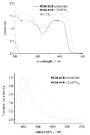
- fluorescence intensity. Conclusion We have presented a novel fluorescent organosilane bearing an acridone fluorophore and its successful transformation into a MCM-41 type material via co-condensation with TEOS. As predicted, the hybrid material shows a change in its fluorescence properties when non-covalently


Other Beilstein-Institut Open Science Activities