


Search results
Search for "hybrid structures" in Full Text gives 60 result(s) in Beilstein Journal of Nanotechnology.
Nanobioarchitectures based on chlorophyll photopigment, artificial lipid bilayers and carbon nanotubes
Beilstein J. Nanotechnol. 2014, 5, 2316–2325, doi:10.3762/bjnano.5.240

- stability, good antioxidant and antimicrobial properties, and could be used as biocoating materials. As compared to the cholesterol-free samples, the cholesterol-containing hybrid structures demonstrated better stability (i.e., their zeta potential reached the value of −36.4 mV), more pronounced oxygen
- 0.3 nm/s scan rate. Fluorescence analysis The fluorescence emission spectra of Chla in liposomes and hybrid structures were collected on a Perkin-Elmer, LS55 fluorescence spectrometer. The samples were excited with 430 nm excitation light. Fluorescence anisotropy measurements were carried out on the


Hybrid spin-crossover nanostructures
Beilstein J. Nanotechnol. 2014, 5, 2230–2239, doi:10.3762/bjnano.5.232

- materials [17]. The properties of these hybrid structures are not only interesting from a fundamental point of view, but are currently envisaged to be applied in various fields of technology. Synthesis of hybrid SCO nanostructures The development of functionalized nano-composite materials with potential



Biopolymer colloids for controlling and templating inorganic synthesis
Beilstein J. Nanotechnol. 2014, 5, 2129–2138, doi:10.3762/bjnano.5.222
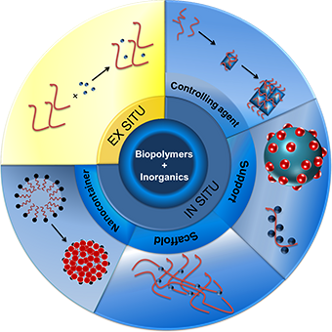
- sol, followed by a gelation process, porous hybrid structures can be obtained. Starting from a colloidal suspension of laponite particles, Shi et al. [4] reported the preparation of a nanocomposite matrix of chitosan and clay that was applied as a glucose biosensor. Very recently, da Costa Neto et al


Controlling the dispersion of supported polyoxometalate heterogeneous catalysts: impact of hybridization and the role of hydrophilicity–hydrophobicity balance and supramolecularity
Beilstein J. Nanotechnol. 2014, 5, 1749–1759, doi:10.3762/bjnano.5.185
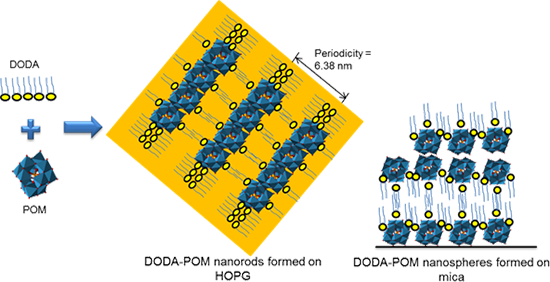
- they were deposited. Finally, we submitted the hybrid structures to an UV–ozone treatment to study the role of the alkyl chains in determining the well-defined supramolecular architectures of the organic–inorganic hybrids priorly observed. Experimental Reagents DODA (C38H80NBr, M = 630.95 g·mol−1) was
- in the encapsulated nanostructures through chemical as well as physical methods. In a chemical analysis, XPS was performed on the nanorods and nanospheres to analyse the presence of elements in these hybrid structures. Doublets corresponding to W 4f (37 and 35 eV) and Mo 3d (232 and 235 eV) core


Designing magnetic superlattices that are composed of single domain nanomagnets
Beilstein J. Nanotechnol. 2014, 5, 956–963, doi:10.3762/bjnano.5.109

- observed. This may shed light on the complexity of the behavior of these unique and extremely interesting magnetic systems. Also, hybrid structures of ferromagnetic superlattices, combined with two-dimensional materials such as graphene and silicene have the potential to revolutionize spin-injection and
- nanomagnetic devices for magnetoresistance experiments and the creation of hybrid structures. The stability of the phases was also strongly indicated as being a function of the coupling strength between the nanomagnets for the case of a system composed of two nanomagnets. In the cases of N nanomagnet


Resonance of graphene nanoribbons doped with nitrogen and boron: a molecular dynamics study
Beilstein J. Nanotechnol. 2014, 5, 717–725, doi:10.3762/bjnano.5.84

- , photonics, composite materials, energy generation and storage, sensors, and biomedicine or bio-applications [3][4][5]. A great effort has been devoted to modify the properties of graphene to facilitate these promising applications, which leads to a variety of graphene derivatives or hybrid structures


Tensile properties of a boron/nitrogen-doped carbon nanotube–graphene hybrid structure
Beilstein J. Nanotechnol. 2014, 5, 329–336, doi:10.3762/bjnano.5.37
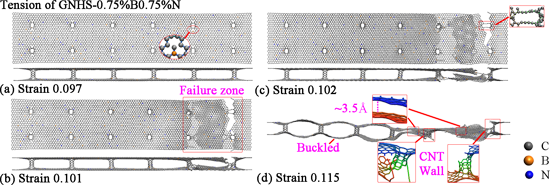
- properties of nanomaterials. Recently, a graphene and carbon nanotube hybrid structure (GNHS) has been reported, which extends the excellent properties of carbon-based materials to three dimensions. In this paper, we carried out a first-time investigation on the tensile properties of the hybrid structures
- with different dopants. It is found that with the presence of dopants, the hybrid structures usually exhibit lower yield strength, Young’s modulus, and earlier yielding compared to that of a pristine hybrid structure. For dopant concentrations below 2.5% no significant reduction of Young’s modulus or
- residual CNT wall are found to adhere to each other after failure with a distance of about 3.4 Å. This study provides a fundamental understanding of the tensile properties of the doped graphene–nanotube hybrid structures, which will benefit the design and also the applications of graphene-based hybrid


Charge and spin transport in mesoscopic superconductors
Beilstein J. Nanotechnol. 2014, 5, 180–185, doi:10.3762/bjnano.5.18

- and 1980s, mostly in the vicinity of the critical temperature. Much less attention has been paid to low temperatures and the role of the quasiparticle spin. Results: We report here on nonlocal transport in superconductor hybrid structures at very low temperatures. By comparing the nonlocal conductance
- models. Conclusion: The observed long-range chargeless spin transport opens a new path to manipulate and utilize the quasiparticle spin in superconductor nanostructures. Keywords: spintronics; superconductor–ferromagnet hybrids; Introduction The investigation of spin-polarized transport in hybrid
- structures was pioneered in the 1970s with the discovery of spin-dependent tunneling into thin-film superconductors with a large Zeeman splitting by Tedrow and Meservey [1][2]. While much of the related basic physics such as tunneling magnetoresistance (TMR) [3] and non-equilibrium spin injection [4] was


![[Graphic 6]](/bjnano/content/inline/2190-4286-5-18-i9.png?max-width=637&scale=1.18182) at a bias voltage of about 2Δ (a) and spin diffusion length λS (b) for di...
at a bias voltage of about 2Δ (a) and spin diffusion length λS (b) for di...

Controlled synthesis and tunable properties of ultrathin silica nanotubes through spontaneous polycondensation on polyamine fibrils
Beilstein J. Nanotechnol. 2013, 4, 793–804, doi:10.3762/bjnano.4.90

- precisely controlled nanopatterns, a hierarchical morphology and organic–inorganic hybrid structures [16][17][18]. It has been demonstrated that the long-chain polyamines (partially combined with proteins) in diatom shells and the silicateins in marine sponges play a vital role in templating the
- reasonable to suggest that LPEI fibrils from higher molar ratios of [OH]/[EI] can allow for the formation of hybrid nanostructures that have a crystalline LPEI core and LPEI@silica hybrid wall (Scheme 1). These hybrid structures (Figure 4D–F) will yield nanotubular silica after the LPEI core is removed by


Nanostructure-directed chemical sensing: The IHSAB principle and the dynamics of acid/base-interface interaction
Beilstein J. Nanotechnol. 2013, 4, 20–31, doi:10.3762/bjnano.4.3
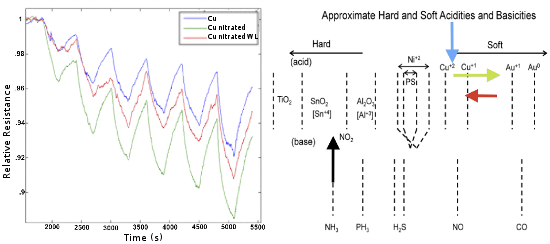
- are readily oxidized to SnOx (x = 2,4) and CuxO (x = 1,2) as demonstrated by XPS measurements [23]. The initially introduced titania (anatase) may be crystalline; however, we cannot be certain of this crystallinity after deposition to the PS interface. The untreated PS hybrid structures are exposed to





