

Search results
Search for "hydrogen evolution" in Full Text gives 54 result(s) in Beilstein Journal of Nanotechnology.
Preparation of NiS/ZnIn2S4 as a superior photocatalyst for hydrogen evolution under visible light irradiation
Beilstein J. Nanotechnol. 2013, 4, 949–955, doi:10.3762/bjnano.4.107
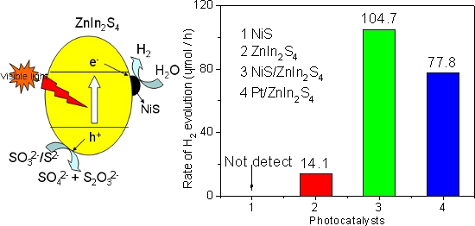
- for hydrogen evolution under visible light irradiation was also investigated. It was found that the photocatalytic hydrogen evolution activity over hexagonal ZnIn2S4 can be significantly increased by loading NiS as a co-catalyst. The formation of a good junction between ZnIn2S4 and NiS via the two
- step hydrothermal processes is beneficial for the directional migration of the photo-excited electrons from ZnIn2S4 to NiS. The highest photocatalytic hydrogen evolution rate (104.7 μmol/h), which is even higher than that over Pt/ZnIn2S4 nanocomposite (77.8 μmol/h), was observed over an optimum NiS
- loading amount of 0.5 wt %. This work demonstrates a high potential of the developing of environmental friendly, cheap noble-metal-free co-catalyst for semiconductor-based photocatalytic hydrogen evolution. Keywords: co-catalyst; hydrogen evolution; NiS; photocatalytic; photocatalysis; visible light


In situ monitoring magnetism and resistance of nanophase platinum upon electrochemical oxidation
Beilstein J. Nanotechnol. 2013, 4, 394–399, doi:10.3762/bjnano.4.46

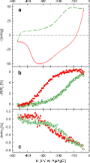
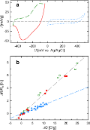
- ). Prior to the measurements the electrode was activated by repeatedly cycling between the oxygen- and hydrogen-evolution regimes. A typical cyclic voltammogram (CV) taken for sample PtER is shown by the gray curve in Figure 1. As the potential is varied with triangular characteristics, the CV curve is run

Characterization and properties of micro- and nanowires of controlled size, composition, and geometry fabricated by electrodeposition and ion-track technology
Beilstein J. Nanotechnol. 2012, 3, 860–883, doi:10.3762/bjnano.3.97
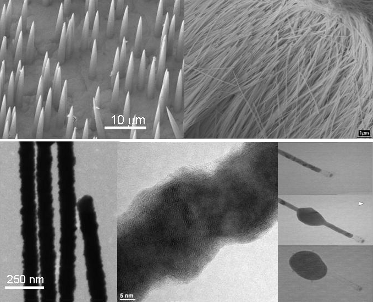
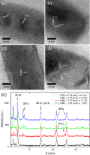
- overvoltages, side reactions, such as hydrogen evolution, are avoided. Figure 7 displays transmission electron microscopy (TEM) images of representative (a) single- and (b) polycrystalline Cu nanowires together with their respective selected-area electron diffraction (SAED) pattern. The single-crystalline Cu








Novel acridone-modified MCM-41 type silica: Synthesis, characterization and fluorescence tuning
Beilstein J. Nanotechnol. 2011, 2, 284–292, doi:10.3762/bjnano.2.33

- dry THF (100 mL). The resulting yellow-greenish suspension was stirred for 15 min at 25 °C until the hydrogen evolution subsided. Subsequently, 1.1 equiv of 3-iodopropyltrimethoxysilane (9.67 g, 6.53 mL, 33.3 mmol) were added dropwise via a syringe through a rubber septum. The golden colored


Other Beilstein-Institut Open Science Activities