


Search results
Search for "phagocytosis" in Full Text gives 57 result(s) in Beilstein Journal of Nanotechnology.
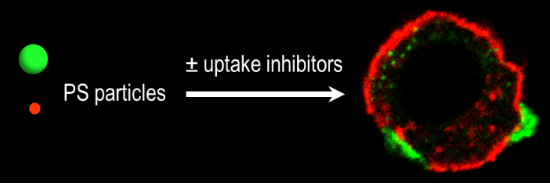
Functionalized polystyrene nanoparticles as a platform for studying bio–nano interactions
Beilstein J. Nanotechnol. 2014, 5, 2403–2412, doi:10.3762/bjnano.5.250

- intentionally applied or unintentionally inhaled nanoparticles get in close contact with macrophages in one way or another. Phagocytosis of debris by phagocytes including macrophages leads to the formation of phagosomes, which subsequently fuse with lysosomes to phagolysosomes. Within the latter, lysosomal
- on cell functions. Particles of about 100 nm have previously been shown to be internalized by cells much more efficient than microparticles, which are taken up primarily by phagocytosis, and also more efficient than particles with a size below 100 nm. It was reported that the uptake of 100 nm
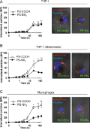
- of specific receptors engaged in the uptake might dictate the rate of particle internalization by a cell. We have shown that in the presence of serum, macrophages take up nanoparticles by phagocytosis using specific interaction with an antibody receptor CD64, which is specifically expressed on the




Nanoparticle interactions with live cells: Quantitative fluorescence microscopy of nanoparticle size effects
Beilstein J. Nanotechnol. 2014, 5, 2388–2397, doi:10.3762/bjnano.5.248
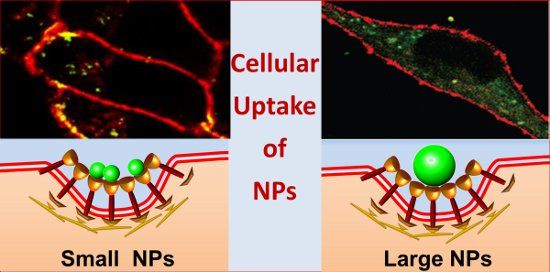
- machinery. Depending on the details of their interactions, proteins adsorbed onto NPs may enhance or reduce internalization of the so disguised NPs. Specialized cells, such as macrophages, neutrophils, and monocytes are capable of phagocytosis (eating by cells), a form of endocytosis in which the cell


PVP-coated, negatively charged silver nanoparticles: A multi-center study of their physicochemical characteristics, cell culture and in vivo experiments
Beilstein J. Nanotechnol. 2014, 5, 1944–1965, doi:10.3762/bjnano.5.205
- radicals whose formation is catalyzed from silver ions generated after uptake of silver by phagocytosis [110]. In contrast to chemical modifications of genomic DNA by reactive oxygen species (ROS) which are difficult to prove, the presence of DSB that result from a radical attack are more easily to detect




Different endocytotic uptake mechanisms for nanoparticles in epithelial cells and macrophages
Beilstein J. Nanotechnol. 2014, 5, 1625–1636, doi:10.3762/bjnano.5.174
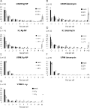
- mechanisms, that is, phagocytosis, macropinocytosis, clathrin- and caveolin-mediated endocytosis, were investigated using a mouse macrophage (J774A.1) and a human alveolar epithelial type II cell line (A549). In order to deduce the involved pathway in nanoparticle uptake, selected inhibitors specific for one
- suggested that macropinocytosis and phagocytosis, as well as clathrin-mediated endocytosis, play a crucial role. The uptake of 40 nm nanoparticles in alveolar epithelial A549 cells was inhibited after depletion of cholesterol in the plasma membrane (preventing caveolin-mediated endocytosis) and inhibition
- describes two different cellular uptake mechanisms: pinocytosis, which involves the uptake of fluids and molecules within small vesicles and phagocytosis, which is responsible for engulfing large particles (e.g., microorganisms and cell debris). Pinocytosis covers macropinocytosis, clathrin-mediated



In vitro interaction of colloidal nanoparticles with mammalian cells: What have we learned thus far?
Beilstein J. Nanotechnol. 2014, 5, 1477–1490, doi:10.3762/bjnano.5.161
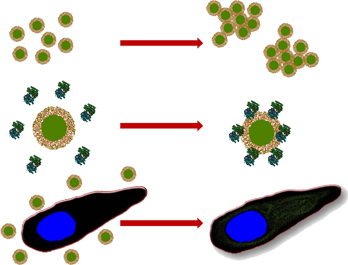
- from there to other cellular organelles is possible, translocation efficiencies still are moderate at best. In addition, NPs free in the cytosol may later end up again in intracellular vesicles through auto-phagocytosis [74]. Thus, for many applications, such as intracellular sensing or drug delivery


Atomic force microscopy recognition of protein A on Staphylococcus aureus cell surfaces by labelling with IgG–Au conjugates
Beilstein J. Nanotechnol. 2013, 4, 743–749, doi:10.3762/bjnano.4.84
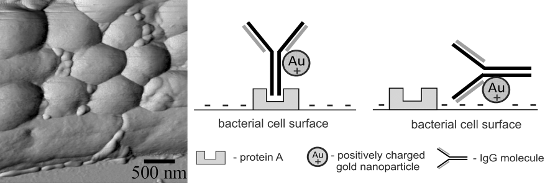
- which IgG molecules are bound in the wrong orientation (in relation to normal antibody function). Thus, bacteria are disrupted by opsonization [10] and phagocytosis [11]. In this regard, the aim of our work was the development of an AFM method to specifically label Staphylococcus aureus, which bears


Magnetic nanoparticles for biomedical NMR-based diagnostics
Beilstein J. Nanotechnol. 2010, 1, 142–154, doi:10.3762/bjnano.1.17

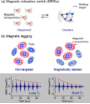
- . Unmodified nanoparticles were used as a control to estimate cell concentration based on non-specific phagocytosis. (Reproduced with permission from Ref [15]. Copyright 2009 National Academy of Sciences, USA.) List of extracellular and intracellular biomarkers tested with BOND-2 and DMR. Selected list of DMR


Other Beilstein-Institut Open Science Activities



