


Search results
Search for "pits" in Full Text gives 58 result(s) in Beilstein Journal of Nanotechnology.
Large-scale analysis of high-speed atomic force microscopy data sets using adaptive image processing
Beilstein J. Nanotechnol. 2012, 3, 747–758, doi:10.3762/bjnano.3.84

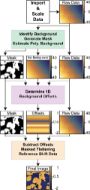
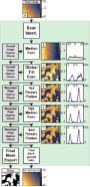
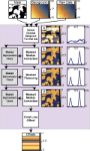
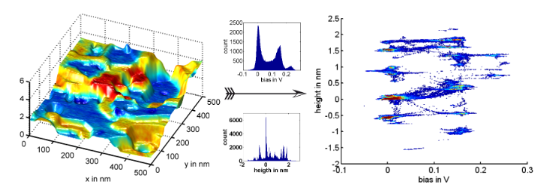
- show the results of 1-D second-order polynomial removal. This line-by-line polynomial subtraction generates many artifacts in the data, for example the surface surrounding the pits appears raised along the fast scan axis in Figure 2B, and continuous levels in Figure 2F have offsets from line to line
- subtraction excluding the pits from the polynomial fit before subtraction. The histograms of each image are shown below. The vertical axis is the same for each histogram. In both the images, and the histograms, the scale has been focused on the upper portion of the grid in order to highlight the distortions




Ordered arrays of nanoporous gold nanoparticles
Beilstein J. Nanotechnol. 2012, 3, 651–657, doi:10.3762/bjnano.3.74

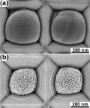
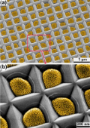
- schematically presented in Figure 1. The surface of a Si(100) wafer was patterned into a periodic array of pyramidal pits (Figure S1, Supporting Information File 1) by using SCIL, reactive ion etching (RIE), and KOH etching. The spatial period of these pits is 520 nm. A 200 nm layer of SiO2 was thermally grown
- acted as a mask during the anisotropic etching of Si in a KOH solution, and the Si surface was patterned into a periodic array of pyramidal pits. After removal of the SiO2 mask, about 20 nm of SiO2 was then again thermally grown on the structured Si surface to avoid a reaction between the subsequently
- spatial period. However, the pits were fabricated by KOH etching in this study and have a depth of about 360 nm, whereas the pits in the previous work were fabricated by reactive ion etching and have a depth of 150 nm. This means that a larger optimized thickness is required for the formation of an



Reduced electron recombination of dye-sensitized solar cells based on TiO2 spheres consisting of ultrathin nanosheets with [001] facet exposed
Beilstein J. Nanotechnol. 2012, 3, 378–387, doi:10.3762/bjnano.3.44

- nanosheets to realize a minimum surface energy. Some spheres have pits on the surface, which may be due to the insufficient reaction duration. The measurement of the N2 adsorption/desorption isotherms of the TiO2 powder shows that the specific surface area of the TiO2 spheres is 82 m2/g, which is slightly


Noncontact atomic force microscopy study of the spinel MgAl2O4(111) surface
Beilstein J. Nanotechnol. 2012, 3, 192–197, doi:10.3762/bjnano.3.21

- of step edges. In the case of Zn-terminated ZnO(0001), a stabilization mechanism was proposed involving the formation of preferentially O-terminated edges and pits, which effectively lowers the excess amount of Zn on this polar surface and reduces the surface dipole [21][22]. To evaluate the effect


Quantitative multichannel NC-AFM data analysis of graphene growth on SiC(0001)
Beilstein J. Nanotechnol. 2012, 3, 179–185, doi:10.3762/bjnano.3.19
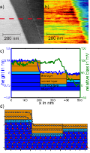
- , the surface structure remains the same upon oxide removal (Figure 2b). The width of the large terraces is slightly reduced and a number of smaller and larger pits and islands with lateral extensions of only a few nanometers up to hundreds of nanometers are found. Except for a few remaining rough spots
- significantly (Figure 1c). The largest atomically flat areas now have a lateral extension of only 100 nm. The sample is covered with small pits of hexagonal shape. A large variety of step heights is found (Table 1). Graphene grown in an argon atmosphere The same starting material and sample preparation, i.e



Formation of precise 2D Au particle arrays via thermally induced dewetting on pre-patterned substrates
Beilstein J. Nanotechnol. 2011, 2, 318–326, doi:10.3762/bjnano.2.37

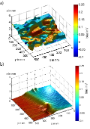
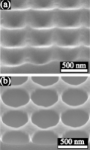
- induced by annealing. Two types of pre-patterned substrates were used: The first comprised an array of pyramidal pits and the second an array of circular holes. For the dewetting of Au films on the pyramidal pit substrate, the structural curvature-driven diffusion cooperates with capillarity-driven
- crystallographic orientation, on a substrate with an array of periodic pits, via solid-state dewetting induced by annealing at 850 °C [9]. Our previous work showed that a pre-patterned substrate with deep grid grooves can also lead to the formation of a 2D ordered Au nanoparticle array via dewetting induced by
- . induced by annealing, has been studied, on both the flat substrate and two types of pre-patterned substrates (one with an array of pyramidal pits and one with an array of circular holes, made using nanoimprint lithography), and large areas of 2D ordered nanoparticle arrays were fabricated. Instead of the





Manipulation of gold colloidal nanoparticles with atomic force microscopy in dynamic mode: influence of particle–substrate chemistry and morphology, and of operating conditions
Beilstein J. Nanotechnol. 2011, 2, 85–98, doi:10.3762/bjnano.2.10
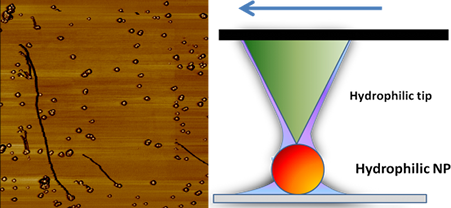
- (FIB) milling technique. The width and depth of the pits are 650 nm and 5 nm, respectively, and the spacing between two adjacent pits is 125 nm. On the patterned surface, the mean direction of motion remains identical (on average), even after a long acquisition time. This stability of the direction of
- the particle movement observed here on the nanopatterned substrates can be attributed to "self-cleaning" of the tip when it crosses the shallow pits. Considering that the pits have only a small influence on the particle direction (Figure 9), which means that all the particles follow the same direction
- deposited onto a silicon wafer. (a) Ordered organization as described in the Experimental section, (b) random distribution. Frame sizes: 3 µm and 1 µm, respectively. As-synthesized Au particles on silicon in ultra-high vacuum. Frame size: 3 µm. AFM image of nanopatterned surface exhibiting Si pits: Frame


The description of friction of silicon MEMS with surface roughness: virtues and limitations of a stochastic Prandtl–Tomlinson model and the simulation of vibration-induced friction reduction
Beilstein J. Nanotechnol. 2010, 1, 163–171, doi:10.3762/bjnano.1.20

- simulation replicates even the fact that a vibrational amplitude with the frequency of the modulation is visible in the lateral force at high modulation amplitudes (‘wobbling in the pits’), and that its envelope has a correlation with the surface roughness. Only in the simulation these effects are smaller


Other Beilstein-Institut Open Science Activities



