

Search results
Search for "protein adsorption" in Full Text gives 56 result(s) in Beilstein Journal of Nanotechnology.
In vitro interaction of colloidal nanoparticles with mammalian cells: What have we learned thus far?
Beilstein J. Nanotechnol. 2014, 5, 1477–1490, doi:10.3762/bjnano.5.161
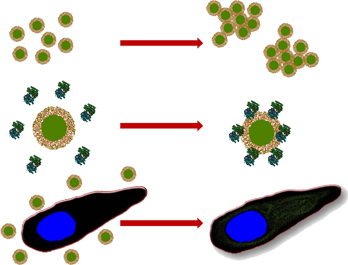
- help to analytically quantify protein adsorption, such as by determining binding constants [30][136], the biological reality is more complex. Serum-containing cell culture media comprise hundreds of different proteins. To make it worse to analyze, protein adsorption is also a dynamic process. Thus


Injection of ligand-free gold and silver nanoparticles into murine embryos does not impact pre-implantation development
Beilstein J. Nanotechnol. 2014, 5, 677–688, doi:10.3762/bjnano.5.80
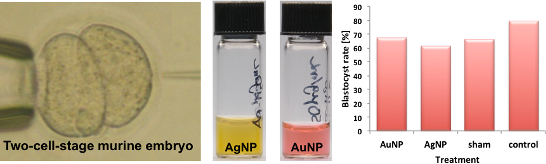
- for instance after exposure of nanoparticles to blood plasma and are the result of protein adsorption to the particle surface [66]. These coronas largely define the biological identity of the particle [67][68]. They have also been reported to reduce the cytotoxicity of nanomaterials [69][70




New hybrid materials based on poly(ethyleneoxide)-grafted polysilazane by hydrosilylation and their anti-fouling activities
Beilstein J. Nanotechnol. 2013, 4, 671–677, doi:10.3762/bjnano.4.75

- reducing bio-adhesion, i.e., protein adsorption, or the adhesion of bacteria and cells. The environmentally friendly coatings obtained by the grafting of PEO onto PSZ are a promising way to prevent the deposition of marine fouling materials onto the hulls of ships [6]. Several factors have been




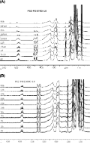

Approaches to nanostructure control and functionalizations of polymer@silica hybrid nanograss generated by biomimetic silica mineralization on a self-assembled polyamine layer
Beilstein J. Nanotechnol. 2011, 2, 760–773, doi:10.3762/bjnano.2.84

- , nanostructured thin films on substrates with tunable nanostructure and surface morphology are of great importance for various applications, such as photoelectronics [1], high-efficiency sensing and bioanalysis [2][3], protein adsorption [4], cell growth [5], surface wettability control [6] and liquid


Characterization of protein adsorption onto FePt nanoparticles using dual-focus fluorescence correlation spectroscopy
Beilstein J. Nanotechnol. 2011, 2, 374–383, doi:10.3762/bjnano.2.43

- correlation spectroscopy; human serum albumin; nanoparticle; protein adsorption; Introduction Recent years have seen enormous advances in the field of nanotechnology. A huge variety of nanoparticles (NPs), defined as objects with all three spatial dimensions in the range of 1–100 nm, has been developed, with
- understand the structural and dynamic properties of the protein corona at the molecular level. Recently, we have used quantitative fluorescence microscopy, especially fluorescence correlation spectroscopy (FCS), to study protein adsorption of human serum albumin (HSA) on polymer-coated FePt NPs with an
- protein adsorption onto the NP surfaces can be measured via an increase of τD. Knowledge of the molecule detection function (MDF), i.e., the probability to detect a fluorescence photon from a molecule at a given position in the sample volume, is key to the precise quantitative analysis of an FCS



Sensing surface PEGylation with microcantilevers
Beilstein J. Nanotechnol. 2010, 1, 3–13, doi:10.3762/bjnano.1.2
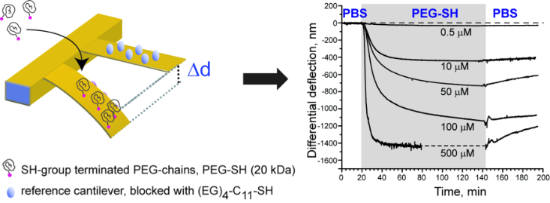
- highly effective at reducing protein adsorption from blood [3] thereby improving the biocompatibility of biomedical implants [4]. The protein-resistant properties of PEG have also been applied to reduce membrane fouling in ultrafiltration membranes for water purification [5]. It is important to develop a
- conjunction with protein adsorption studies, this may have specific applications as integrated (and miniaturizable) process sensors. More generally, this particular capability of microcantilever sensors may provide new insight into the biochemical and nanomechanical properties of biopolymers in vitro. For



Other Beilstein-Institut Open Science Activities