


Search results
Search for "transmission spectra" in Full Text gives 53 result(s) in Beilstein Journal of Nanotechnology.
Transmission eigenvalue distributions in highly conductive molecular junctions
Beilstein J. Nanotechnol. 2012, 3, 40–51, doi:10.3762/bjnano.3.5
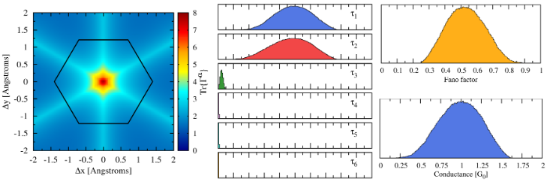
- transmission eigenchannels into molecular resonances based on the isolated resonance approximation, which helps to illustrate the workings of our many-body theory, and facilitates unambiguous interpretation of transmission spectra. Conclusion: We confirm that Pt–benzene–Pt junctions have two dominant
- approximation further, we calculated the average total transmission through a Pt–benzene–Pt junction. The transmission spectra calculated using the full molecular spectrum, the isolated HOMO resonance and the isolated LUMO resonance are each shown as a function of the chemical potential of the leads μPt in


![[Graphic 39]](/bjnano/content/inline/2190-4286-3-5-i64.png?max-width=637&scale=1.18182) (top panel) and Tr{Γ} (bottom panel) over the ensemble describ...
(top panel) and Tr{Γ} (bottom panel) over the ensemble describ...


When “small” terms matter: Coupled interference features in the transport properties of cross-conjugated molecules
Beilstein J. Nanotechnol. 2011, 2, 862–871, doi:10.3762/bjnano.2.95

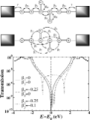
- draw the larger systems with one cross-conjugated unit up and one down there would be no difference in the Hamiltonian if we instead wanted to model the system where both units were pointing in the same direction. The transmission spectra of the 1cc, 2cc and 2ccs junctions are shown in Figure 3
- the transport. The transmission spectra through the π-orbitals of 1cc, 2cc and 2ccs based junctions calculated by using the MDE many-body theory (using the Hamiltonian of Equation 10) are shown in Figure 9, and no supernodes are observed. Qualitatively, the splitting of the central supernode in the




Towards multiple readout application of plasmonic arrays
Beilstein J. Nanotechnol. 2011, 2, 501–508, doi:10.3762/bjnano.2.54

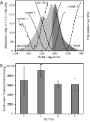
- -label Cy3.5, attached to a DNA strand, in comparison to the transmission spectra of various plasmonic arrays. The transmission minima (indicating the LSPR excitation) overlap with the absorption and emission spectra differently. (B) The detected fluorescence intensity is normalized with respect to the
- Petschulat and Thomas Pertsch for providing the transmission spectra. Further, D.C. thanks Keiko Munechika, Yeechi Chen and David Ginger for helpful discussions during the stay at Ginger Research Lab (University of Washington) in summer 2009.


Other Beilstein-Institut Open Science Activities



