

Search results
Search for "SnO2" in Full Text gives 81 result(s) in Beilstein Journal of Nanotechnology.
Photoelectrochemical and Raman characterization of In2O3 mesoporous films sensitized by CdS nanoparticles
Beilstein J. Nanotechnol. 2013, 4, 255–261, doi:10.3762/bjnano.4.27

- , Ag2S, Bi2S3 and others) immobilized onto the surface of mesoporous films of wide-bandgap oxides (TiO2, ZnO, SnO2, Nb2O5, Ta2O5, WO3, In2O3) are used as the sensitizing components [2][3][4][5]. It is considered that the best technique for the in situ deposition of such nanoparticles is the successive


Nanostructure-directed chemical sensing: The IHSAB principle and the dynamics of acid/base-interface interaction
Beilstein J. Nanotechnol. 2013, 4, 20–31, doi:10.3762/bjnano.4.3
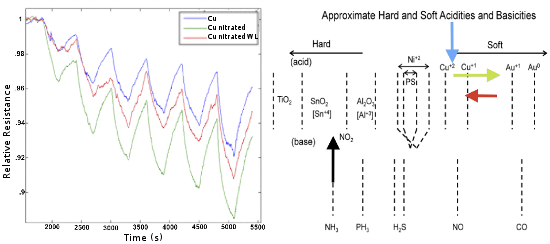
- gas and metal oxides. The dynamic interaction of NO with TiO2, SnO2, NiO, CuxO, and AuxO (x >> 1), in order of decreasing acidity, demonstrates this effect. Interactions with the metal-oxide-decorated interface can be modified by the in situ nitridation of the oxide nanoparticles, enhancing the
- broader-based and predicts reversible sensor–analyte interactions. The fractional deposition of TiO2, SnO2, NiO, CuxO, and AuxO (x >> 1) nanostructured islands (Figure 1) modifies the sensitivity response of the extrinsic porous silicon interface. The deposited nanostructures, in effect, dominate the PS
- decorated surface is five times more responsive than the untreated PS interface [24]. For p+-type PS, TiO2, SnO2, CuxO, and AuxO decorated surfaces are respectively ≥ 4, 2.5, 3–3.5, and 7 times more responsive. The analyte response data forms the basis for the development of the materials positioning


Self-assembled monolayers and titanium dioxide: From surface patterning to potential applications
Beilstein J. Nanotechnol. 2011, 2, 845–861, doi:10.3762/bjnano.2.94

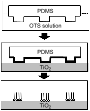
- should be pointed out that the SSD technique is not limited to the deposition of titanium dioxide and was utilized for patterned growth of other oxides such as In2O3 [70], Ta2O5, SnO2 and SrTiO3 [69]. The most popular means for selective growth is direct site-selective deposition (Figure 4), based on



Extended X-ray absorption fine structure of bimetallic nanoparticles
Beilstein J. Nanotechnol. 2011, 2, 237–251, doi:10.3762/bjnano.2.28
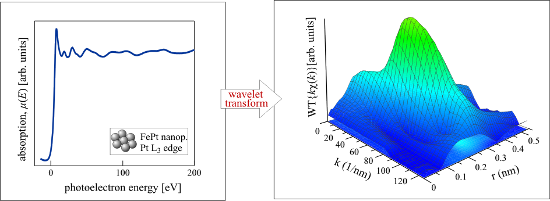
- several examples can be found for EXAFS analysis on nanoparticle systems, e.g., Co [8], CdS [9], CdSe [10], SnO2 [11] and Au [12] nanoparticles, as well as Ag nanoparticles embedded in glass [13][14]. To discuss the advantages and possible drawbacks of EXAFS analysis in nanoparticulate systems, this paper



Schottky junction/ohmic contact behavior of a nanoporous TiO2 thin film photoanode in contact with redox electrolyte solutions
Beilstein J. Nanotechnol. 2011, 2, 127–134, doi:10.3762/bjnano.2.15
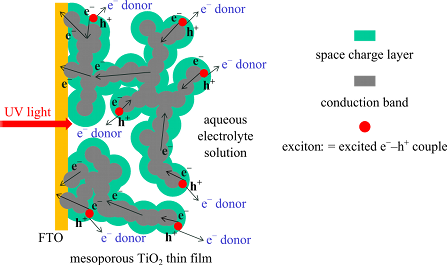
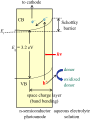
- are transported first to the fluorine-doped tin oxide (FTO, SnO2:F) conductive layer through TiO2 grain boundaries and then to the cathode reducing electron acceptor there (O2 in the present case). In a Schottky junction, under the conditions when the band structure is flat without any bending, the
- To prepare a nanoporous TiO2 film, Ti-nanoxide paste (T/SP, average particle size 13 nm, anatase >90%) was purchased from Solaronix SA, Aubonne, Switzerland. Larger size TiO2 powders, G2 (500 nm, rutile >95%) was purchased from Showa Denko Co., Ltd, Japan. F-doped SnO2 conductive glass (FTO, surface




Room temperature synthesis of indium tin oxide nanotubes with high precision wall thickness by electroless deposition
Beilstein J. Nanotechnol. 2011, 2, 119–126, doi:10.3762/bjnano.2.14

- surfaces of substrates or homogeneous nucleation in solution, is determined by the supersaturated solution [16]. When the solution is supersaturated, nucleation begins; ITO nanocrystallites form on the template surface (Equation 12), according to the concentration ratio of In2O3 and SnO2, due to the


Other Beilstein-Institut Open Science Activities