
Search results
Search for "aluminum" in Full Text gives 252 result(s) in Beilstein Journal of Nanotechnology. Showing first 200.
Engineered titania nanomaterials in advanced clinical applications
Beilstein J. Nanotechnol. 2022, 13, 201–218, doi:10.3762/bjnano.13.15


Sputtering onto liquids: a critical review
Beilstein J. Nanotechnol. 2022, 13, 10–53, doi:10.3762/bjnano.13.2

- the reactive gas molecules and atoms, ionized or not, present in the plasma leads to the formation of a layer of compound material on the surface of the target. For example, a few nanometers thick layer of AlOx will cover an aluminum (Al) target surface when it is sputtered in an Ar/O2 atmosphere






Plasmon-enhanced photoluminescence from TiO2 and TeO2 thin films doped by Eu3+ for optoelectronic applications
Beilstein J. Nanotechnol. 2021, 12, 1271–1278, doi:10.3762/bjnano.12.94
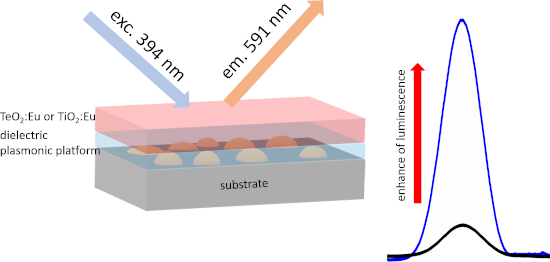
- film. However, a blueshift occurs here due to the electrical properties of aluminum oxide. Additionally, it can be seen, that the position of the minimum of transmission as function of the Al2O3 film thickness. This may be explained by the different permittivity of the layers [34][35][36]. Emission and


Revealing the formation mechanism and band gap tuning of Sb2S3 nanoparticles
Beilstein J. Nanotechnol. 2021, 12, 1021–1033, doi:10.3762/bjnano.12.76
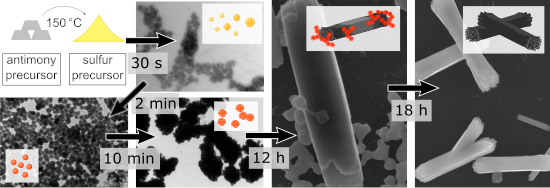
- aluminum holder, explaining the detection of these elements. Oxygen may have been detected due to contamination of the sample, the grid, or the holder. Measurement results of the white product obtained by the direct injection of the Sb precursor into oleylamine at 150 °C without the addition of sulfur: (a


Self-assembly of Eucalyptus gunnii wax tubules and pure ß-diketone on HOPG and glass
Beilstein J. Nanotechnol. 2021, 12, 939–949, doi:10.3762/bjnano.12.70

- specimens with recrystallized structures of wax and ß-diketone were prepared for SEM (Gemini Supra 40VP, Zeiss, Oberkochen, Germany) three days after the evaporation of the solvent. They were fixed on aluminum stubs (Plano, Wetzlar, Germany) with double-sided adhesive tape (Double-sided Tape Universal, Tesa




Nanogenerator-based self-powered sensors for data collection
Beilstein J. Nanotechnol. 2021, 12, 680–693, doi:10.3762/bjnano.12.54
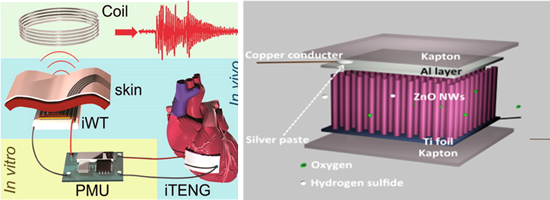
- ion triboelectric nanosensor [16]. By adding three ligand molecules to the surface of nanoporous anodic aluminum oxide, the detection sensitivity for Cu2+, Pb2+, and Cr3+ reached 0.005 × 10⁻⁶, 0.003 × 10⁻⁶, and 0.004 × 10⁻⁶ M, respectively. The self-powered tribo-nanosensor generates different output



A review of defect engineering, ion implantation, and nanofabrication using the helium ion microscope
Beilstein J. Nanotechnol. 2021, 12, 633–664, doi:10.3762/bjnano.12.52
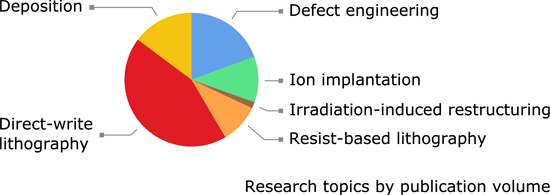
- silicon substrate supporting an amorphous nanoporous aluminum oxide structure was irradiated with helium ions causing dome-shaped swelling of the substrate and thereby 3D deformation of the supported material, accompanied by enlargement of the nanopores to accommodate the new topography [96]. 3
- responsible for the thinning effect encountered. In a related study, helium ion irradiation of an amorphous nanoporous aluminum oxide sample caused pores to markedly shrink in size, also attributed to ion-induced mass transport [96] (Figure 4b). Further related to mass transport, local helium ion irradiation


Impact of GaAs(100) surface preparation on EQE of AZO/Al2O3/p-GaAs photovoltaic structures
Beilstein J. Nanotechnol. 2021, 12, 578–592, doi:10.3762/bjnano.12.48
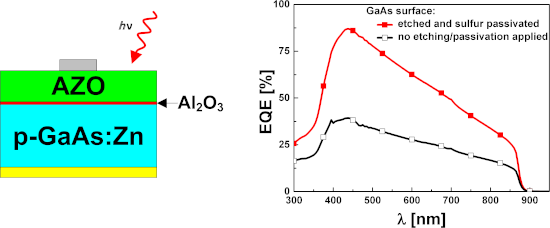
- the removal of the native oxide layer followed by an adequate surface passivation technique [13] and/or by a proper choice of the dielectric and its deposition method. Regarding the dielectric, the most common ones are aluminum oxide (Al2O3) and hafnium dioxide (HfO2) for which the preferable
- for aluminum-doped zinc oxide). Experimental GaAs surface treatment We used lightly Zn-doped GaAs single-crystal (100) wafer (p = 6.8 × 1016 cm−3, ρ = 3.2 × 10⁻¹ Ω·cm, μ ≤ 225 cm2/Vs, d = 400 μm) (fabricated at the Institute of Electronic Materials Technology, ITME) as the substrate. Before starting
- passivation layer in the first few ALD cycles. By applying ALD, we were able to create both Al2O3 and AZO layers in a single ALD process conducted at 160 °C. Aluminum oxide was deposited within five cycles of (trimethylaluminum/Al(CH3)3, TMA, CAS:75-24-1) and H2O precursor supply while AZO required 10 multi




On the stability of microwave-fabricated SERS substrates – chemical and morphological considerations
Beilstein J. Nanotechnol. 2021, 12, 541–551, doi:10.3762/bjnano.12.44

- solution. Subsequently, the microwave vial was capped with an aluminum crimp cap and a Teflon septum seal and was subjected to microwave irradiation. The microwave was set to operate at a constant irradiation power of 300 W. According to our previous investigations of the process parameters, the synthesis


Determination of elastic moduli of elastic–plastic microspherical materials using nanoindentation simulation without mechanical polishing
Beilstein J. Nanotechnol. 2021, 12, 213–221, doi:10.3762/bjnano.12.17

- aluminum, respectively (low-density polyethylene with E = 1.37 GPa, σy = 20 MPa, and E/σy ≈ 69; aluminum with E = 70 GPa, σy = 228 MPa, and E/σy ≈ 307). Figure 2 shows curves of the microsphere with 11.5 µm radius being indented to different depths by a rigid conical indenter to produce different maximum


ZnO and MXenes as electrode materials for supercapacitor devices
Beilstein J. Nanotechnol. 2021, 12, 49–57, doi:10.3762/bjnano.12.4
- biocompatibility, photothermal efficiency, low Seebeck coefficient, as well as good conductivity. They synthesized tantalum carbide MXene sheets from a tantalum aluminum carbide (Ta4AlC3) MAX phase through etching the intermediate aluminium with the aid of hydrofluoric acid (HF). Analysis of the synthesized
- structures with a hexagonal crystal lattice. Because the aluminum was removed, there is no visible Raman vibration. Moreover, CV, chronopotentiometry (CP), and EIS were used to test the electrochemical behavior of the synthesized tantalum carbide MXenes. In 0.1 M sulfuric acid (H2SO4) as electrolyte, a
Seebeck coefficient of silicon nanowire forests doped by thermal diffusion
Beilstein J. Nanotechnol. 2020, 11, 1707–1713, doi:10.3762/bjnano.11.153

- is squeezed between two aluminum blocks maintained at different temperatures TH = THot and TC = TCold. Given the surface A of the sample, the squeezing pressure has been set to 20 MPa for all measured samples. A third block THRef is maintained at the same temperature as TH (within ±0.1°), so that the
- the evaluation of the Seebeck coefficient S. Simultaneously to the measurement of the thermal resistance of each sample, the voltage between the aluminum blocks TH and TC has been measured (Seebeck voltage Vseebeck for TH − TC). However, the temperature difference ΔT = TH − TC includes also the


Fabrication of nano/microstructures for SERS substrates using an electrochemical method
Beilstein J. Nanotechnol. 2020, 11, 1568–1576, doi:10.3762/bjnano.11.139

- in KCl solution. In this study, the Raman intensity of R6G (2 × 10⁻⁶ mol·L−1) on the Ag substrate was larger with subsequent drying treatment than without. Anodic aluminum oxide (AAO) has been used as a mask to fabricate nanodot SERS substrates [40][41][42][43]. Using an AAO mask, Han et al. [41


One-step synthesis of carbon-supported electrocatalysts
Beilstein J. Nanotechnol. 2020, 11, 1419–1431, doi:10.3762/bjnano.11.126
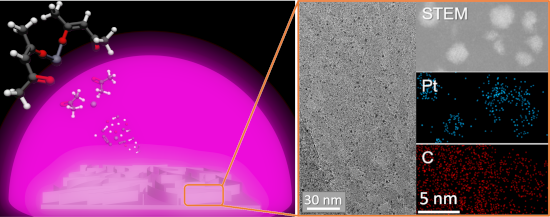
- the plasma system, synthesis, and characterization methods are given in a recent publication on the growth of Al/CNW hybrid materials from aluminum acetylacetonate [17]. Synthesis The deposition experiments are performed in an inductively coupled plasma-enhanced chemical vapor deposition system




An atomic force microscope integrated with a helium ion microscope for correlative nanoscale characterization
Beilstein J. Nanotechnol. 2020, 11, 1272–1279, doi:10.3762/bjnano.11.111
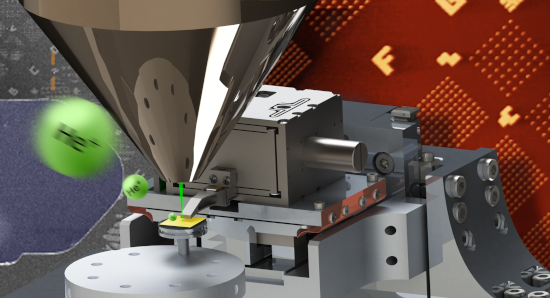
- probes with boron-doped 1 kΩ sensing elements, connected in a Wheatstone bridge configuration with aluminum tracks [20][21] and with single crystal diamond (SCD) tips that are commercially available (SCL-SensorTech Fabrication GMBH, Vienna, Austria). The SCD tips (tip radius below 15 nm, height 12–16 µm


Plant growth regulation by seed coating with films of alginate and auxin-intercalated layered double hydroxides
Beilstein J. Nanotechnol. 2020, 11, 1082–1091, doi:10.3762/bjnano.11.93

- layered compounds, emerges as a very promising approach to a new form of growth regulator application. Thus, the presented work had three aims: (i) the synthesis and characterization of an organic–inorganic hybrid material containing a layered double hydroxide (LDH) of zinc and aluminum and the synthetic



Vibration analysis and pull-in instability behavior in a multiwalled piezoelectric nanosensor with fluid flow conveyance
Beilstein J. Nanotechnol. 2020, 11, 1072–1081, doi:10.3762/bjnano.11.92

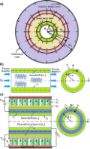
- edge and clamped-simply supported edge, respectively. The material properties of the different layers of aluminum (Al) nanoshell and piezoelectric layers (PZT-4) are shown in Table 2 and Table 3, respectively [18][20]. The other bulk and surface geometrical parameters of FC-MWPENS are shown in Table 4


![[Graphic 46]](/bjnano/content/inline/2190-4286-11-92-i46.svg?max-width=637&scale=1.18182) on DNF of FC-MWPENS.
on DNF of FC-MWPENS.


![[Graphic 50]](/bjnano/content/inline/2190-4286-11-92-i50.svg?max-width=637&scale=1.18182) on DNF of SS FC-MWPENS.
on DNF of SS FC-MWPENS.


![[Graphic 54]](/bjnano/content/inline/2190-4286-11-92-i54.svg?max-width=637&scale=1.18182) on DNF of SS FC-MWPENS.
on DNF of SS FC-MWPENS.


![[Graphic 59]](/bjnano/content/inline/2190-4286-11-92-i59.svg?max-width=637&scale=1.18182) for fluid velocity
for fluid velocity ![[Graphic 60]](/bjnano/content/inline/2190-4286-11-92-i60.svg?max-width=637&scale=1.18182) on DNF of SS FC-MWPENS.
on DNF of SS FC-MWPENS.

![[Graphic 61]](/bjnano/content/inline/2190-4286-11-92-i61.svg?max-width=637&scale=1.18182) for pull-in voltage on DNF of SS FC-MWPENS.
for pull-in voltage on DNF of SS FC-MWPENS.

![[Graphic 67]](/bjnano/content/inline/2190-4286-11-92-i67.svg?max-width=637&scale=1.18182) for fluid velocity
for fluid velocity ![[Graphic 68]](/bjnano/content/inline/2190-4286-11-92-i68.svg?max-width=637&scale=1.18182) on DNF of SS FC-MWPENS.
on DNF of SS FC-MWPENS.

![[Graphic 69]](/bjnano/content/inline/2190-4286-11-92-i69.svg?max-width=637&scale=1.18182) for pull-in voltage on DNF of SS FC-MWPENS.
for pull-in voltage on DNF of SS FC-MWPENS.

![[Graphic 73]](/bjnano/content/inline/2190-4286-11-92-i73.svg?max-width=637&scale=1.18182) on DNF of SS FC-MWPENS.
on DNF of SS FC-MWPENS.


![[Graphic 75]](/bjnano/content/inline/2190-4286-11-92-i75.svg?max-width=637&scale=1.18182) on DNF of SS FC-MWPENS.
on DNF of SS FC-MWPENS.

Excitonic and electronic transitions in Me–Sb2Se3 structures
Beilstein J. Nanotechnol. 2020, 11, 1045–1053, doi:10.3762/bjnano.11.89

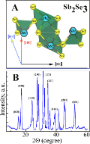
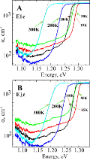
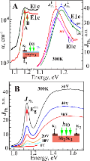
- crystal layers were characterized by a high reflectance, which is characteristic of metallic aluminum mirrors. Some measurements were also carried out on the spectrometer DFS-32 coupled with a Specord M-40 and a Jasco V-670. The photoconductivity spectra were obtained on a single spectrometer (MDR-2) with

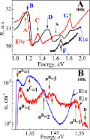
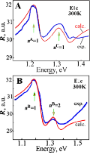
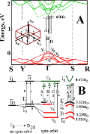

Effect of Ag loading position on the photocatalytic performance of TiO2 nanocolumn arrays
Beilstein J. Nanotechnol. 2020, 11, 717–728, doi:10.3762/bjnano.11.59
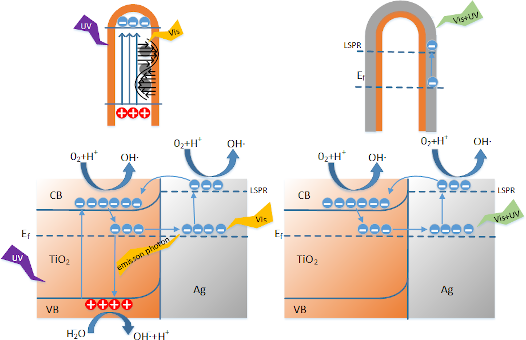
- solar energy harvesting in photovoltaic and photocatalytic applications owing to their extremely high visible-light absorption and tuned effective band gap. In this work, Ag-loaded TiO2 nanocolumn (Ag-TNC) arrays were fabricated based on anodic aluminum oxide (AAO) template by combining atomic layer
- ) of Ag and the absorption of light by TiO2. These results represent a promising step forward to the development of high-performance photocatalysts for energy conversion and storage. Keywords: anodic aluminum oxide template; nanocolumn arrays; photocatalysis; surface plasmon resonance; Introduction
- preparation of 1D TiO2 nanostructures is mainly performed by using anodization [17], hydrothermal [18] and template [19] methods. Meanwhile, the most common methods for the combination with precious metals are chemical deposition [20] and physical deposition [21]. The development of anodized aluminum oxide


Structural optical and electrical properties of a transparent conductive ITO/Al–Ag/ITO multilayer contact
Beilstein J. Nanotechnol. 2020, 11, 695–702, doi:10.3762/bjnano.11.57
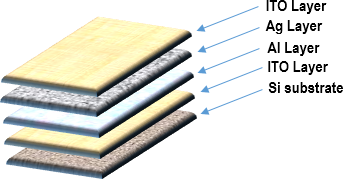
- works of Roh et al. [30] and Ding et al. [39] who used aluminum/palladium and copper interlayers, respectively. Carrier concentration and mobility of the IAAI films are higher than those of the ITO films. The IAAI carrier concentration increased from 6.2 × 10⁻²¹ to 8.9 × 10⁻²¹ cm−3 after annealing


High dynamic resistance elements based on a Josephson junction array
Beilstein J. Nanotechnol. 2020, 11, 417–420, doi:10.3762/bjnano.11.32

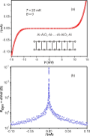
- followed by ultrahigh vacuum deposition of materials was used for the fabrication of the nanostructures. Hybrid QPSJ samples were made of Ti, Al and aluminum oxide [12]. The high-impedance JJs studied in this paper, similar to those from [12], were fabricated from superconducting thin film Al oxidized in
- test sample fabricated from superconducting thin film aluminum oxidized in situ to form tunnel barriers. Left panel: overview of the structure. Right panel: details of the JJ element. (a) Experimental I–V characteristics of 50 pairs of Al–AlOx junctions connected in series. Inset shows a schematic of

An investigation on the drag reduction performance of bioinspired pipeline surfaces with transverse microgrooves
Beilstein J. Nanotechnol. 2020, 11, 24–40, doi:10.3762/bjnano.11.3

- outer surface in a concentric annulus flow were tested exclusively. As can be seen from Figure 7a, the annulus channel was composed of aluminum pipelines with different diameters. The outer diameter of the inner scaled pipeline was 19.5 mm, the inner diameter of the outer scaled pipeline was 35 mm, and
- the inner pipeline was fixed by the centering regulators. Based on the microgrooves’ geometric parameters obtained by the numerical simulation, microgrooves were manufactured on the outer surface of the aluminum pipeline by lathe machining, as shown in Figure 7b. The height and width of the


Advanced hybrid nanomaterials
Beilstein J. Nanotechnol. 2019, 10, 2563–2567, doi:10.3762/bjnano.10.247
- example of a hybrid material in which an indigo derivative is stabilized into magnesium aluminum phyllosilicate. This material, palygorskite, was used to produce beautiful mural paintings that are still shining centuries later [1][2][3]. Since these origins, the field of hybrid materials has developed
Label-free highly sensitive probe detection with novel hierarchical SERS substrates fabricated by nanoindentation and chemical reaction methods
Beilstein J. Nanotechnol. 2019, 10, 2483–2496, doi:10.3762/bjnano.10.239

- /nanomachining methods [26][27][28][29][30] have been used to fabricate SERS substrates with two main advantages. First, the wear of the tip is negligible during machining on the metal surface due to the low hardness of the metals used (copper, aluminum). Second, the micro/nanomechanical machining method is


The role of Ag+, Ca2+, Pb2+ and Al3+ adions in the SERS turn-on effect of anionic analytes
Beilstein J. Nanotechnol. 2019, 10, 2338–2345, doi:10.3762/bjnano.10.224
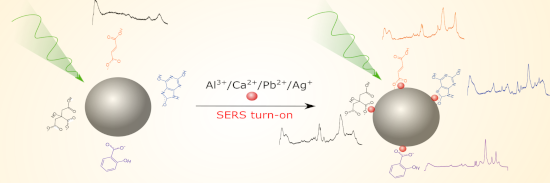
- emitting at 532 nm at a power of ≈20 mW measured on the sample. In form of 10 µL drops, the sample solution was placed on a microscope slide covered with aluminum foil. The laser was focused on the liquid drop using a 5× objective (NA = 0.12). The spectra were recorded by averaging four acquisitions of 4 s