


Search results
Search for "hydration" in Full Text gives 79 result(s) in Beilstein Journal of Nanotechnology.
Large-scale atomistic and quantum-mechanical simulations of a Nafion membrane: Morphology, proton solvation and charge transport
Beilstein J. Nanotechnol. 2013, 4, 567–587, doi:10.3762/bjnano.4.65
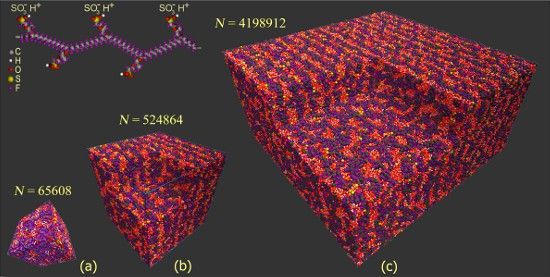
- + responsible for charge transfer reactions. The hydration level, [H2O]/[SO3H], is defined as the ratio of the number of water molecules to the number of sulfonated groups: λ = nw/nsnc. The value of λ was 5, 10, and 20. Note that the hydration level λ = 5 is close to the percolation threshold value for water
- molecules in a Nafion membrane [38][48], while λ = 10 and 20 is close to the operating regime. At these hydration levels, the membrane may function as a proton-conducting material [61][62][63]. One should keep in mind that the range of λ values corresponding to the specified hydration regime (low or high
- hydration conditions) depends on the ratio of hydrophobic/hydrophilic segments in a polymer chain [53]. That is why under certain conditions the state with λ = 10 and 20 can be referred to the high hydration level. For the systems under study, both λ values correspond to high acidities (pH<<1). Thus, the







Growth behaviour and mechanical properties of PLL/HA multilayer films studied by AFM
Beilstein J. Nanotechnol. 2012, 3, 778–788, doi:10.3762/bjnano.3.87

- the film bilayer number n. This result contradicts the results of Richert et al. [4], who reported a decrease in E from 90 kPa for n = 20 to 40 kPa for n = 60. The authors suggested a possibility of film softening due to greater hydration of the upper layers rather than due to a change in surface


Pulse-response measurement of frequency-resolved water dynamics on a hydrophilic surface using a Q-damped atomic force microscopy cantilever
Beilstein J. Nanotechnol. 2012, 3, 260–266, doi:10.3762/bjnano.3.29

- Masami Kageshima Department of Physics, Tokyo Gakugei University, 4-1-1 Nukui-kita-machi, Koganei, Tokyo 184-8501, Japan 10.3762/bjnano.3.29 Abstract The frequency-resolved viscoelasticity of a hydration layer on a mica surface was studied by pulse-response measurement of a magnetically driven
- –sample system. The significant viscoelasticity spectrum of the hydration layer was successfully derived in a frequency range below 100 kHz by comparison of data obtained at a distance of 300 nm from the substrate with those taken in the proximity of the substrate. A positive value of the real part of the
- stiffness was determined and is attributed to the reported solidification of the hydration layers. Keywords: atomic force microscopy; hydration; pulse-response; quality-factor control; viscoelasticity; Introduction Liquid solvation is a phenomenon common to a large variety of liquid–solid interfaces [1




Parallel- and serial-contact electrochemical metallization of monolayer nanopatterns: A versatile synthetic tool en route to bottom-up assembly of electric nanocircuits
Beilstein J. Nanotechnol. 2012, 3, 134–143, doi:10.3762/bjnano.3.14

- ) sites of nondestructively patterned OTS/Si monolayers demonstrates that metal ions have to shed their hydration shell and reach the electrode surface before being discharged, rather than being first reduced to neutral atoms by electron transfer to hydrated ionic species in solution [54][55


Other Beilstein-Institut Open Science Activities



