

Search results
Search for "magnetic resonance imaging" in Full Text gives 81 result(s) in Beilstein Journal of Nanotechnology.
PEGylated versus non-PEGylated magnetic nanoparticles as camptothecin delivery system
Beilstein J. Nanotechnol. 2014, 5, 1312–1319, doi:10.3762/bjnano.5.144
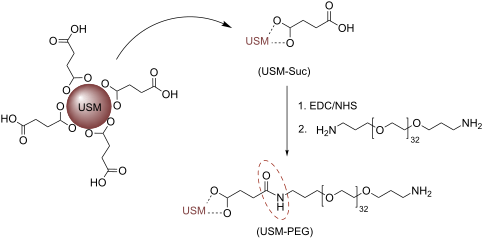
- promising as delivery systems due to their low toxicity and their ability to be used both in cancer diagnosis and therapy [21][22][23]. SPION can be effectively used as contrast agents for magnetic resonance imaging [24][25], as carriers for chemotherapeutic drugs [26][27][28] and to destroy cancer cells by


Manipulation of isolated brain nerve terminals by an external magnetic field using D-mannose-coated γ-Fe2O3 nano-sized particles and assessment of their effects on glutamate transport
Beilstein J. Nanotechnol. 2014, 5, 778–788, doi:10.3762/bjnano.5.90

- surface. In this context, biocompatible polymers can be attached to the surface of the nanoparticles to avoid their agglomeration and enhance their non-specific intracellular uptake [4]. Magnetic resonance imaging could be used for tracking labeled cells in vivo by using iron oxide nanoparticles coated by



Plasma-assisted synthesis and high-resolution characterization of anisotropic elemental and bimetallic core–shell magnetic nanoparticles
Beilstein J. Nanotechnol. 2014, 5, 466–475, doi:10.3762/bjnano.5.54

- as powerful nanotools in many areas of biology, biophysics and medicine [1]. Possible applications include their use as contrast agents for cell tracking via magnetic resonance imaging (MRI) [2], as colloidal mediators in cancer therapy (hyperthermia) [3] or as nanocarriers for targeted drug delivery


Extracellular biosynthesis of gadolinium oxide (Gd2O3) nanoparticles, their biodistribution and bioconjugation with the chemically modified anticancer drug taxol
Beilstein J. Nanotechnol. 2014, 5, 249–257, doi:10.3762/bjnano.5.27

- convertor [2][3], as additives in UO2 fuel rods for nuclear reactors [2], and as an additive in ZrO2 to enhance its toughness [3][4]. Gd2O3 has several potential applications in biomedicine, too. For example, it is used in magnetic resonance imaging, since it exhibits superparamagnetism and involves T1


Magnetic nanoparticles for biomedical NMR-based diagnostics
Beilstein J. Nanotechnol. 2010, 1, 142–154, doi:10.3762/bjnano.1.17

- ][21][22][23][24][25]. A variety of chemical methods, ranging from traditional wet chemistry to high-temperature thermal decomposition, have been employed to synthesize MNPs. Colloidal iron oxide nanoparticles, which are used as clinical magnetic resonance imaging (MRI) contrast agents, are generally


Preparation and characterization of supported magnetic nanoparticles prepared by reverse micelles
Beilstein J. Nanotechnol. 2010, 1, 24–47, doi:10.3762/bjnano.1.5

- the medical field [7], e.g., in hyperthermia [8], contrast enhancing in magnetic resonance imaging [9][10] or the use as cell markers [9] which in-turn can be read out by highly-sensitive devices like TMR-sensors [11]. Moreover, magnetic NPs are thought to improve a variety of catalytic reactions [12






Other Beilstein-Institut Open Science Activities