


Search results
Search for "microelectronics" in Full Text gives 82 result(s) in Beilstein Journal of Nanotechnology.
High-resolution electrical and chemical characterization of nm-scale organic and inorganic devices
Beilstein J. Nanotechnol. 2013, 4, 318–319, doi:10.3762/bjnano.4.35
- Pierre Eyben IMEC VZW, Kapeldreef 75, 3001 Leuven, Belgium 10.3762/bjnano.4.35 Almost ever since the advent of the microelectronics adventure, silicon-based MOSFET (metal–oxide–semiconductor field-effect transistor) technology has been largely dominant. However, for a few years now this
A look underneath the SiO2/4H-SiC interface after N2O thermal treatments
Beilstein J. Nanotechnol. 2013, 4, 249–254, doi:10.3762/bjnano.4.26

- experimental values. Acknowledgements The authors would like to thank S. Di Franco for his support during fabrication of the device prototypes. ST Microelectronics R&D in Catania is acknowledged for funding and invaluable assistance. This work was partially funded by the Marie Curie ITN NetFISiC (EC FP7 grant
- agreement no. 264613), by the national project PON Ambition Power (PON01_00700), and by ST Microelectronics, Catania (under the research contract 04.03.2011.002 D.B. Legal Dept. 3774).
Micro- and nanoscale electrical characterization of large-area graphene transferred to functional substrates
Beilstein J. Nanotechnol. 2013, 4, 234–242, doi:10.3762/bjnano.4.24
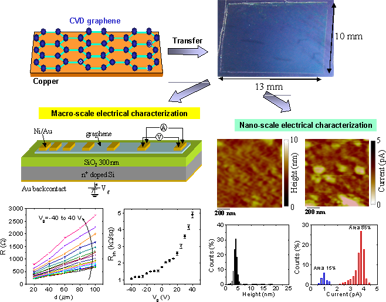
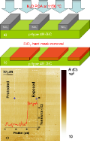
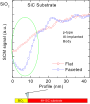
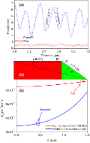
- properties of the graphene membrane. In this paper, we investigated the morphological and electrical properties of CVD graphene transferred onto SiO2 and on a polymeric substrate (poly(ethylene-2,6-naphthalene dicarboxylate), briefly PEN), suitable for microelectronics and flexible electronics applications
- microelectronics; poly(ethylene-2,6-naphthalene dicarboxylate) or PEN, a transparent polymer analogue to the more common PET, but with stronger mechanical resistance, higher degradation temperature and higher chemical inertness in acid and alkaline conditions, which can be useful for transparent and flexible



Electron-beam patterned self-assembled monolayers as templates for Cu electrodeposition and lift-off
Beilstein J. Nanotechnol. 2012, 3, 101–113, doi:10.3762/bjnano.3.11

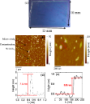
- -off (Figure 7b). We ascribe this to nonvertical growth of the trench walls due to transport-limited deposition, similar to subconformal Cu deposition in microelectronics [55][56]. Besides the definition of the lateral dimensions, another point of interest is the surface topography. Reminding ourselves





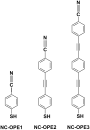
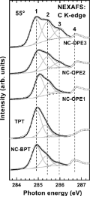
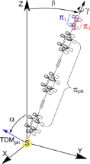
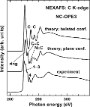
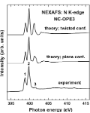
X-ray spectroscopy characterization of self-assembled monolayers of nitrile-substituted oligo(phenylene ethynylene)s with variable chain length
Beilstein J. Nanotechnol. 2012, 3, 12–24, doi:10.3762/bjnano.3.2

- semiconductor microelectronics devices, although very efficient and compact, are being pushed to their physical limits in terms of further miniaturization with associated issues such as electrical leakage and heat dissipation, and hence this is driving consideration of entirely new types of platforms. One



Self-assembled monolayers and titanium dioxide: From surface patterning to potential applications
Beilstein J. Nanotechnol. 2011, 2, 845–861, doi:10.3762/bjnano.2.94

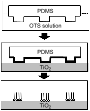
- areas of photovoltaics, microelectronics, microelectromechanics, photocatalysis, corrosion prevention and even biomedicine should be regarded as appetizers paving the way for further studies to be performed. Keywords: photocatalysis; remote degradation; self-assembled monolayers; titanium dioxide



The atomic force microscope as a mechano–electrochemical pen
Beilstein J. Nanotechnol. 2011, 2, 659–664, doi:10.3762/bjnano.2.70

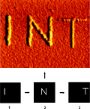
- numerous applications including in the fields of microelectronics, nanoscale electronics and nano-electromechanical systems (NEMS). Considerable progress was achieved recently in the field of self-organized electrochemical patterning of nanowires. In thin-film electrolytes, regular arrays of nanowires were


Other Beilstein-Institut Open Science Activities



