Search results
Search for "nanoporous" in Full Text gives 116 result(s) in Beilstein Journal of Nanotechnology.
Electrochemical coating of dental implants with anodic porous titania for enhanced osteointegration
Beilstein J. Nanotechnol. 2015, 6, 2183–2192, doi:10.3762/bjnano.6.224
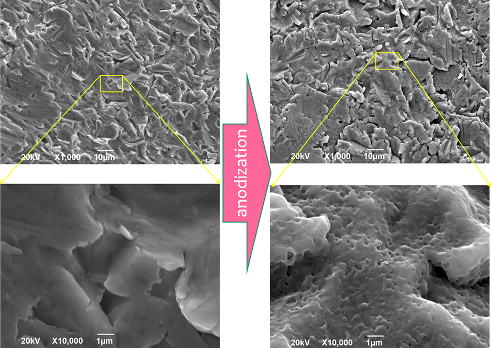
- arrays are not necessary [9]. A single anodization is sufficient and from this perspective, may represent a simple and inexpensive nanopatterning procedure for biomedical Ti. In fact, the application of nanoporous oxides as biological surfaces (where living cells should adhere and grow) has been already
- species to the APT coating from those naturally resulting in the dissolved acid electrolyte. Interesting candidate elements are F, Ca and Mg and P, as demonstrated by recent loading carried out on implants coated with nanoporous titania by means of different techniques [22][32][33]. We selected Mg, which
- to form a nanoporous structure. These pores are on average 5–10 times larger than those in the pristine APT (i.e., on the microscale). We make the hypothesis that the coating is porous due to local percolation of the ionic current through it, with the arrangement of such conduction channels favoring


Selective porous gates made from colloidal silica nanoparticles
Beilstein J. Nanotechnol. 2015, 6, 2105–2112, doi:10.3762/bjnano.6.215

- (ethylene oxide) (PS-b-PEO) copolymers as soft-templating agents. Nanoparticles synthesis was carried out in a mixed solvent system. After spin-coating onto a macroporous silicon nitride support, silica nanoparticles were calcined under controlled conditions. An organized nanoporous layer was obtained
- were obtained, suggesting possible applications of these nanoporous films as selective gates for controlled transport of chemical species in solution. Keywords: block copolymers; coatings; colloidal nanoparticles; silica; sol–gel synthesis; Introduction The development of smart nanoporous devices for
- in the preparation of microfiltration devices was realized by the surface functionalization of macroporous supports or membranes by nanoporous functional coatings [17][18][19][20]: the macroporous, permeable supports, in fact, can provide mechanical strength to the thinner functional coatings on top


Surface engineering of nanoporous substrate for solid oxide fuel cells with atomic layer-deposited electrolyte
Beilstein J. Nanotechnol. 2015, 6, 1805–1810, doi:10.3762/bjnano.6.184
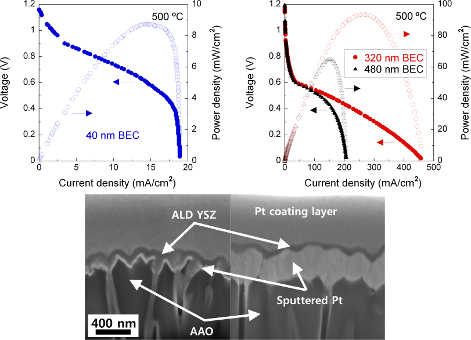


Formation of substrate-based gold nanocage chains through dealloying with nitric acid
Beilstein J. Nanotechnol. 2015, 6, 1362–1368, doi:10.3762/bjnano.6.140
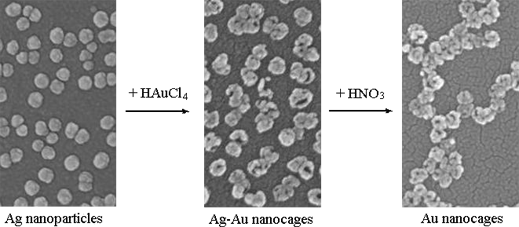
- final Au NCs, which maybe limit their applications. The dealloying or selective deletion of Ag from Ag–Au alloys with oxidative etchants such as nitric acid or perchloric acid has been widely used to synthesize nanoporous gold (NPG) [18][19][20][21]. Moreover, Xia et al. employed Fe(NO3)3 and H2O2 as
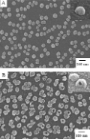
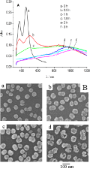
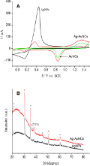
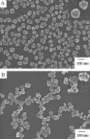
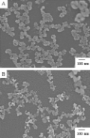
- reported that the concentration of HNO3 is an important parameter because it alters the chemical potential difference across the nanoporous/alloy interface and affects the morphology of Ag–Au alloy during dealloying. Figure 6 exhibits the SEM images of Ag–Au NCs treated with various concentration of HNO3
- from the dealloying of Ag–Au alloy to form nanoporous gold, in which the concentration of HNO3 was rather high. For a dilute HNO3 solution, the chemical reaction that may take place is given as follows [31]: It is reported that the reaction is rather slow at HNO3 concentrations of less than 3.80 M (ca

Polymer blend lithography for metal films: large-area patterning with over 1 billion holes/inch2
Beilstein J. Nanotechnol. 2015, 6, 1205–1211, doi:10.3762/bjnano.6.123
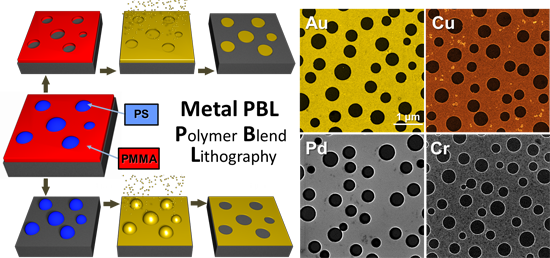
- such as glass or metal can also be used as substrates. For example iron was used as substrate for the fabrication of nanoporous gold mesoflower arrays, which served afterwards for surface-enhanced Raman scattering [23]. With the metal PBL technique it is possible to fabricate more than one billion


Tunable magnetism on the lateral mesoscale by post-processing of Co/Pt heterostructures
Beilstein J. Nanotechnol. 2015, 6, 1082–1090, doi:10.3762/bjnano.6.109

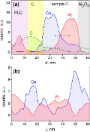
- activated oxidation of carbon at the Pt/C interface occurs, leading to the formation of CO and a reorganization and coalescence of Pt nanocrystallites by surface diffusion. The latter, in turn, results in a nanoporous morphology, which is clearly seen in the SEM images of samples B and C in the insets to
- surface of the nanoporous Pt layer in which the Co deposit (and then purified Co) is located. Accordingly, the diffraction pattern of the lower layer most likely shows an overlay of the Pt and the CoPt L10 phases. Hard-magnetic response at a Co/Pt ratio of 1:1 As the presence of the CoPt L10 phase is




From lithium to sodium: cell chemistry of room temperature sodium–air and sodium–sulfur batteries
Beilstein J. Nanotechnol. 2015, 6, 1016–1055, doi:10.3762/bjnano.6.105
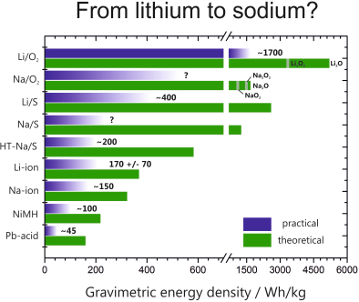
- group also investigated non-carbon electrodes, such as nanoporous gold or titanium carbide (TiC) [60][84]. Both materials are claimed to significantly improve the cycle performance compared to carbon electrodes due to a higher chemical stability towards lithium oxide species. On the other hand, the


Electrical properties of single CdTe nanowires
Beilstein J. Nanotechnol. 2015, 6, 444–450, doi:10.3762/bjnano.6.45

- Elena Matei Camelia Florica Andreea Costas Maria Eugenia Toimil-Molares Ionut Enculescu National Institute for Materials Physics, Magurele, Ilfov, Romania, 77125 GSI, Planckstraße 1, 64291 Darmstadt, Germany 10.3762/bjnano.6.45 Abstract Ion track, nanoporous membranes were employed as templates
- excellent reproducibility and a narrow distribution of the geometrical characteristics [8][9][10][11][12][13]. The method typically makes use of a nanoporous membrane as a template along with a method for filling its pores. As templates, most used are polymer ion track membranes, anodic alumina and diblock
- copolymer templates, while the filling methods range from electrochemical or electroless deposition, to atomic layer deposition or molten metal injection. The nanoporous polymer ion track membranes are obtained by polymer foil irradiation with swift heavy ions and further chemical etching of the ion tracks


Nanoparticle shapes by using Wulff constructions and first-principles calculations
Beilstein J. Nanotechnol. 2015, 6, 361–368, doi:10.3762/bjnano.6.35

- range order in LiBH4 confined in 2–4 nm pores in nanoporous carbon is connected to the reduction of the barriers for the rotational motion of BH4− anions and the high- temperature behavior even at temperatures well below the bulk Tc [63]. The experimental insight to the properties of nano-confined LiBH4



Nanoporous Ge thin film production combining Ge sputtering and dopant implantation
Beilstein J. Nanotechnol. 2015, 6, 336–342, doi:10.3762/bjnano.6.32
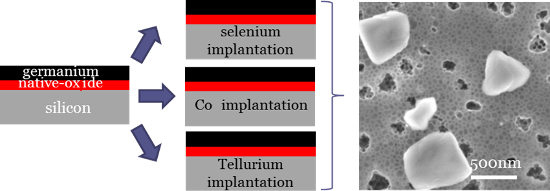
- , 13397 Marseille, France Department of Physics, University of Central Florida, Orlando, FL 32816, USA 10.3762/bjnano.6.32 Abstract In this work a novel process allowing for the production of nanoporous Ge thin films is presented. This process uses the combination of two techniques: Ge sputtering on SiO2
- different nature in the material (vacancy, dislocation, amorphization, etc.). High-dose implantations in Ge (>1015 atoms/cm2) have been reported to induce the formation of nanoporous structures [16][17][18][19][20][21][22][23][24][25]. Thus, ion implantation may be a simple way to produce a nanoporous
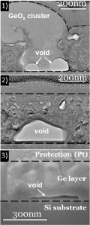
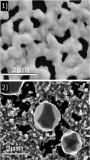
- ), (ii) holes with an average lateral size of ≈100 nm, and (iii) a nanoporous structure exhibiting pores with an average lateral size of ≈35 nm. The same three types of defects are observed in all the three sets of samples. The average size and the density of these defects are reported in Table 1. An


Poly(styrene)/oligo(fluorene)-intercalated fluoromica hybrids: synthesis, characterization and self-assembly
Beilstein J. Nanotechnol. 2014, 5, 2450–2458, doi:10.3762/bjnano.5.254

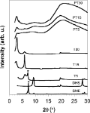
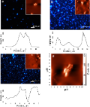
- of the keto-defects green emission band, peaked at around 530 nm, at the expense of the initial blue emission. In the flat PT15 film the contribution of keto-defects emission is almost suppressed and the decrease of PL intensity is slower (Figure 6c) with respect to neat TF film. In the nanoporous




Synthesis and characterization of fluorescence-labelled silica core-shell and noble metal-decorated ceria nanoparticles
Beilstein J. Nanotechnol. 2014, 5, 2413–2423, doi:10.3762/bjnano.5.251

- metallic catalysts. For automobile catalytic converters meso- or nanoporous ceria or alumina is used as washcoat (on which the noble metal catalysts are deposited) for cordierite, the latter supplying the required mechanical strength. Here the oxygen storage capacity of CeO2 improves the performance of the


Biopolymer colloids for controlling and templating inorganic synthesis
Beilstein J. Nanotechnol. 2014, 5, 2129–2138, doi:10.3762/bjnano.5.222
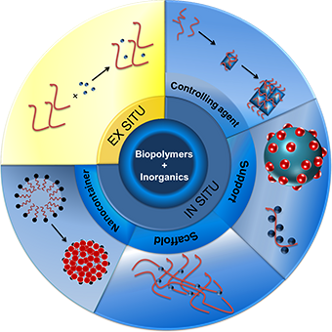
- . Reprinted with permission from [87]. Copyright 2008 John Wiley & Sons. Schematic representation of aerogel preparation. A nanoporous cellulose gel is impregnated with the silica precursor TEOS (a). Afterwards, the silica formation takes place by sol–gel process (hydrolysis and condensation), yielding a


Liquid fuel cells
Beilstein J. Nanotechnol. 2014, 5, 1399–1418, doi:10.3762/bjnano.5.153

- is a four-electron process, which corresponds to the formation of glycolic acid, a major product determined by chromatography (GCMS) [100]. An acidic EG fuel cell using a 100 µm nanoporous proton-conducting membrane and a Pt–Ru anode catalyst demonstrated a peak power density of 300 mW/cm2 for the
- high OCV (1.75) V and showed a very high peak power density (1.02 W/cm2 at 80 °C) [161]. A higher temperature improves the performance of the cathode but has little effect on the anode [161]. An electrocatalyst consisting of dealloyed nanoporous gold leaves demonstrated activities toward both hydrazine
- towards hydrolysis turned out to be more efficient catalysts than platinum. Thiourea, a known hydrogen evolution inhibitor, was also used as an additive to increase the coulombic efficiency [181]. Nanoporous gold electrodes prepared by extracting Ag from an AgAu alloy catalyze the oxidation of AB at a

Nanoporous composites prepared by a combination of SBA-15 with Mg–Al mixed oxides. Water vapor sorption properties
Beilstein J. Nanotechnol. 2014, 5, 1226–1234, doi:10.3762/bjnano.5.136

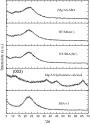
- -synthesis method, produces a composite material with Mg–Al mixed oxides homogeneously dispersed on the SBA-15 nanoporous surface. The resulting composites present textural properties similar to the SBA-15. On the other hand, with the second procedure (in situ method), Mg and Al mixed oxides occur on the
- might be utilized as as acid-base catalysts, adsorbents, sensors or storage nanomaterials. Keywords: calcined Mg–Al hydrotalcite; nanoporous composites; SBA-15; vapor sorption; Introduction Multifunctional nanomaterials are designed to satisfy specific ranged sets of performance requirements. The
- 40 °C to 55 °C (equilibrium temperature). Therefore, the smaller pore size causes slow water diffusion. Conclusion Nanoporous composites were obtained from combinations of Mg–Al precursors of a hydrotalcite with SBA-15. The post-synthesis method is a simple and effective way to prepare composites



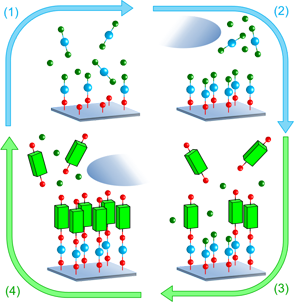
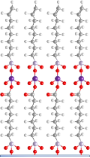
Organic and inorganic–organic thin film structures by molecular layer deposition: A review
Beilstein J. Nanotechnol. 2014, 5, 1104–1136, doi:10.3762/bjnano.5.123




Functionalized nanostructures for enhanced photocatalytic performance under solar light
Beilstein J. Nanotechnol. 2014, 5, 994–1004, doi:10.3762/bjnano.5.113
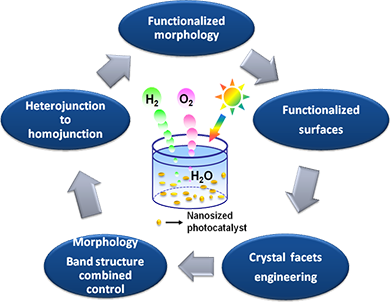
- hydrogen production. Both CuGa2In3S8 (1.91 eV) and AgGa2In3S8 (2.27 eV) showed a quite high photocatalytic activity [62]. Chen and co-workers synthesized hierarchical ZnS–In2S3–CuS nanospheres with a nanoporous structure. A high QE of 22.6% at 420 nm is achieved without loading cocatalysts due to their


Nanostructure sensitization of transition metal oxides for visible-light photocatalysis
Beilstein J. Nanotechnol. 2014, 5, 696–710, doi:10.3762/bjnano.5.82
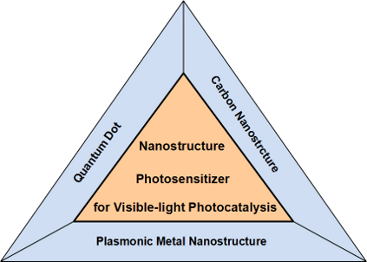
- photosensitization of nanoporous titanium dioxide, zinc oxide, tin dioxide, niobium oxide, and tantalum oxide by quantum-sized cadmium sulfide, lead sulfide, silver sulfide, antimony sulfide, and bismuth sulfide. They found that the photocurrent quantum yields of these photosensitized transition metal oxides can be
- [59][60][61][62][63], photocatalytic water splitting [64][65] photoelectrochemical water splitting [66][67][68][69][70][71][72], photocatalytic conversion of CO2 with H2O to hydrocarbon fuels [73], and degradation of organic molecules [74]. In 2004, Tatsuma et al. reported that nanoporous TiO2 films




Nanoscale patterning of a self-assembled monolayer by modification of the molecule–substrate bond
Beilstein J. Nanotechnol. 2014, 5, 258–267, doi:10.3762/bjnano.5.28

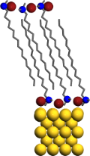
- reductive desorption of the less tightly bound thiol molecules in the UPD-free Au areas to yield either nanoporous SAMs or binary SAMs in the case of backfilling with a second type of thiol [11]. So far, however, this approach has been lacking control as UPD is mediated by random defects [24][26][27] which
- selective removal of thiols from UPD-free Au areas has been exploited for the generation of nanoporous SAMs [11], the process lacked control as UPD occurred at defects present in the native monolayer. The approach based on the SAMs used here, which perfectly block UPD, allows for the exploitation of this


Atomic layer deposition, a unique method for the preparation of energy conversion devices
Beilstein J. Nanotechnol. 2014, 5, 245–248, doi:10.3762/bjnano.5.26
- the interface causes transport to become limiting. For this reason, nanostructured interfaces with elongated folds or tubes can result in optimized devices (Figure 2). In this context, any method capable of depositing thin functional layers onto structured substrates, and especially into nanoporous


3D-nanoarchitectured Pd/Ni catalysts prepared by atomic layer deposition for the electrooxidation of formic acid
Beilstein J. Nanotechnol. 2014, 5, 162–172, doi:10.3762/bjnano.5.16

- , University of Ottawa, 161 Louis-Pasteur St., Ottawa, ON, K1N 6N5, Canada 10.3762/bjnano.5.16 Abstract Three-dimensionally (3D) nanoarchitectured palladium/nickel (Pd/Ni) catalysts, which were prepared by atomic layer deposition (ALD) on high-aspect-ratio nanoporous alumina templates are investigated with
- the catalyst, and it provides a high coverage of high aspect ratio nanostructures [21][22][23]. It is therefore possible to precisely design catalysts onto nanoarchitectured supports that exhibit enhanced abilities for fuel cell applications [24][25]. As previously proposed [26], nanoporous anodic
- have been investigated for the electrooxidation of formic acid in 0.5 M H2SO4. The deposition of nickel oxide from NiCp2 and O3 precursors on high aspect ratio nanoporous Al2O3 has been demonstrated. Although the chemical composition analysis of the NiO layers has not shown that the reductive treatment


Constant-distance mode SECM as a tool to visualize local electrocatalytic activity of oxygen reduction catalysts
Beilstein J. Nanotechnol. 2014, 5, 141–151, doi:10.3762/bjnano.5.14
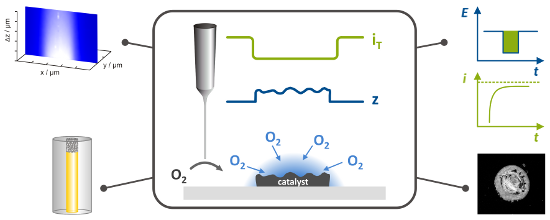
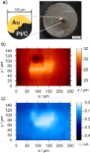
- , Germany) as background electrolyte. As a model catalyst a commercial nanoporous ORR catalyst from ETEK (Natick, USA) with 20 wt % Pt on Vulcan XC72 was used. An air saturated 0.1 M sodium phosphate buffer (pH 7, VWR International, Darmstadt, Germany) was used for all investigations of the catalytic




Advances in nanomaterials
Beilstein J. Nanotechnol. 2013, 4, 805–806, doi:10.3762/bjnano.4.91
- these contributions is found in this Thematic Series in the form of original research articles reflecting recent advances in nanomaterials. The articles in this Thematic Series highlight recent developments, from nanoporous polymers to graphene quantum dots, from concepts for designing magnetic
Preparation of electrochemically active silicon nanotubes in highly ordered arrays
Beilstein J. Nanotechnol. 2013, 4, 655–664, doi:10.3762/bjnano.4.73

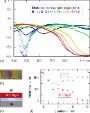
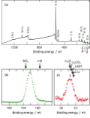
- spectroscopic ellipsometry for thin silica films, and by nuclear magnetic resonance and X-ray photoelectron spectroscopy for nanoporous samples. After removal of the lithium oxide byproduct, the silicon nanotubes can be contacted electrically. In a lithium ion electrolyte, they then display the electrochemical
- waves also observed for other bulk or nanostructured silicon systems. The method established here paves the way for systematic investigations of how the electrochemical properties (capacity, charge/discharge rates, cyclability) of nanoporous silicon negative lithium ion battery electrode materials
- -standing nanoporous oxide membrane. Its mechanical stability is only sufficient for practical purposes if its thickness is beyond 100 µm. Because of the very large aspect ratio of the pores, the ALD SiO2 coating does not reach their lower extremity: in our experimental conditions, the continuous, conformal





Nanoglasses: a new kind of noncrystalline materials
Beilstein J. Nanotechnol. 2013, 4, 517–533, doi:10.3762/bjnano.4.61
- surface region of the metal due to an electrochemical double layer at the interface between the electrolyte and the nanoporous metallic material. By means of this induced electric charge, all properties of the nanoporous metal that depend on its electronic structure may be tuned. As multiphase nanoglasses
- –Sc–Cu although these elements are practically immiscible in the crystalline state. Generation of an electrically charged surface in a nanoporous metal (e.g., Au) if it is immersed into a suitable electrolyte (here KOH) and if a voltage is applied between the metal and the electrolyte so that a double
- -layer is formed at the surface of the nanoporous metal [85][86][87]. Reproduced with permission from [86]. Acknowledgements The author gratefully acknowledges the numerous contributions from his colleagues all over the world, in particular from Professors/Drs. Albe, Birringer, Hahn, Fang, Feng, Jiang