


Search results
Search for "sorption" in Full Text gives 81 result(s) in Beilstein Journal of Nanotechnology.
Pure hydrogen low-temperature plasma exposure of HOPG and graphene: Graphane formation?
Beilstein J. Nanotechnol. 2012, 3, 852–859, doi:10.3762/bjnano.3.96

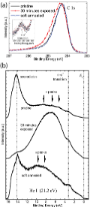
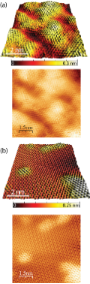
- whether these blisters still contain hydrogen gas underneath them during storage of HOPG under ambient conditions. Similar blister formation was observed after thermal sorption of hydrogen into graphite, and hydrogen gas storage was claimed by thermal desorption experiments [31]. AFM topography images of



Distribution of functional groups in periodic mesoporous organosilica materials studied by small-angle neutron scattering with in situ adsorption of nitrogen
Beilstein J. Nanotechnol. 2012, 3, 428–437, doi:10.3762/bjnano.3.49
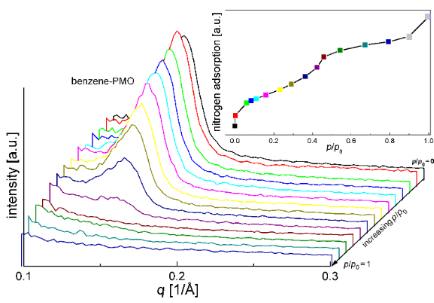
- ], divinylbenzene [12] or biphenyl [13]. However, direct experimental proofs for this molecular-scale periodicity are only rarely given. Gas sorption [14], wide-angle X-ray scattering (WAXS), i.e., powder X-ray diffraction (XRD), and IR spectroscopy [15] are commonly used as analysis tools for porous materials in
- ] and providing insight into both the sorption mechanism, i.e., micropore filling, formation of nitrogen layers and capillary condensation [23][24], and the structural properties. Often adsorbates are favored in which hydrogen atoms can be isotopically substituted by deuterium atoms and, hence, the


Nanostructured, mesoporous Au/TiO2 model catalysts – structure, stability and catalytic properties
Beilstein J. Nanotechnol. 2011, 2, 593–606, doi:10.3762/bjnano.2.63

- calcination in air at 350 °C for 3 h, with a ramp rate of 1 K min−1. For the N2 sorption and inductively coupled plasma ionization spectroscopy (ICP–OES) measurements, a larger quantity of the titania material was needed: The remaining coating solution was cast in petri dishes and aged analogously to the thin
- /TiO2 film yielded statistically relevant data. The surface area and the pore diameter of the titania (cast TiO2 material, different batches) was determined by N2 sorption measurements (Autosorb MP1 and Quadrasorb, Quantachrome). The specific surface area was calculated using the Brunauer–Emmett–Teller
- and constant partial pressure of the other reactant (1 mbar). Supporting Information Supporting Information features details on the nitrogen sorption measurement of porous titania. Supporting Information File 38: Details of sorption measurements. Acknowledgements This work was supported by the




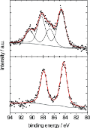


Inorganic–organic hybrid materials through post-synthesis modification: Impact of the treatment with azides on the mesopore structure
Beilstein J. Nanotechnol. 2011, 2, 486–498, doi:10.3762/bjnano.2.52

- sorption analysis. Similar effects were observed for unmodified silica gels by simple ageing in azide-containing media, whether a relatively small or a sterically demanding counter ion (Na+ or (H3C)4N+) was used. The structural modification did not seem to depend greatly on whether an organic aprotic
- evaluated by nitrogen sorption and small angle X-ray scattering (SAXS) analyses. Figure 2 shows the nitrogen adsorption/desorption isotherms at 77 K for modified silica gels before and after nucleophilic substitution (SiO2–(CH2)1,3–Cl → SiO2–(CH2)1,3–N3). The isotherms for the chloroalkyl-containing
- range of 1.7 to 2.4 nm for the methyl-spacer samples (n = 1), and in the range of 1.0 to 1.3 nm for the propyl-spacer samples (n = 3). Regardless of which sorption branch was applied for the calculation, a significant enlargement in the mesopore diameter after nucleophilic substitution in the range of


Novel acridone-modified MCM-41 type silica: Synthesis, characterization and fluorescence tuning
Beilstein J. Nanotechnol. 2011, 2, 284–292, doi:10.3762/bjnano.2.33

- sorption hysteresis. We may therefore conclude that the silica obtained has a very uniform structure and a homogeneous composition, thus proving that the co-condensation could be carried out in a controllable way, and that the formation of larger mesopores was prevented in the presence of the organic
- well as the textural properties of the hybrid materials were determined at 77 K by a Quantachrome Autosorb 1 sorption analyzer. Before analysis, the samples were activated at 120 °C overnight in the vacuum and then the adsorption–desorption procedure was conducted by passing nitrogen into the sample
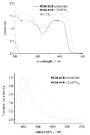
- cm−1). C=O vibrational band section of the infrared spectra of compound 1 (A), MCM-ACR (B) and MCM-ACR + Sc(OTf)3 (C). TEM images showing the mesoporous structure of MCM-ACR (left: frontal, right: lateral), inset in left image: Electron diffraction pattern. Sorption isotherm (left) and pore size


Twofold role of calcined hydrotalcites in the degradation of methyl parathion pesticide
Beilstein J. Nanotechnol. 2011, 2, 99–103, doi:10.3762/bjnano.2.11

- have correlated the degradation of an aqueous solution of MP at room temperature, with the basicity of the adsorbing materials. It was found that the metal composition of hydrotalcites determines both the surface electronic properties (basic or acidic) and the sorption capacity. Depending on the basic
- sorbed on a bentonite (cationic clay) [6][7][8]. Moreover, the bentonite sorption capacity may be increased if the clay is exchanged with cetyltrimethylammonium bromide (CTAB). Indeed, the hydrophobic character of the pesticide and the organoclay enhances the retention through two mechanisms; either MP
- effective (Figure 1b) and after 1170 minutes of the sorption process MP still remained in the waste solution as p-NP. The result using Ni–Al mixed oxide as sorbent was surprising, as it did not promote the degradation of MP (Figure 1c). Figure 2 shows the MP degradation performance to p-NP of Mg–Al, Zn–Al


Other Beilstein-Institut Open Science Activities



