

Search results
Search for "structural characterization" in Full Text gives 90 result(s) in Beilstein Journal of Nanotechnology.
Spectroscopic mapping and selective electronic tuning of molecular orbitals in phosphorescent organometallic complexes – a new strategy for OLED materials
Beilstein J. Nanotechnol. 2014, 5, 2248–2258, doi:10.3762/bjnano.5.234
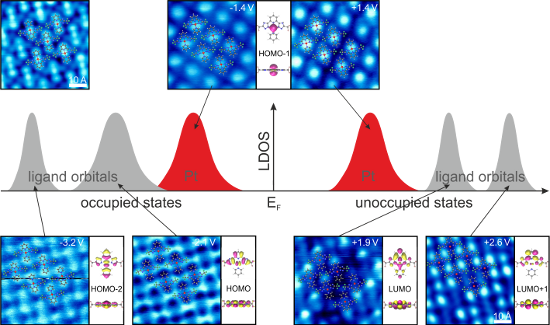
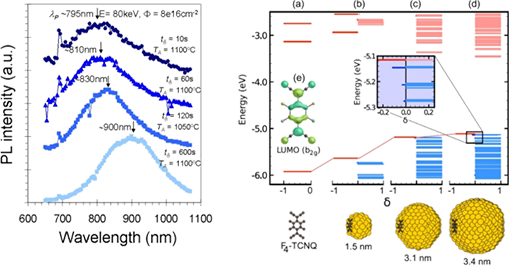
- to the vacuum level. For a comparison with the measured values from STS (which are given relative to EF), a constant corresponding to the work function of 5.1 eV has to be added to the calculated values (cf. details in the discussion). Structural analysis For the the structural characterization of as



Carbon nano-onions (multi-layer fullerenes): chemistry and applications
Beilstein J. Nanotechnol. 2014, 5, 1980–1998, doi:10.3762/bjnano.5.207
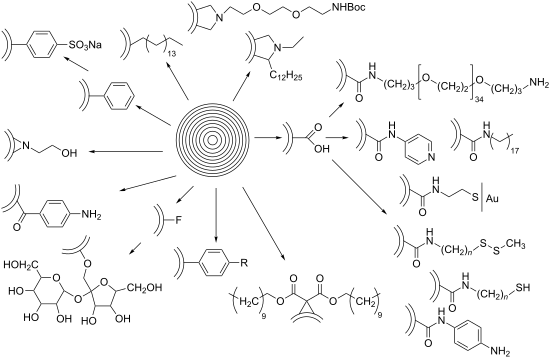
- -resolution transmission electron microscopy (HRTEM) has been widely employed to visualize CNOs and to study the mechanisms of CNO formation and their structural properties. Raman spectroscopy is another useful technique for the structural characterization of CNOs and corroborates the basic graphitic


Silicon and germanium nanocrystals: properties and characterization
Beilstein J. Nanotechnol. 2014, 5, 1787–1794, doi:10.3762/bjnano.5.189
- other useful techniques that can provide information regarding the structural properties of NCs. One of them is grazing incidence small X-ray scattering (GISAXS), which is a non-destructive technique for the structural characterization of NCs supported on a substrate [32] and NCs embedded in a matrix


Integration of ZnO and CuO nanowires into a thermoelectric module
Beilstein J. Nanotechnol. 2014, 5, 927–936, doi:10.3762/bjnano.5.106

- ). Samples were then placed in the furnace and oxidized at 400 °C for 12 h in 80% oxygen/20% argon atmosphere (300 sccm flow). Morphological and structural characterization The morphology of the nanowires has been investigated by Scanning Electron Microscopy (FE-SEM LEO 1525). Samples were attached to


Optical and structural characterization of oleic acid-stabilized CdTe nanocrystals for solution thin film processing
Beilstein J. Nanotechnol. 2014, 5, 881–886, doi:10.3762/bjnano.5.100

- 10.3762/bjnano.5.100 Abstract This work presents results of the optical and structural characterization of oleic acid-stabilized cadmium telluride nanocrystals (CdTe-NC) synthesized by an organometallic route. After being cleaned, the CdTe-NC were dispersed in toluene to obtain an ink-like dispersion
- transferred through flexible tubing by using N2 flux and the colloid temperature was reduced to 190 ± 2 °C. This value was maintained as reflux temperature. Sample preparation to optical and structural characterization: Initially, the CdTe-NC were processed by a size separation technique. On a colloidal


Shape-selected nanocrystals for in situ spectro-electrochemistry studies on structurally well defined surfaces under controlled electrolyte transport: A combined in situ ATR-FTIR/online DEMS investigation of CO electrooxidation on Pt
Beilstein J. Nanotechnol. 2014, 5, 735–746, doi:10.3762/bjnano.5.86
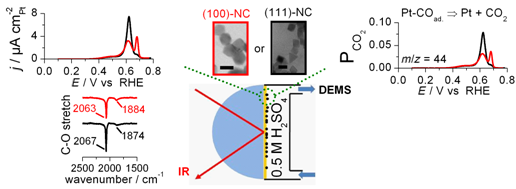
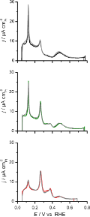
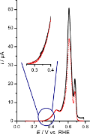
- structural characterization of 3 batches of differently shaped Pt nanoparticles by electron microscopy, and electrochemical techniques, including H-underpotential deposition as well Ge and Bi deposition (section ‘Characterization of the Pt samples’). Subsequently, we will characterize the CO adsorption




Evolution of microstructure and related optical properties of ZnO grown by atomic layer deposition
Beilstein J. Nanotechnol. 2013, 4, 690–698, doi:10.3762/bjnano.4.78
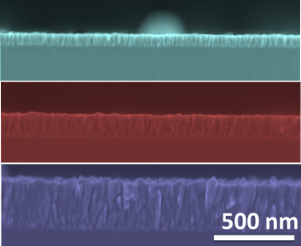
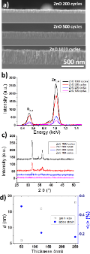
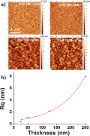
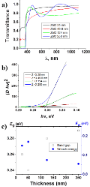
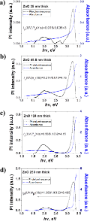
- effects decreasing bend of the surface band as a result of an increasing grain size. The structural characterization (GIXRD) shows an improvement of the crystalline structure with the thickness. The EDX results show a monotonous decrease of the O/Zn ratio with a growth of the film while remaining greater

Plasticity of nanocrystalline alloys with chemical order: on the strength and ductility of nanocrystalline Ni–Fe
Beilstein J. Nanotechnol. 2013, 4, 542–553, doi:10.3762/bjnano.4.63

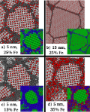
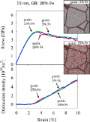
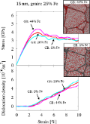
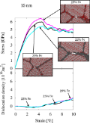
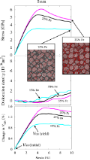
- constant engineering strain rate (108 1/s) in uniaxial direction on the simulation cell. The cell size was allowed to relax perpendicular to the strain axis. Results Structural characterization In a first step, the elemental distribution in the model structures relaxed by the hybrid MD/MC scheme were



Characterization of electroforming-free titanium dioxide memristors
Beilstein J. Nanotechnol. 2013, 4, 467–473, doi:10.3762/bjnano.4.55
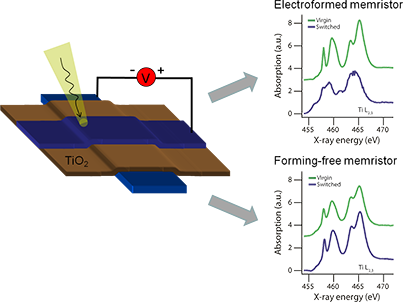
- performed using scanning transmission X-ray microscopy (STXM) at the Advanced Light Source in the Lawrence Berkeley National Laboratory. STXM allows spatially-resolved X-ray absorption spectroscopy (XAS) to be performed on a sample and is well-suited for chemical and structural characterization of the thin



Catalytic activity of nanostructured Au: Scale effects versus bimetallic/bifunctional effects in low-temperature CO oxidation on nanoporous Au
Beilstein J. Nanotechnol. 2013, 4, 111–128, doi:10.3762/bjnano.4.13



FTIR nanobiosensors for Escherichia coli detection
Beilstein J. Nanotechnol. 2012, 3, 485–492, doi:10.3762/bjnano.3.55
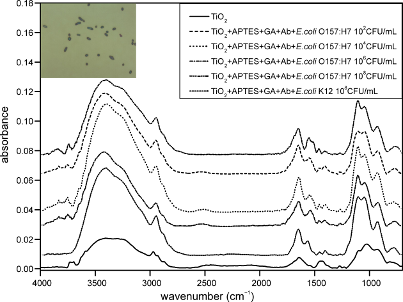
- , and carbohydrates, and their mid-infrared (MIR) spectra can be used for the identification and structural characterization of different pathogens and subspecies [27]. MIR spectra are additive and sensitive, and allow the fingerprinting and quantification of the pathogen of interest, transforming the


Forming nanoparticles of water-soluble ionic molecules and embedding them into polymer and glass substrates
Beilstein J. Nanotechnol. 2012, 3, 267–276, doi:10.3762/bjnano.3.30

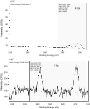
- morphology The first aim of this research was to prove that the nanoparticles produced and deposited onto the polymer and glass substrates have the same composition as the initial salts dissolved in water before the sonication. The structural characterization of the KI nanoparticles deposited on the silicon




Parallel- and serial-contact electrochemical metallization of monolayer nanopatterns: A versatile synthetic tool en route to bottom-up assembly of electric nanocircuits
Beilstein J. Nanotechnol. 2012, 3, 134–143, doi:10.3762/bjnano.3.14

- /monolayer contact electrodes. Work toward the realization of such circuits and their electrical–structural characterization is currently in progress. As far as basic electrochemical aspects are concerned, it is of interest to note that the present findings offer direct experimental support to the recent


Nanoscaled alloy formation from self-assembled elemental Co nanoparticles on top of Pt films
Beilstein J. Nanotechnol. 2011, 2, 473–485, doi:10.3762/bjnano.2.51

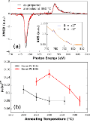
- lower than for CoPt in the L10 phase. The Co volume fraction in our specimens typically amounts to few parts per thousand or less. Therefore, a thorough structural characterization of the alloy formation with standard laboratory equipment is not practical. Instead, we probe the magnetic signatures of


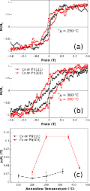
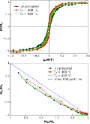
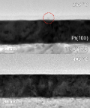


Magnetic coupling mechanisms in particle/thin film composite systems
Beilstein J. Nanotechnol. 2010, 1, 101–107, doi:10.3762/bjnano.1.12

- other hand is less well studied. The aim of our present investigation is to shed light on these various interactions. Results and Discussion Structural characterization Hexagonal close packing of self-assembled NPs as a result of the spin-coating process was confirmed by means of atomic force microscopy