


Search results
Search for "superconductor" in Full Text gives 81 result(s) in Beilstein Journal of Nanotechnology.
Magnetic reversal dynamics of a quantum system on a picosecond timescale
Beilstein J. Nanotechnol. 2015, 6, 1946–1956, doi:10.3762/bjnano.6.199
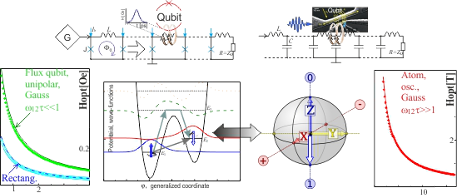
- magnetization reversal of superconducting flux qubits (see Figure 4c) is achievable for Josephson transmission lines that are designed and built using the latest advances in superconductor technology. Moreover, the unusual ability to create the so-called Δ-type artificial atom (forbidden by the selection rules




Physics, chemistry and biology of functional nanostructures II
Beilstein J. Nanotechnol. 2014, 5, 1218–1219, doi:10.3762/bjnano.5.134
- introduction of those in various materials allowed for solutions to problems which have been present for a long time. An example is the problematical increase of the critical current in new MgB2 superconducting material. This superconductor is very promising for technical applications due to its high critical
Charge and spin transport in mesoscopic superconductors
Beilstein J. Nanotechnol. 2014, 5, 180–185, doi:10.3762/bjnano.5.18

- and 1980s, mostly in the vicinity of the critical temperature. Much less attention has been paid to low temperatures and the role of the quasiparticle spin. Results: We report here on nonlocal transport in superconductor hybrid structures at very low temperatures. By comparing the nonlocal conductance
- models. Conclusion: The observed long-range chargeless spin transport opens a new path to manipulate and utilize the quasiparticle spin in superconductor nanostructures. Keywords: spintronics; superconductor–ferromagnet hybrids; Introduction The investigation of spin-polarized transport in hybrid
- superconductor. By fitting gnl at a given bias voltage for different contact distances to an exponential decay, we can obtain a bias-dependent charge relaxation length (see [12] for details). The corresponding results are shown in Figure 2b. Since we are interested here mostly in the behavior at finite magnetic


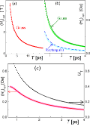
![[Graphic 6]](/bjnano/content/inline/2190-4286-5-18-i9.png?max-width=637&scale=1.18182) at a bias voltage of about 2Δ (a) and spin diffusion length λS (b) for di...
at a bias voltage of about 2Δ (a) and spin diffusion length λS (b) for di...

P-wave Cooper pair splitting
Beilstein J. Nanotechnol. 2012, 3, 493–500, doi:10.3762/bjnano.3.56

- spin-active interfaces in Cooper pair splitters so far have not been investigated. Results: We analyze the current and the cross correlation of currents in a superconductor–ferromagnet beam splitter, including spin-active scattering. Using the Hamiltonian formalism, we calculate the cumulant-generating
- function of charge transfer. As a first step, we discuss characteristics of the conductance for crossed Andreev reflection in superconductor–ferromagnet beam splitters with s-wave and p-wave superconductors and no spin-active scattering. In a second step, we consider spin-active scattering and show how to
- realize p-wave splitting using only an s-wave superconductor, through the process of spin-flipped crossed Andreev reflection. We present results for the conductance and cross correlations. Conclusion: Spin-activity of interfaces in Cooper pair splitters allows for new features in ordinary s-wave Cooper


![[Graphic 23]](/bjnano/content/inline/2190-4286-3-56-i36.png?max-width=637&scale=1.18182) according to Equation 13 is cal...
according to Equation 13 is cal...
Enhancement of the critical current density in FeO-coated MgB2 thin films at high magnetic fields
Beilstein J. Nanotechnol. 2011, 2, 809–813, doi:10.3762/bjnano.2.89

- material, with a hexagonal crystal structure and a critical temperature of Tc = 39 K, raised a lot of questions about its transport properties. This strong type-II superconductor has a fairly high critical current density in zero magnetic field, i.e., up to Jc ~ 1.6 × 10⁷ A/cm2 at 15 K [2]. This
- a dramatic loss of the current-carrying abilities of this superconductor due to the weakening of the flux-line pinning with increasing magnetic field. The problem to be solved is how to increase the pinning force and to overcome the dramatic dropdown of the critical current in a strong external


Scanning probe microscopy and related methods
Beilstein J. Nanotechnol. 2010, 1, 155–157, doi:10.3762/bjnano.1.18
- gives insight into fascinating phenomena, such as metal-superconductor transitions or metal-insulator transitions. Another important development is related to nanomechanics, where phenomena, such as friction, wear, elasticity and plasticity are studied on an atomic scale. Atomic friction has been

Other Beilstein-Institut Open Science Activities



