


Search results
Search for "amino groups" in Full Text gives 106 result(s) in Beilstein Journal of Nanotechnology.
Energy transfer in complexes of water-soluble quantum dots and chlorin e6 molecules in different environments
Beilstein J. Nanotechnol. 2013, 4, 895–902, doi:10.3762/bjnano.4.101

- -terminated polyethylene glycol (PEG-OH)thiol and amino-terminated polyethylene glycol (PEG-NH2)thiol with a ratio of 3 to 1. This enables to obtain stable colloidal solutions of quantum dots. Then the covalent binding of the QD surface amino groups with the Ce6 carboxyl functional groups using EDAC as a
- the membrane and those of the Ce6. We replaced the carboxyl groups on the pore walls by amino groups with EDAC similar as described in [12]. This made it possible to create membranes with positive charges on the pore walls and to embed Ce6 molecules into membranes. Estimations of the FRET efficiency


Selective surface modification of lithographic silicon oxide nanostructures by organofunctional silanes
Beilstein J. Nanotechnol. 2013, 4, 218–226, doi:10.3762/bjnano.4.22
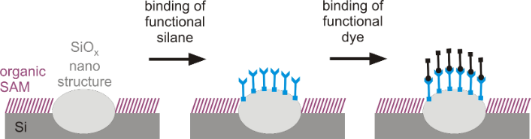
- this may be a hint that either the APTES monolayer is not closed on a nanoscopic scale or the molecules in the monolayer are not well-ordered. The latter would lead to a rather low density of surface amino groups [39] that are available for reaction with the functional group of FITC. However, the next
- -neighbor distance between two adjacent surface amino groups must be below the AFM tip diameter (≈30 nm) as no distinct height steps or islands could be observed in the AFM images. A resolution of the density of bound molecules may be possible by using novel techniques such as the measurement of AFM


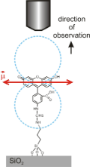
![[Graphic 2]](/bjnano/content/inline/2190-4286-4-22-i2.png?max-width=637&scale=1.18182) (red arrow) of FITC bound to a SiO2 surface.
(red arrow) of FITC bound to a SiO2 surface.
Directed deposition of silicon nanowires using neopentasilane as precursor and gold as catalyst
Beilstein J. Nanotechnol. 2012, 3, 535–545, doi:10.3762/bjnano.3.62

- nanoparticles with a size of 60 nm were synthesized by following standard protocols [42] and deposited from solution onto Si[111] substrates. For this, the native oxide layer of the silicon wafers was modified by a monolayer of 3-aminopropyl-terminated siloxane [43], the amino groups of which are able to


FTIR nanobiosensors for Escherichia coli detection
Beilstein J. Nanotechnol. 2012, 3, 485–492, doi:10.3762/bjnano.3.55
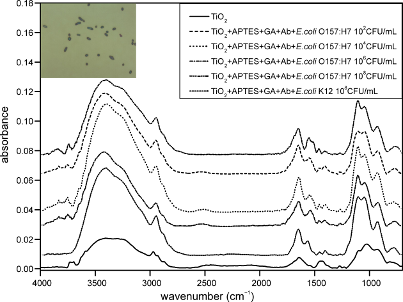
- our group [26]. Film functionalization The optimization of the functionalization with amino-groups was obtained by immersing the calcined films in a solution 0.2 M of APTES in toluene for 24 h at 25 °C. The amino grafted films were carefully washed with toluene over several washing cycles and finally
- antibodies due to the formation of an imine. Here, the terminal amino groups of APTES were changed to aldehydic groups that, in the following step, were covalently coupled with the amino groups of the antibody. The APTES–GA linking is shown in Figure 2b, in which the bands due to the formation of imines in


Influence of water on the properties of an Au/Mpy/Pd metal/molecule/metal junction
Beilstein J. Nanotechnol. 2011, 2, 384–393, doi:10.3762/bjnano.2.44

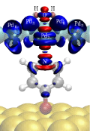
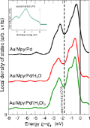
- molecules, periodic density functional theory (DFT) calculations of the bare Au/ATP/Pd junction, assuming a () structure of the ATP molecules, were able to reproduce the experimentally observed downshift of the Pd DOS reasonably well [2][12] under the assumption that the amino groups of the ATP molecules

![[Graphic 1]](/bjnano/content/inline/2190-4286-2-44-i1.png?max-width=637&scale=0.945456) )R3...
)R3...


![[Graphic 2]](/bjnano/content/inline/2190-4286-2-44-i2.png?max-width=637&scale=1.18182) = 1/3 ML. Plott...
= 1/3 ML. Plott...
Microfluidic anodization of aluminum films for the fabrication of nanoporous lipid bilayer support structures
Beilstein J. Nanotechnol. 2011, 2, 104–109, doi:10.3762/bjnano.2.12

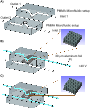
- . Vesicle rupture is probably aided via electrostatic interactions of the negative phosphate of the zwitterionic POPC-heads with the protonated amino groups from the APTES molecules immobilized on the surface [42]. In principle, one could also expect coverage of the inside pore walls, as has been observed


Other Beilstein-Institut Open Science Activities



