


Search results
Search for "chitosan" in Full Text gives 108 result(s) in Beilstein Journal of Nanotechnology.
Carbon nano-onions (multi-layer fullerenes): chemistry and applications
Beilstein J. Nanotechnol. 2014, 5, 1980–1998, doi:10.3762/bjnano.5.207
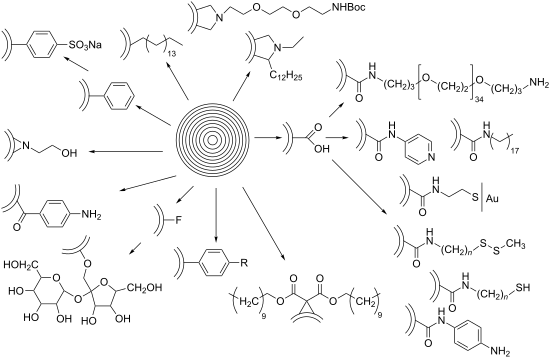
- composites have been reported (Scheme 9). In one study, composites consisting of CNOs and poly(diallyldimethylammonium chloride) (PDDA) or chitosan (Chit) were prepared and their electrochemical properties were studied [43]. In another study, CNO–PDDA composite films were used for the detection of dopamine


Ionic liquid-assisted formation of cellulose/calcium phosphate hybrid materials
Beilstein J. Nanotechnol. 2014, 5, 1553–1568, doi:10.3762/bjnano.5.167
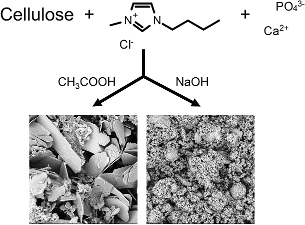
- transition is delayed with respect to OCP grown in the absence of the carbohydrate matrix. One of the issues of chitin, however, is again its limited solubility in most mineralization media. This limits the processing and mineralization efficiencies. Chitosan, which exhibits a higher water solubility than
- chitin, has therefore been used as an alternative scaffold for calcium phosphate mineralization [16][17]. Among others, chitosan/HAP scaffolds show good osteoconductivity and biodegradability, as has been shown for some synthetic composites in rats [18]. Chiono et al. developed a photochemical approach
- towards the triggered nucleation of calcium phosphate on chitosan cast films [19]. Mineralization is induced by photoexcitation of fluorescein molecules grafted to the chitosan films. The authors claim that the formation of local positive charges by electron transfer from the fluorophore to reactive


Controlling mechanical properties of bio-inspired hydrogels by modulating nano-scale, inter-polymeric junctions
Beilstein J. Nanotechnol. 2014, 5, 887–894, doi:10.3762/bjnano.5.101

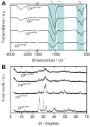
- general approach for creating novel catecholaminergic derivatives of biopolymers such as alginate, hyaluronic acid, chitosan, dextran, and other synthetic or proteineous materials for a variety of applications. Quinone, an oxidized form of catechol, is reactive to nucleophiles such as hydroxyl, amine, and



Antimicrobial nanospheres thin coatings prepared by advanced pulsed laser technique
Beilstein J. Nanotechnol. 2014, 5, 872–880, doi:10.3762/bjnano.5.99

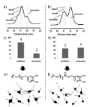
- -chitosan-magnetite-eugenol (PLA-CS-Fe3O4@EUG) nanospheres by matrix assisted pulsed laser evaporation (MAPLE). Transmission electron microscopy (TEM) and scanning electron microscopy (SEM) investigation proved that the homogenous Fe3O4@EUG nanoparticles have an average diameter of about 7 nm, while the PLA
- ) bacteria strains. Moreover, the obtained nano-coatings showed a good biocompatibility and facilitated the normal development of human endothelial cells. These nanosystems may be used as efficient alternatives in treating and preventing bacterial infections. Keywords: antimicrobial; chitosan; magnetite
- Polylactic acid (PLA), polyvinyl alcohol (PVA), chitosan (CS), eugenol (EUG), FeCl3, FeSO4·7H2O, NH4OH (25%), chloroform and n-hexane were purchased from Sigma-Aldrich. Preparation of magnetite nanostructures A well-known procedure described in our previous work was used to synthesize the magnetite




Injection of ligand-free gold and silver nanoparticles into murine embryos does not impact pre-implantation development
Beilstein J. Nanotechnol. 2014, 5, 677–688, doi:10.3762/bjnano.5.80
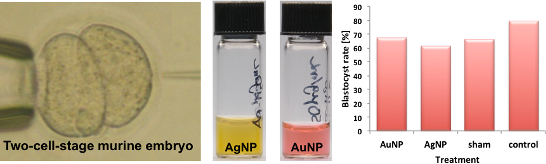
- culture model, noting increased apoptosis, decreased cell numbers and decreased implantation rates [37]. So far, AuNP have only been investigated once in a murine in vitro embryo culture model for their influence on blastocyst development [38]. In this study on chitosan nanoparticles morulae were co




The softening of human bladder cancer cells happens at an early stage of the malignancy process
Beilstein J. Nanotechnol. 2014, 5, 447–457, doi:10.3762/bjnano.5.52

- influence of certain such compounds as chitosan [14] or cisplatin [20] on the mechanics of single cells, while pointing out that studies on the correlation between the mechanical properties and the structure of the actin cytoskeleton are particularly important for developing and monitoring cancer therapies


One pot synthesis of silver nanoparticles using a cyclodextrin containing polymer as reductant and stabilizer
Beilstein J. Nanotechnol. 2014, 5, 380–385, doi:10.3762/bjnano.5.44
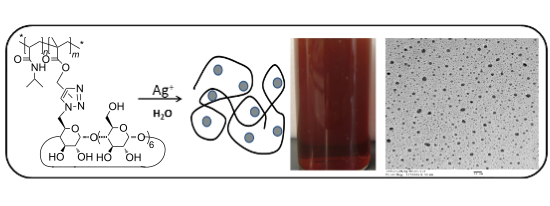
- described which act simultaneously as reducing and stabilization agent in aqueous medium. Typical examples are polyacrylamide, poly(sodium acrylate), polyethylene glycol, chitosan or soluble starch [11][17][18][19]. However, up to now polymers bearing CD attached have not been used for the preparation of


Growth behaviour and mechanical properties of PLL/HA multilayer films studied by AFM
Beilstein J. Nanotechnol. 2012, 3, 778–788, doi:10.3762/bjnano.3.87

- ]. Engler et al. reported a similar spreading behaviour for smooth-muscle cells [3]. An enhanced cell growth was observed also for cross-linked chitosan/hyaluronan multilayer films, as compared to the native ones [8]. These reports suggest that polyelectrolyte multilayer films are ideal matrices for bio


Other Beilstein-Institut Open Science Activities



