Search results
Search for "crystallites" in Full Text gives 202 result(s) in Beilstein Journal of Nanotechnology. Showing first 200.
Formation of ferromagnetic molecular thin films from blends by annealing
Beilstein J. Nanotechnol. 2017, 8, 1469–1475, doi:10.3762/bjnano.8.146

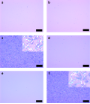
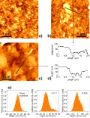
- for one hour (Figure 2b) does not affect the surface morphology. However, increasing the temperature to 330 °C and covering the films (Figure 2c) leads to the formation of larger crystallites. Similar results are obtained for the mixed films (Figure 2d–f), although annealing at a temperature of 270 °C
- already allows the molecules to rearrange into large elongated crystallites. This was observed previously for iron phthalocyanine (FePc) thin films deposited at different substrate temperatures [16]. However, in that case the length of the major axis was found to be 200 nm at a temperature of 260 °C. The
- crystallites in our MnPc films reach a size of up to 10 µm for their longer axis, which is attractive for high coercivity in magnetism and improved charge transport along the crystallites. Results from optical microscopy can be refined by X-ray diffraction (XRD). Figure 3a shows the XRD patterns of the as



Development of polycationic amphiphilic cyclodextrin nanoparticles for anticancer drug delivery
Beilstein J. Nanotechnol. 2017, 8, 1457–1468, doi:10.3762/bjnano.8.145

- face whilst the polycationic PC βCDC6 has 7 cationic groups on the primary face and 14 lipophilic groups on the secondary face. Both nanoparticles were prepared by a nanoprecipitation technique which is based on spherical crystallites of the polymer while precipitation occurs at the interface. In


Comprehensive Raman study of epitaxial silicene-related phases on Ag(111)
Beilstein J. Nanotechnol. 2017, 8, 1357–1365, doi:10.3762/bjnano.8.137

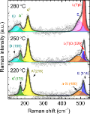
- band at 520 cm−1 with a FWHM of 8 cm−1. This mode is similar to the L(T)O phonon mode of diamond-like silicon, clearly indicating the formation of Si crystallites. Additionally, the second-order TO phonon mode around 900 cm−1 (Figure 2, top spectrum) supports the bulk-like nature of the structures
- formed. The fact that the intensity of the L(T)O phonon mode gets higher for deposition at 350 °C demonstrates that the sizes of the crystallites enlarge with increasing deposition temperatures. However, this temperature is still low compared to the growth temperature of crystalline Si, which usually
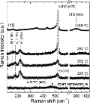
- the “mixed phase”. The spectrum of the sample prepared at 250 °C exhibits the same Raman bands as those of epitaxial silicene (Figure 4, bottom) plus two additional Raman modes at 155 and 520 cm−1. The latter is consistent with the position of the L(T)O phonon mode of Si crystallites clearly



Characterization of ferrite nanoparticles for preparation of biocomposites
Beilstein J. Nanotechnol. 2017, 8, 1257–1265, doi:10.3762/bjnano.8.127

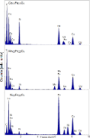
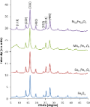
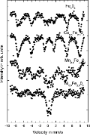
- , the XRD data indicates the preservation of the structure of magnetite regardless of substitution of other ions (Co, Ni, and Mn) in the crystallographic positions of Fe, and no preference in occupation is seen. The average grain size of the crystallites was calculated from the X-ray spectra using



Preparation of thick silica coatings on carbon fibers with fine-structured silica nanotubes induced by a self-assembly process
Beilstein J. Nanotechnol. 2017, 8, 1145–1155, doi:10.3762/bjnano.8.116
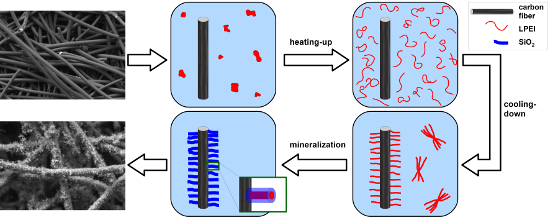
- self-assembles onto the carbon fiber substrate in the form of nanoscopic crystallites, which serve as a template for the subsequent silica deposition. The silicification at close to neutral pH is spatially restricted to the localized polyamine and consequently to the fiber surface. In case of the


Hierarchically structured nanoporous carbon tubes for high pressure carbon dioxide adsorption
Beilstein J. Nanotechnol. 2017, 8, 1135–1144, doi:10.3762/bjnano.8.115
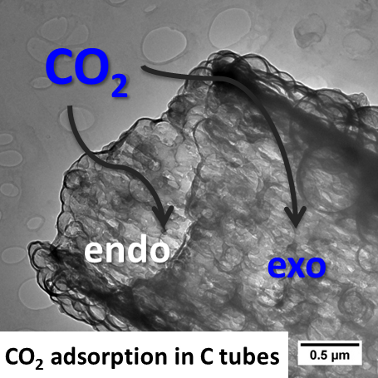
- (DFT, slit pore model) for carbon tubes (4) which are carbonized at 950 °C (black/triangles), 1300 °C (red/diamonds) and 1600 °C (blue/circles). TEM images of a SiC tube wall with interconnected, crystalline SiC particles (a) and the corresponding SAED pattern (b). Individual SiC crystallites are shown


Growth, structure and stability of sputter-deposited MoS2 thin films
Beilstein J. Nanotechnol. 2017, 8, 1115–1126, doi:10.3762/bjnano.8.113
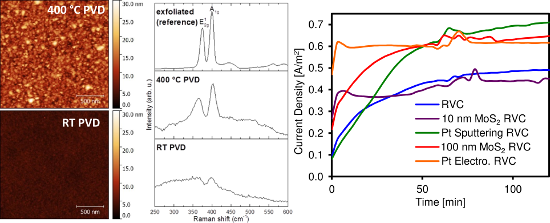
- consistent with reference MoS2. The specular diffraction peak (d = 7.27 Å) was investigated by θ/2θ scans at different ψ angles, yielding a mosaicity of the crystallites of 8°. The formation of amorphous MoS2 by sputter deposition onto substrates at RT compared to formation of nanocrystalline MoS2 with a


Study of the correlation between sensing performance and surface morphology of inkjet-printed aqueous graphene-based chemiresistors for NO2 detection
Beilstein J. Nanotechnol. 2017, 8, 1023–1031, doi:10.3762/bjnano.8.103

- suspension has been centrifuged for 45 min at 1000 rpm in order to remove unexfoliated graphite crystallites. The final ink has been obtained by taking 20 mL of this as-prepared graphene suspension, drying it in vacuum at 40 °C overnight, then adding 10 mL of fresh solvent mixture and briefly sonicating for


Vapor-phase-synthesized fluoroacrylate polymer thin films: thermal stability and structural properties
Beilstein J. Nanotechnol. 2017, 8, 933–942, doi:10.3762/bjnano.8.95

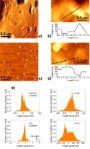
- thermal expansion coefficient of the systems studied. A comparison with the thermal expansion of the crystallites shows that the thermal expansion of the lamella (αcryst = 2.18 ± 0.05 × 10⁻⁴ K−1) accounts only for about half of the total film thickness increase (αfilm = 4.5 ± 0.5 × 10⁻⁴ K−1). This




Analysis and modification of defective surface aggregates on PCDTBT:PCBM solar cell blends using combined Kelvin probe, conductive and bimodal atomic force microscopy
Beilstein J. Nanotechnol. 2017, 8, 579–589, doi:10.3762/bjnano.8.62
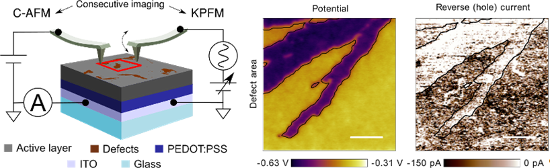
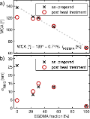
- authors of this previous study reported that PCBM crystallites are formed and grow in size according to the processing time of solvent vapor annealing (slow drying of a film) [23]. Since the degradation and/or the evaporation of remaining solvent from bare active layers will be different from those of


Functionalized TiO2 nanoparticles by single-step hydrothermal synthesis: the role of the silane coupling agents
Beilstein J. Nanotechnol. 2017, 8, 304–312, doi:10.3762/bjnano.8.33
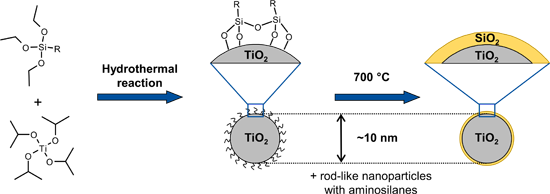
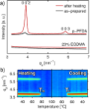
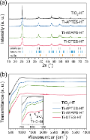
- [38]. Heat treatment XRD patterns of heat-treated TiO2 and the in situ surface-functionalized TiO2 nanoparticles are shown Figure 7a, and these patterns were also refined (Figure S2 of Supporting Information File 1). While the pure TiO2 sample exhibits crystallites growth (from 5.7 to 28.8 nm), the
- functionalized nanoparticles with silane coupling agents showed only negligible growth of the crystallites after the heat treatment. Calculated crystallite sizes of the heat-treated samples are listed in Table 2. Additionally, in TiO2-HT, the heat treatment induced a partial phase transition from brookite and



Template-controlled piezoactivity of ZnO thin films grown via a bioinspired approach
Beilstein J. Nanotechnol. 2017, 8, 296–303, doi:10.3762/bjnano.8.32

- the coupling of the materials response in the z-direction to an electric field applied in the same direction [7]. For piezoactive, polycrystalline ZnO thin films it is therefore essential that most of the crystallites are oriented in the same way. This means a (002) texture is formed resulting in a
- composite nacre with its remarkable mechanical stability [37]. The growth of the inorganic, polycrystalline aragonite platelets is directed by biopolymers. This organic template leads to oriented attachment of the CaCO3 crystallites so that a preferred orientation along the c-axis arises [38]. According to
- crystallites with the sulfonate groups leads to oriented attachment which is also maintained for higher film thicknesses. The lower charge of the COOH on the other hand is not high enough to prevent the attachment of differently oriented crystallites. The degree of crystallite orientation influences the


Performance of natural-dye-sensitized solar cells by ZnO nanorod and nanowall enhanced photoelectrodes
Beilstein J. Nanotechnol. 2017, 8, 287–295, doi:10.3762/bjnano.8.31

- physical properties of the photoanode. Experimental Both ZnO NRs and NWs were grown on FTO substrates (1.5 × 1.5 cm2) by CBD [8][22]. Before the ZnO NR preparation, a seed layer of ZnO crystallites was deposited by spin coating (1000 rpm, 60 s) using a solution of 5 mM zinc acetate dihydrate in ethanol


Photocatalysis applications of some hybrid polymeric composites incorporating TiO2 nanoparticles and their combinations with SiO2/Fe2O3
Beilstein J. Nanotechnol. 2017, 8, 272–286, doi:10.3762/bjnano.8.30
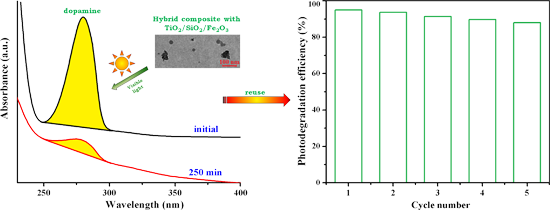
- crystallites in the case of TiO2/SiO2 NPs due to a limitation effect exerted by the presence of the SiO2 phase in the growth of TiO2 grains [48]. However, the crystalline structure of TiO2 nanoparticles was not significantly modified by the SiO2 domains. The estimated size of the anatase crystallites according



Performance of colloidal CdS sensitized solar cells with ZnO nanorods/nanoparticles
Beilstein J. Nanotechnol. 2017, 8, 210–221, doi:10.3762/bjnano.8.23

- crystallites was calculated to be ≈5.2 nm using the Scherrer equation. The bright field image of the synthesized powder indicated the finer and porous nature of the synthesized CdS nanoparticles (Figure 1b). The high resolution TEM (HRTEM) image shows the (111) and (311) crystalline planes with d values of


Nanocrystalline TiO2/SnO2 heterostructures for gas sensing
Beilstein J. Nanotechnol. 2017, 8, 108–122, doi:10.3762/bjnano.8.12
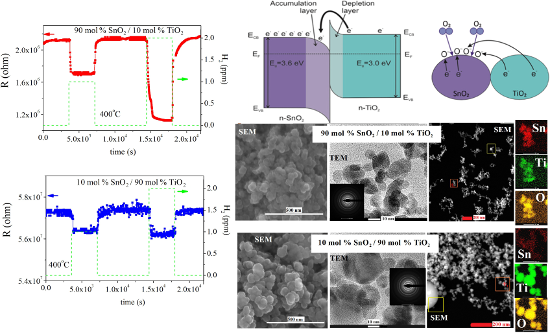
- phase begins to predominate (71.1 wt %) with lattice constants slightly higher than those of 100% TiO2 indicating partially decomposed solid solution (case C). Furthermore, the evidence of precipitation of 18.4 wt % SnO2 cassiterite with very small crystallites of about 3 nm favors the hypothesis of a
- probably composed of smaller crystallites while separate SnO2 grains were not identified by SAED for 10 mol % SnO2/90 mol % TiO2. Element mapping suggests that a small amount of Sn (Figure 4d) is finely dispersed within the TiO2 matrix. In the 90 mol % SnO2/10 mol % TiO2 heterostructures Ti is well




Nanostructured SnO2–ZnO composite gas sensors for selective detection of carbon monoxide
Beilstein J. Nanotechnol. 2016, 7, 2045–2056, doi:10.3762/bjnano.7.195
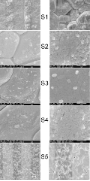
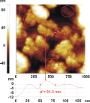
- measurements, leading to the assumption that the samples exist in amorphous phase. However, the presence of random nanoscale crystallites embedded in an amorphous matrix cannot be ruled out. AFM measurements were performed at a much higher resolution scale than SEM in order to reveal the morphology (fine grain
- typical grain dimension is around 31 nm. Similar values were obtained for all the composite sensors in the prepared series. From the same AFM image, the morphology of the alumina transducer, consisting of large crystallites, could be also observed. Gas sensing measurements on the ZnO–SnO2 composite
- materials, using XRD). The identification of these phases was not possible in the present case as the thin films were amorphous, but as mentioned before, the presence of the crystallites in an amorphous matrix was not ruled out. Sensor response to humidity In real life applications, environmental humidity




Organoclay hybrid materials as precursors of porous ZnO/silica-clay heterostructures for photocatalytic applications
Beilstein J. Nanotechnol. 2016, 7, 1971–1982, doi:10.3762/bjnano.7.188

- diffractometer using monochromatic Cu Kα radiation, scanning from 2 to 70° in 2θ degrees with steps of 0.02 degrees. The average size of the crystallites was calculated by using the Debye–Scherrer formula [33]. Fourier transform infrared spectroscopy (FTIR) was performed in a Bruker IFS 260 66v/S





Effect of nanostructured carbon coatings on the electrochemical performance of Li1.4Ni0.5Mn0.5O2+x-based cathode materials
Beilstein J. Nanotechnol. 2016, 7, 1960–1970, doi:10.3762/bjnano.7.187

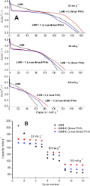
- in the samples can be associated with the observed features of the pyrolysis of precursors. Melting of linear PVA causes a wetting of LNM grains with the polymer melt followed by a relatively uniform pyrolysis of the thin polymer films on the surface of oxide crystallites. In the case of cross-linked
- PVA, the polymer pyrolysis tentatively occurs without preliminary melting. The pyrolysis of PVA particles allocated in the voids between LNM crystallites results in forming mesoporous particulates of amorphous carbon in the interparticular space. Another difference between the pyrolysis products of
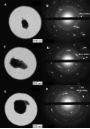
- Li1.4Ni0.5Mn0.5O2+x crystallites and, hence, to a substantial decrease in its electrochemical capacity values. The electrode–electrolyte interface in composite electrode materials is reduced by the thin carbon nanocoating that protects a part of Li1.4Ni0.5Mn0.5O2+x surface from electrochemical degradation. SAED



Morphology of SiO2 films as a key factor in alignment of liquid crystals with negative dielectric anisotropy
Beilstein J. Nanotechnol. 2016, 7, 1743–1748, doi:10.3762/bjnano.7.167

- of particle incidence. Moreover, two-fold alignment domains can appear with two easy axes symmetrical with respect to that plane [4][8]. Amosova et al. [5] explained switching in LC alignment in terms of the length of the crystallites forming relief of the aligning surface and surface wetting by


Properties of Ni and Ni–Fe nanowires electrochemically deposited into a porous alumina template
Beilstein J. Nanotechnol. 2016, 7, 1709–1717, doi:10.3762/bjnano.7.163

- mutual orientation of crystallites along the main direction of growth (the Z-axis oriented vertically along a pore). The existence of other weak peaks shows the presence of small amount of crystallites with other directions of growth and confirms the polycrystalline structure of Ni NWs. Previously it has
- specific feature of Ni NWs electrodeposited into an alumina template under certain deposition conditions (overpotential and temperature). Perhaps, the difference in the primary direction of crystallites between a continuous film and NWs is the different behavior of nanocrystallites of the same material
- reported that under identical conditions of electrochemical deposition the primary orientation of crystallites (texture) for alloy films (Ni–Fe coating) and single-component films (Ni) will be different as a result of significant grain refinement and increasing Fe content in the range from 1 to 25% [41


Influence of hydrothermal synthesis parameters on the properties of hydroxyapatite nanoparticles
Beilstein J. Nanotechnol. 2016, 7, 1586–1601, doi:10.3762/bjnano.7.153
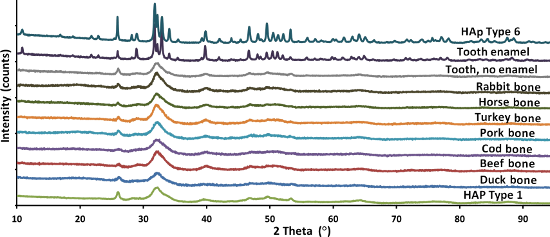
- -fast PIXcel1D detector [37]. The analysis was performed at room temperature in the range 2θ = 10–100° with a step of 0.03°. The average diameter of nano-HAp crystallites (dhkl) was calculated on the basis of the Scherrer’s equation [38]. Density measurements. The density of two nano-HAp types were
- , a full particle size distribution curve and an estimation of “thickness” of this curve (error bars) are obtained. For calculating the crystallite diameter and size distribution, the Nanopowder XRD Processor Demo web application employs equations derived for spherical crystallites. The website http
- growth of the crystallites (nanoparticles) from Type 1 to Type 6 was observed. The presence of other crystalline phases or any amorphous components was not observed. In addition, the XRD method was used to test a beef bone, a rabbit bone, a horse bone, a turkey bone, a pork bone and a duck bone (Figure 3


Mesoporous hollow carbon spheres for lithium–sulfur batteries: distribution of sulfur and electrochemical performance
Beilstein J. Nanotechnol. 2016, 7, 1229–1240, doi:10.3762/bjnano.7.114

- visible, while diffraction peaks of crystalline sulfur can be observed when the sulfur content is approximately 70 wt %. There are two possible explanations for the existence of crystalline sulfur in the composites. The first is that sulfur fills the cavities of the HCS leading to larger crystallites than
- in the mesopores of the shell. The second explanation is that sulfur accumulates on the outside of the hollow spheres, thus showing bulk-like behavior. Given that no broadening of the sulfur reflections due to nano-sized crystallites can be observed, we conclude that the crystalline sulfur is only


Efficient electron-induced removal of oxalate ions and formation of copper nanoparticles from copper(II) oxalate precursor layers
Beilstein J. Nanotechnol. 2016, 7, 852–861, doi:10.3762/bjnano.7.77
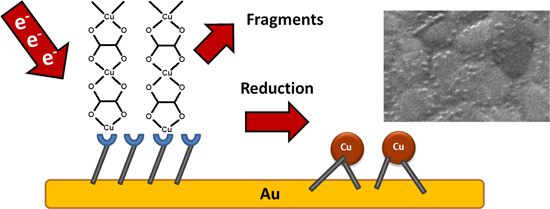
- preparation by drying solutions at a surface usually does not yield a layer with homogeneous thickness but rather aggregates of small crystallites [12][13]. In contrast, when polymer matrices deposited by spin-coating and containing ionic Au were irradiated [14][15], the NP size could be tuned by controlling
- MUA SAM (Figure 4a). The grain boundaries between the gold crystallites are clearly visible and the facets are smooth and free of apparent defects. An image of a sample covered with copper(II) oxalate after 16 deposition cycles (Figure 4b) reveals that the material grows as needle-like structures
- /cm2 at 500 eV, the initial copper(II) oxalate crystallites are still seen (Figure 4c). This is in accordance with the presence of residual oxalate bands in a RAIR spectrum of the same sample recorded prior to the HIM measurement (Figure 2). However, small particles have started to emerge from the


Microscopic characterization of Fe nanoparticles formed on SrTiO3(001) and SrTiO3(110) surfaces
Beilstein J. Nanotechnol. 2016, 7, 817–824, doi:10.3762/bjnano.7.73

- range of 2–3 nm. Nanoparticles on STO (001) substrates showed almost the same size range and density. In both diffraction patterns of a STO(001) substrate (Figure 1b) and of a STO(110) substrate (Figure 1c), faint Debye ring patterns that imply the formation of randomly oriented crystallites are