Search results
Search for "fluorescence microscopy" in Full Text gives 111 result(s) in Beilstein Journal of Nanotechnology.
The softening of human bladder cancer cells happens at an early stage of the malignancy process
Beilstein J. Nanotechnol. 2014, 5, 447–457, doi:10.3762/bjnano.5.52

- show that in human bladder cancer cells, both the expression level of actin (in particular, β-actin) and its 3D-organization in the probing volume govern the elastic properties. The organization of actin filaments present on the surface of a cell as probed by AFM and fluorescence microscopy is not
- types of malignant cells, HTB-9 (grade II, carcinoma) and HT-1376 (grade III, carcinoma) do not show the presence of stress fibers. These results are consistent with fluorescence microscopy images of actin filaments stained by using phalloidin that was labeled with Alexa Fluor 488 dye (Figure 2, panels
- ) showed various organizations of the actin cytoskeleton as observed by fluorescence microscopy. In non-malignant HCV29 cells, both short actin filaments and stress fibers are visible. Similarly, both structures are present in cancerous T24 cells (transitional cell carcinoma). The two other cancerous cells


Extracellular biosynthesis of gadolinium oxide (Gd2O3) nanoparticles, their biodistribution and bioconjugation with the chemically modified anticancer drug taxol
Beilstein J. Nanotechnol. 2014, 5, 249–257, doi:10.3762/bjnano.5.27

- ) and X-ray photoemission spectroscopy (XPS). The Gd2O3–taxol bioconjugate was confirmed by UV–vis spectroscopy and fluorescence microscopy and was purified by using high performance liquid chromatography (HPLC). Keywords: bioconjugation; biodistribution; gadolinium oxide; humicola sp; transmission
- -1601 PC) operated at a resolution of 1 nm. Fluorescence microscopy Fluorescence measurements of Gd2O3–taxol bioconjugate were carried out by using a Perkin Elmer LS-50B spectrofluorimeter with a slit width of 7 nm for both monochromators and a scan speed of 100 nm/min. Purification of Gd2O3–taxol


Apertureless scanning near-field optical microscopy of sparsely labeled tobacco mosaic viruses and the intermediate filament desmin
Beilstein J. Nanotechnol. 2013, 4, 510–516, doi:10.3762/bjnano.4.60

- versatile and extensively used in applications ranging from nanotechnology to life sciences. In fluorescence microscopy luminescent dyes serve as position markers. Moreover, they can be used as active reporters of their local vicinity. The dipolar coupling of the tip with the incident light and the
- ; fluorescence microscopy; Introduction Scanning near-field optical microscopy (SNOM) provides sub-wavelength optical resolution [1]. The sample is excited by the strongly confined near-field at the tip apex, which is induced by the dipolar coupling between the incident light and the probe. Moreover, coupling


Porous polymer coatings as substrates for the formation of high-fidelity micropatterns by quill-like pens
Beilstein J. Nanotechnol. 2013, 4, 377–384, doi:10.3762/bjnano.4.44
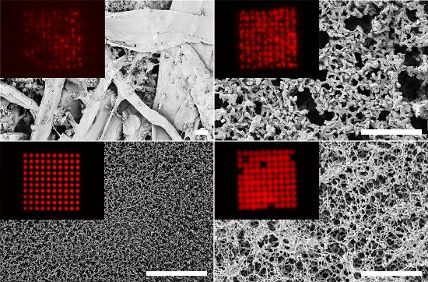
- . Comparison of printed phloxine B solution on different substrates. Fluorescence microscopy images of the printed solution on (a) paper, (b) nylon, (c) porous HEMA polymer film, and (d) nitrocellulose. Corresponding in situ bright-field images with delivery microchannel cantilever still in place for (e) paper
- containing BSA (green), respectively (inset shows a fluorescence microscopy image of one of the pristine bromophenol blue patterns, scale bar equals 100 µm). Supporting Information Supporting Information File 4: Figures S1 and S2. Acknowledgements This work was carried out with the support of the Karlsruhe


Near-field effects and energy transfer in hybrid metal-oxide nanostructures
Beilstein J. Nanotechnol. 2013, 4, 306–317, doi:10.3762/bjnano.4.34

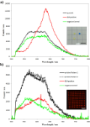
- applications such as the generation of hydrogen by photocatalytic splitting of water molecules. We use high-resolution techniques such as confocal fluorescence microscopy for the investigation of energy-transfer processes. The experiments are supported by simulations of the electromagnetic field enhancement in








Selective surface modification of lithographic silicon oxide nanostructures by organofunctional silanes
Beilstein J. Nanotechnol. 2013, 4, 218–226, doi:10.3762/bjnano.4.22
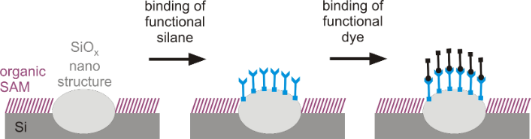
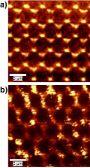
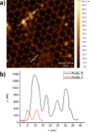
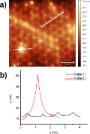
- successful binding is confirmed by AFM topography measurements and spectrally resolved fluorescence microscopy. Prior to the two-step functionalization with APTES and FITC, the quality of the silane layer formation is tested and proven by the binding of long-chained silanes, which are known to form densely
- of such systems may also be influenced by many other factors, such as tip–sample interactions and the formation of water layers, that strongly depend on the chemical nature of the surface. FITC functionalized nanostructures have been investigated using fluorescence microscopy, which further confirms


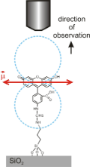
![[Graphic 2]](/bjnano/content/inline/2190-4286-4-22-i2.png?max-width=637&scale=1.18182) (red arrow) of FITC bound to a SiO2 surface.
(red arrow) of FITC bound to a SiO2 surface.
Diamond nanophotonics
Beilstein J. Nanotechnol. 2012, 3, 895–908, doi:10.3762/bjnano.3.100

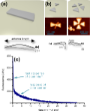
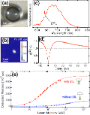
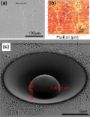
- . Subsequently, diamond nanocrystals are spin coated onto the substrate. By using a dual atomic force microscope (AFM) and confocal microscopy setup, diamond nanocrystals that contain single color centers are then identified by fluorescence microscopy and second-order photon autocorrelation, and their position





The oriented and patterned growth of fluorescent metal–organic frameworks onto functionalized surfaces
Beilstein J. Nanotechnol. 2012, 3, 570–578, doi:10.3762/bjnano.3.66

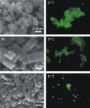
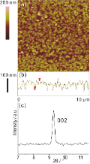
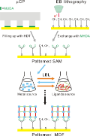
- ethanolic solution. Due to the chemical properties of –COOH and –CH3, we could expect that the growth of [Zn2(adc)2(dabco)] would be restricted to the –COOH functionalized areas. As the fluorescence-microscopy image given in Figure 7a demonstrates, the growth of [Zn2(adc)2(dabco)] on such a patterned
- (adc)2(dabco)] nucleation. The close-up image shows the well-defined rectangles (1 × 0.3 µm2) where EB irradiation was performed. Again, the fluorescence microscopy image (Figure 8c) supports the notion that the darker areas in Figure 8a are in fact arrays of rectangles formed by the [Zn2(adc)2(dabco





Distance dependence of near-field fluorescence enhancement and quenching of single quantum dots
Beilstein J. Nanotechnol. 2011, 2, 645–652, doi:10.3762/bjnano.2.68

- Volker Walhorn Jan Paskarbeit Heinrich Gotthard Frey Alexander Harder Dario Anselmetti Experimental Biophysics and Applied Nanosciences, Bielefeld University, Department of Physics, Universitätsstr. 25, 33615 Bielefeld, Germany 10.3762/bjnano.2.68 Abstract In fluorescence microscopy and
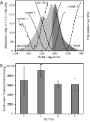
- effects. In the presented work we used a combined total internal reflection fluorescence microscopy (TIRFM)–AFM setup to elucidate this issue. We measured the fluorescence emission emanating from single quantum dots as a function of distance from the apex of a gold-coated cantilever tip. As well as
- Fluorescence microscopy and spectroscopy are important and versatile tools in life sciences. Fluorophores are not merely position markers, but can be regarded as active transducers that interact with species in their local vicinity and provide information about their micro-environment. The spectroscopic


Towards multiple readout application of plasmonic arrays
Beilstein J. Nanotechnol. 2011, 2, 501–508, doi:10.3762/bjnano.2.54

- spectrum of the fluorescence reporter molecules prevents the parallel detection of several fluorescent dye labels by fluorescence microscopy. Raman spectroscopy, i.e., the excitation of vibrational modes through inelastic light scattering, allows one to obtain highly specific molecular fingerprint
- on a quartz wafer biochip platform for DNA detection by fluorescence and SERS readout. By doing so, fluorescence microscopy allows for a fast detection of any positive or negative binding event within several seconds. Moreover SERS provides detailed molecular fingerprint information of fluorescence


Characterization of protein adsorption onto FePt nanoparticles using dual-focus fluorescence correlation spectroscopy
Beilstein J. Nanotechnol. 2011, 2, 374–383, doi:10.3762/bjnano.2.43

- understand the structural and dynamic properties of the protein corona at the molecular level. Recently, we have used quantitative fluorescence microscopy, especially fluorescence correlation spectroscopy (FCS), to study protein adsorption of human serum albumin (HSA) on polymer-coated FePt NPs with an