


Search results
Search for "surface potential" in Full Text gives 105 result(s) in Beilstein Journal of Nanotechnology.
Distinguishing magnetic and electrostatic interactions by a Kelvin probe force microscopy–magnetic force microscopy combination
Beilstein J. Nanotechnol. 2011, 2, 552–560, doi:10.3762/bjnano.2.59
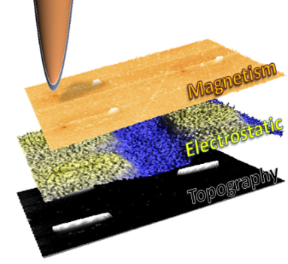
- ., they exhibit large surface potential differences causing heterogeneous electrostatic interaction between the tip and the sample that could be interpreted as a magnetic interaction. To distinguish clearly the origin of the tip–sample forces we propose to use a combination of Kelvin probe force
- the topography of organic and inorganic materials and to study chemical (composition), mechanical (including friction and stiffness, etc.), electrical (surface potential, work function), magnetic (domain structure) or biological (specific recognition) properties. A priori, the unknown contribution of
- based materials [10][11]. In general, these materials present low magnetic moment at room temperature. In addition, since the substrate and the nanomagnets present quite different electronic behavior, the sample can exhibit large surface potential differences, which cause heterogeneous electrostatic


Characterization of protein adsorption onto FePt nanoparticles using dual-focus fluorescence correlation spectroscopy
Beilstein J. Nanotechnol. 2011, 2, 374–383, doi:10.3762/bjnano.2.43

- . For apoA-I, there is only a weak area of positive surface potential (Figure 3b), consistent with the low affinity toward the NPs. For HSA binding to FePt NPs, we have previously reported a Hill coefficient n < 1 [11], which is indicative of anti-cooperative binding, meaning that the binding affinity


The role of the cantilever in Kelvin probe force microscopy measurements
Beilstein J. Nanotechnol. 2011, 2, 252–260, doi:10.3762/bjnano.2.29

- inhomogeneous sample surface potential. Both the probe and the sample were divided into boundary elements in order to calculate their surface charge density. Unlike our previous work [7], where the probe was divided into conical and spherical elements, here we used commercial software (MSC/Patran®) in order to
- the probe boundary elements divided by 2εo, and (d) the vector , which is a discrete representation of the surface potential, corresponding to a probe centered at r = (x,y,z). Matrices G, D, B and vector were previously defined in [7] and are explained again in the Appendix section. The probe–sample
- system was solved by dividing the mutual interactions into homogeneous and inhomogeneous parts. The homogeneous part represents a system with a probe above an infinite earthed plane, while the inhomogeneous part accounts for the contribution of the sample surface potential to the electrostatic force


Single-pass Kelvin force microscopy and dC/dZ measurements in the intermittent contact: applications to polymer materials
Beilstein J. Nanotechnol. 2011, 2, 15–27, doi:10.3762/bjnano.2.2
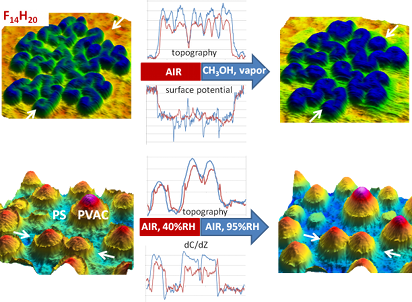
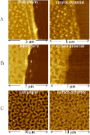
- interactions can be performed in the intermittent contact regime in different environments. Such combination provides sensitive detection of the surface potential and capacitance gradient with nanometer-scale spatial resolution as it was verified on self-assemblies of fluoroalkanes and a metal alloy. The KFM
- selective swelling of components. Keywords: atomic force microscopy; fluoroalkanes; Kelvin force microscopy; surface potential; Introduction Atomic force microscopy (AFM) applications include high-resolution imaging, probing of local materials properties and compositional mapping of heterogeneous
- enable measurements of electrical properties (surface potential, dielectric permittivity, capacitance, etc.) at a tip–sample junction. Here we will demonstrate that single-pass Kelvin force microscopy (KFM) studies based on sensing of an electrostatic force gradient can be performed in the intermittent





Defects in oxide surfaces studied by atomic force and scanning tunneling microscopy
Beilstein J. Nanotechnol. 2011, 2, 1–14, doi:10.3762/bjnano.2.1
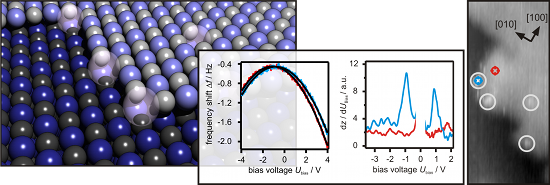
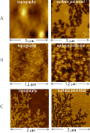
- . The simultaneously measured frequency shift Δf and tunneling current It give insight into the local surface potential as well as into the local electronic structure. The corresponding results of such an experiment are shown in Figure 7, where the tip scanned across an F0 defect. The three stacked


Other Beilstein-Institut Open Science Activities



