


Search results
Search for "tip–sample interaction" in Full Text gives 104 result(s) in Beilstein Journal of Nanotechnology.
Manipulation of gold colloidal nanoparticles with atomic force microscopy in dynamic mode: influence of particle–substrate chemistry and morphology, and of operating conditions
Beilstein J. Nanotechnol. 2011, 2, 85–98, doi:10.3762/bjnano.2.10
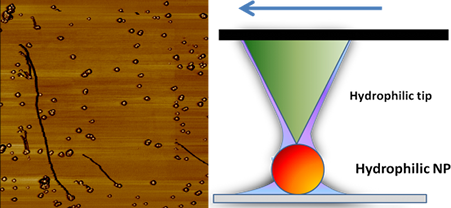
- oscillation amplitude of the tip, Aset, was kept constant by a feedback loop. In such cases, the power dissipation accompanying the tip-sample interaction can be determined from the following relationship [21][22][23][24][25][26][27][28][29][30][31][32][33][34][35][36]: where Apiezo is the oscillation
- constants of 5 and 48 N/m (respectively, MPP12100 from Veeco and PPP-NCLR from Nanosensors) were used. During manipulation, the oscillation amplitude of the tip, Aset, was kept constant by a feedback loop. In this case, the power dissipation accompanying the tip–sample interaction can be determined from


Defects in oxide surfaces studied by atomic force and scanning tunneling microscopy
Beilstein J. Nanotechnol. 2011, 2, 1–14, doi:10.3762/bjnano.2.1
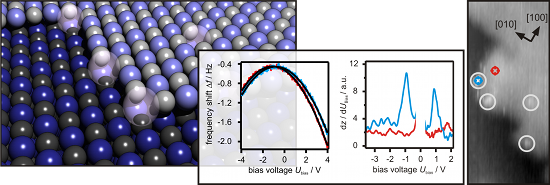
- measurements and the corresponding theoretical results are presented in Figure 8. At the defect site, the tip-sample interaction increases significantly with decreasing distance. From a structural point of view the positions of the defects are ”holes”, i.e., missing oxygen atoms in the lattice. In the first


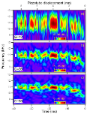
Tip-sample interactions on graphite studied using the wavelet transform
Beilstein J. Nanotechnol. 2010, 1, 172–181, doi:10.3762/bjnano.1.21

- , i.e., signal with a frequency spectrum changing during the data collection. This work will show that the tip-sample interaction forces can be quantitatively measured using CWT with acquisition times as short as few tens of milliseconds, as required for practical DFS imaging. Since wavelets are a
- of the PSD as a function of z. Considering each flexural mode equivalent to a mass-spring system, the tip-sample interaction elastic constant kts = −dFts/dz is expressed as a function of the resonant frequency as , where is the resonant frequency of the free cantilever, is the resonant frequency of
- effect of the tip-sample interaction dominates. Continuous wavelet transform and time-frequency resolution The FT analysis provides a frequency representation of a signal with perfect spectral resolution but without the possibility to correlate the frequency spectrum with the signal evolution in time




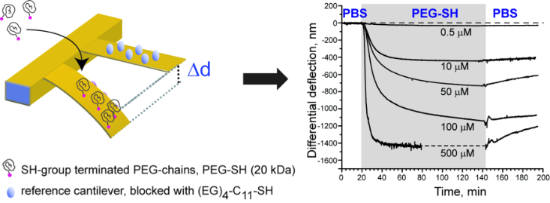
Sensing surface PEGylation with microcantilevers
Beilstein J. Nanotechnol. 2010, 1, 3–13, doi:10.3762/bjnano.1.2
- on the AFM images can be understood by comparing the tip-sample interaction forces obtained in PBS and 20% 2-propanol, respectively (Figure 5). Specifically, the thickness of the PEG layer (defined by the onset of repulsion) reduces from 26 nm in the brush-like state to 5 nm in the collapsed state



Other Beilstein-Institut Open Science Activities



