


Search results
Search for "tip apex" in Full Text gives 103 result(s) in Beilstein Journal of Nanotechnology.
Single-pass Kelvin force microscopy and dC/dZ measurements in the intermittent contact: applications to polymer materials
Beilstein J. Nanotechnol. 2011, 2, 15–27, doi:10.3762/bjnano.2.2
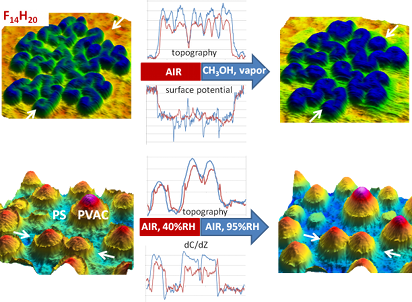
- nanotubes probes (generously provided by Carbon Design Innovations). The probes with small tip apex and tips with high aspect ratio provide higher spatial resolution of surface potential images whereas the probes with thicker tips have a better signal-to-noise ratio of the surface potential. The majority of
- exhibit a different dC/dZ patterns with a central part darker that the perimeter. This suggests that at elevated locations only the tip apex is sensing the electrostatic force and a large part of the tip participates in the force interactions when the domains are lower. The second is related to the





Defects in oxide surfaces studied by atomic force and scanning tunneling microscopy
Beilstein J. Nanotechnol. 2011, 2, 1–14, doi:10.3762/bjnano.2.1
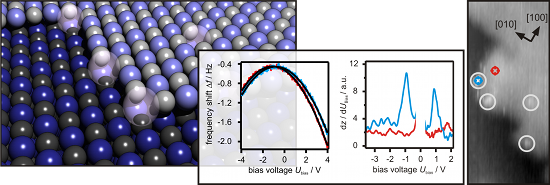
- surface [26]. Assuming that the forces acting on such metal adatoms are comparable to those on the tip apex, one may conclude that a more attractive interaction occurs between the oxygen sites and the tip. This results in a contrast where oxygen atoms are imaged as protrusions in a constant Δf NC-AFM


Tip-sample interactions on graphite studied using the wavelet transform
Beilstein J. Nanotechnol. 2010, 1, 172–181, doi:10.3762/bjnano.1.21

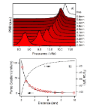
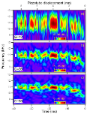
- decrease of the Q value just before the jumps-to-contact. The dissipation mechanism related to this sharp transition is due to a local interaction of the tip apex with the surface. In these experiments, the acquisition and storage of the photodiode time signal requires tens of seconds at each tip-sample




Other Beilstein-Institut Open Science Activities



