

Search results
Search for "calcium" in Full Text gives 129 result(s) in Beilstein Journal of Nanotechnology.
Exploring the retention properties of CaF2 nanoparticles as possible additives for dental care application with tapping-mode atomic force microscope in liquid
Beilstein J. Nanotechnol. 2014, 5, 36–43, doi:10.3762/bjnano.5.4
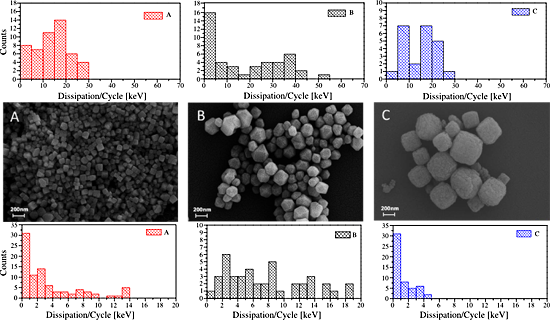
- very interesting for application in science, technology and medical applications including dentistry [18]. In this context calcium fluoride is of high interest in saliva chemistry and in the context of reducing acid dissolution of teeth [19]. The outermost layer of the teeth, also called enamel, has
- upon exposure to a fluorated solution has been observed with AFM in liquid [26]. To the best of our knowledge no manipulation experiment of particles adsorbed on human tooth enamel has been performed so far. The anticaries activity of calcium fluoride nanoparticles is mainly determined by two factors
- adhesion strength of calcium fluoride nanoparticles adsorbed on mica and on tooth enamel in liquid with AM-AFM. Theory As already described above, manipulation experiments in the tapping-mode are difficult to quantify as dynamic and friction processes are involved at the same time. To connect the power


Surface assembly and nanofabrication of 1,1,1-tris(mercaptomethyl)heptadecane on Au(111) studied with time-lapse atomic force microscopy
Beilstein J. Nanotechnol. 2014, 5, 26–35, doi:10.3762/bjnano.5.3
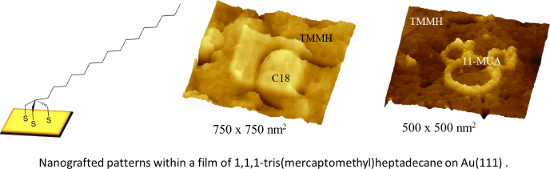
- dried with calcium hydride (CaH2) and distillated before use. Pyridinium chlorochromate (PCC) and lithium aluminum hydride (LiAlH4) were purchased from Alfa Aesar. 1-Octadecanol (ReagentPlus®, 99%), formaldehyde (37 wt % in H2O), trifluoromethanesulfonic anhydride (≥99%), 18-crown-6 (≥99.9%), pyridine


Nano-FTIR chemical mapping of minerals in biological materials
Beilstein J. Nanotechnol. 2012, 3, 312–323, doi:10.3762/bjnano.3.35

- inorganic particles embedded in organic matrices [15][16][17]. Major tissues of interest include the phosphatic (bone) family of materials, and the carbonatic family as found, e.g., in mollusc shells. Within the phylum Brachiopoda, both strategies of hybrid shell architecture have evolved: Calcium carbonate
- crystals in an organic matrix [18][19][20], and laminates of calcium phosphate nanoparticle reinforced chitin fibers [21][22]. FTIR spectroscopic microscopy is a well-established method and has been extensively used to study bone biominerals at several micrometers spatial resolution [23][24][25][26][27][28
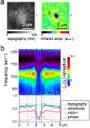
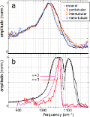
- shown in Figure 5). The spectra in Figure 3b and Figure 3c (and also the extracted averaged spectral profiles in Figure 4) are dominated by a single, sharp resonance, which differs in frequency position for orthorhombic aragonite (855 cm−1) and trigonal calcite (873 cm−1), and thus both calcium





Detection of interaction between biomineralising proteins and calcium carbonate microcrystals
Beilstein J. Nanotechnol. 2011, 2, 222–227, doi:10.3762/bjnano.2.26

- brittle calcium carbonate mineral platelets embedded in a mechanically weak organic layer, nature has created a tough material. For recent reviews dealing with biomineralisation and especially nacre consult [2] and [3]. The fracture resistance of the whole shell and especially nacre, which consists of
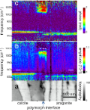
- unspecific binding seems unlikely, since lanes A and C (Figure 4) show no difference in intensity. Verification of a specific binding would be most interesting, because this would be evidence that protein–mineral interaction guide polymorph selection and morphology of the calcium carbonate crystals. This
- on the molecular to atomic scale and conducting further experiments. Experimental As we stated several times above, the detection of interaction between biomineralising proteins and calcium carbonate microcrystals in this study is based on a modified approach from [1]. The main differences between


Other Beilstein-Institut Open Science Activities