


Search results
Search for "cellulose" in Full Text gives 133 result(s) in Beilstein Journal of Nanotechnology.
Biopolymer colloids for controlling and templating inorganic synthesis
Beilstein J. Nanotechnol. 2014, 5, 2129–2138, doi:10.3762/bjnano.5.222
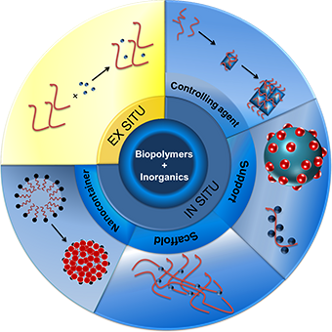
- find starch [13][14], different cellulose derivatives [15], dextran [16], pectin [17], alginate [18], and poly(amino acids) or proteins [19][20][21][22][23][24][25][26][27][28][29]. Researchers in the biomineralization field very often extract proteins from biological matter and use them for the ex
- example of a heterogeneous catalyst was reported by Taubert’s group with gold/cellulose nanocrystal hybrids produced in the presence of ionic liquids [88]. Also for catalytic applications, nanoparticles of silver, gold, and platinum were synthesized by using a cellulose aerogel [89]. Cellulose has been
- further used for silicates. Zhang et al. [90] presented the in situ formation of silica in a cellulose aerogel (Figure 8). The addition of the silicate precursor (TEOS) takes place first, followed by a sol–gel process and the cellulose/silica composite formation. The aerogel is formed by drying with


Ionic liquid-assisted formation of cellulose/calcium phosphate hybrid materials
Beilstein J. Nanotechnol. 2014, 5, 1553–1568, doi:10.3762/bjnano.5.167
- Ahmed Salama Mike Neumann Christina Gunter Andreas Taubert Institute of Chemistry, University of Potsdam, D-14476 Potsdam, Germany Cellulose and Paper Department, National Research Center, El-Tahrir Street, Dokki, Cairo, Egypt Institute of Earth and Environmental Sciences, University of Potsdam, D
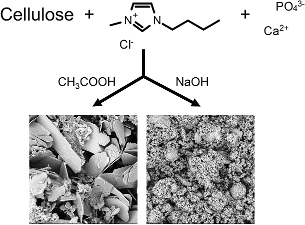
- -14476 Potsdam, Germany 10.3762/bjnano.5.167 Abstract Cellulose/calcium phosphate hybrid materials were synthesized via an ionic liquid-assisted route. Scanning electron microscopy, transmission electron microscopy, energy-dispersive X-ray spectroscopy, X-ray diffraction, infrared spectroscopy, and
- thermogravimetric analysis/differential thermal analysis show that, depending on the reaction conditions, cellulose/hydroxyapatite, cellulose/chlorapatite, or cellulose/monetite composites form. Preliminary studies with MC3T3-E1 pre-osteoblasts show that the cells proliferate on the hybrid materials suggesting that


Surface topography and contact mechanics of dry and wet human skin
Beilstein J. Nanotechnol. 2014, 5, 1341–1348, doi:10.3762/bjnano.5.147

- cellulose fibers. In fact, cellulose fibers exhibit elastoplastic properties very similar to the stratum corneum: Both absorb water strongly and swell by wetting, both have elastic moduli of the order of 10 MPa in the wet state and of the order of 1 GPa in the dry state [11]. The swelling (and elastic


AFM as an analysis tool for high-capacity sulfur cathodes for Li–S batteries
Beilstein J. Nanotechnol. 2013, 4, 611–624, doi:10.3762/bjnano.4.68
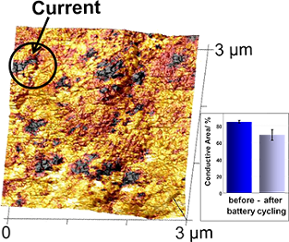
- ]. Polyvinylidene fluoride (PVDF) and carboxymethyl cellulose (CMC) binders were used to test the influence of the binders on the battery performance. The suspension-spraying technique is advantageous because it can be used in mass production processes. In a first step the focus was on the preparation of a porous
- measurements (see below). The sprayed cathodes prepared with carboxymethyl cellulose (CMC) binders (SC-CMC) show discharge capacities of 136 mAh·g−1 after 50 cycles, which is inferior to other values (Figure 1). One of the reasons for the low initial discharge capacity compared to the theoretical capacity
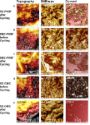
- significant differences were found for the deformation values with the exception of cellulose as a binder material. The adhesion force was smallest for the fluorine containing PVDF binder. For the identification of sulfur the stiffness values were used. During the stiffness measurements the tip puts a





Porous polymer coatings as substrates for the formation of high-fidelity micropatterns by quill-like pens
Beilstein J. Nanotechnol. 2013, 4, 377–384, doi:10.3762/bjnano.4.44
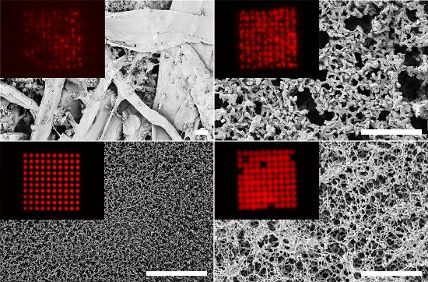
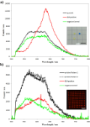
- illumination and a CoolSNAP HQ2 camera (Photometrics). Phloxine B patterns were observed in Texas Red filter (Nikon Y-2E/C) with exposure times ranging from 10 ms (HEMA substrates) over 40 ms (nitro cellulose substrate) to 50 ms (plain paper and nylon). The fluorescent spectra were recorded on the same


Mechanical and thermal properties of bacterial-cellulose-fibre-reinforced Mater-Bi® bionanocomposite
Beilstein J. Nanotechnol. 2013, 4, 325–329, doi:10.3762/bjnano.4.37

- Mary University of London, Mile End Road, London E1 4NS, United Kingdom School of Materials and Mineral Resources Engineering, Universiti Sains Malaysia, 14300 Nibong Tebal, Penang, Malaysia 10.3762/bjnano.4.37 Abstract The effects of the addition of fibres of bacterial cellulose (FBC) to commercial
- FBC into Mater-Bi. FBC is easily incorporated in Mater-Bi matrix and produces homogeneous Mater-Bi/FBC composite. The crystallinity of the Mater-Bi/FBC composites decrease in relation to the increase in the volume fraction of FBC. Keywords: bacterial cellulose; bio-nanocomposites; Mater-Bi
- ; mechanical; thermal; Introduction Farm products offer a wide range of commodities such as cellulose, starch, rubber, and other materials that are environmentally friendly. Starch, one of the promising natural materials, most abundantly available after cellulose, has been considered a good candidate in


Paper modified with ZnO nanorods – antimicrobial studies
Beilstein J. Nanotechnol. 2012, 3, 684–691, doi:10.3762/bjnano.3.78

- ]. Cellulose fibers used for papermaking are hygroscopic in nature [9][10] and this property was used to our advantage when developing the antimicrobial paper. The adsorbed moisture can be utilized for the production of hydroxyl radicals (·OH) and/or hydrogen peroxide (H2O2) through photocatalysis. Both ·OH
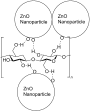
- grown on glass substrates [25]. The proper attachment of the ZnO nanorods to the paper is crucial for commercial applications. Cellulose, the major ingredient of softwood pulp, is a long-chain polymer with hydroxyl groups that can form hydrogen bonds with the surface oxygen atoms of ZnO nanoparticles
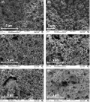
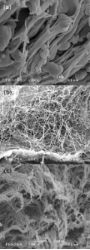
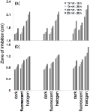
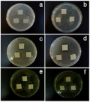
- the inhibition zone. Growth of A. niger in the presence of (a) untreated paper and (b) paper with ZnO nanorods, after 72 h of growth. Schematic diagram showing possible hydrogen bonding of the hydroxy groups on the cellulose molecule with surface oxygen atoms of the ZnO nanoparticles. Scanning




Fabrication and spectroscopic studies on highly luminescent CdSe/CdS nanorod polymer composites
Beilstein J. Nanotechnol. 2010, 1, 94–100, doi:10.3762/bjnano.1.11

- resulting nanocomposites show high transparency of up to 93%. A photoluminescence quantum efficiency of 70% was obtained, with an optimum combination of nanorod (0.05 wt %) and at a UV-initiator concentration of 0.1 wt % for poly(lauryl methacrylate). Nanorods tend to agglomerate in cellulose triacetate
- amount of cross-linker either flexible (<20 wt % EGDM) or rigid nanocomposites could be fabricated. In our second method we fabricated thin polymer films using a radical free drop-casting process. Cellulose triacetate (CTA) was chosen as polymer because of its high transparency, hydrophobicity and


Other Beilstein-Institut Open Science Activities



