


Search results
Search for "nanomedicine" in Full Text gives 136 result(s) in Beilstein Journal of Nanotechnology.
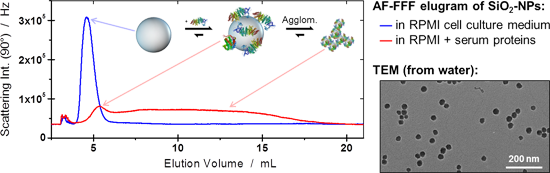
Effects of surface functionalization on the adsorption of human serum albumin onto nanoparticles – a fluorescence correlation spectroscopy study
Beilstein J. Nanotechnol. 2014, 5, 2036–2047, doi:10.3762/bjnano.5.212

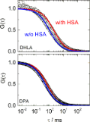
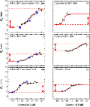
- attention. Considering the wide variety of existing NPs and the complexity of biological fluids, substantial variations in their mutual interactions can be expected. Knowledge of these interactions is, however, indispensible for safe applications of NPs in the field of nanomedicine, for example, as highly



Carbon nano-onions (multi-layer fullerenes): chemistry and applications
Beilstein J. Nanotechnol. 2014, 5, 1980–1998, doi:10.3762/bjnano.5.207
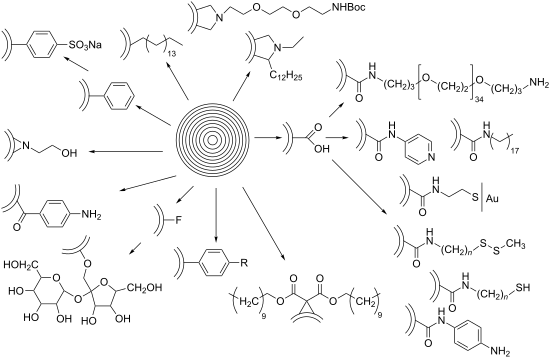
- , could be modified with flavonoid compounds, for the example quercitin, a compound known for its anti-inflammatory potential [49], giving rise to future applications in nanomedicine. Some additional metal oxide-containing composite materials were studied for applications as electrode materials in


Biocompatibility of cerium dioxide and silicon dioxide nanoparticles with endothelial cells
Beilstein J. Nanotechnol. 2014, 5, 1795–1807, doi:10.3762/bjnano.5.190
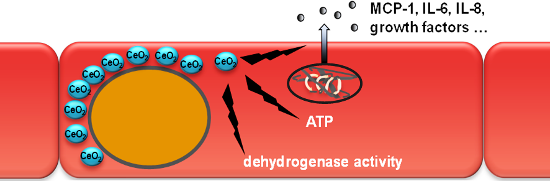
- ]. SiO2 nanoparticles are employed in the fabrication of electric and thermal insulators [6], as drug-delivery systems in nanomedicine [7][8], as anticaking and thickener agents in food production [9][10], as well as in cosmetics, drugs and printer toners [11]. Human exposure to these nanoparticles arises
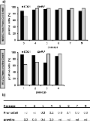


The surface properties of nanoparticles determine the agglomeration state and the size of the particles under physiological conditions
Beilstein J. Nanotechnol. 2014, 5, 1774–1786, doi:10.3762/bjnano.5.188
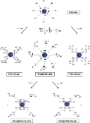
- cosmetics, and even in food [51]. Furthermore, both silica and siloxane particles are promising candidates for applications in the field of nanomedicine. In particular, the poly(organosiloxane) particles offer high versatility and flexibility with regard to architecture, composition and functionalization


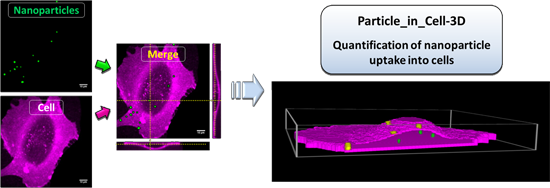
Precise quantification of silica and ceria nanoparticle uptake revealed by 3D fluorescence microscopy
Beilstein J. Nanotechnol. 2014, 5, 1616–1624, doi:10.3762/bjnano.5.173
- properties have been described as beneficial applications in nanomedicine [17][18][19]. On the other hand, oxidative stress and impaired cell viability were shown to be a function of the particle dose and the exposure time [1][20]. However, most of the studies concerning the interaction of silica and ceria


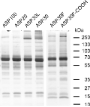
The protein corona protects against size- and dose-dependent toxicity of amorphous silica nanoparticles
Beilstein J. Nanotechnol. 2014, 5, 1380–1392, doi:10.3762/bjnano.5.151
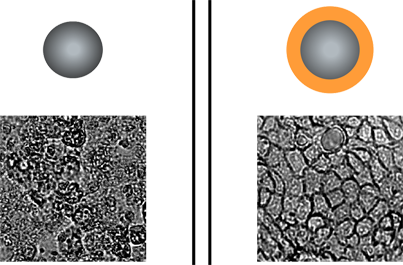
- interface in general. Keywords: biobarrier; gastrointestinal tract; high-throughput profiling; nanomedicine; nanotoxicity; Introduction Besides the wide use of nanomaterials in industrial products, biomedical applications of nanoparticles (NP) are steadily increasing [1][2][3][4][5]. However, despite




Nanodiamond-DGEA peptide conjugates for enhanced delivery of doxorubicin to prostate cancer
Beilstein J. Nanotechnol. 2014, 5, 937–945, doi:10.3762/bjnano.5.107
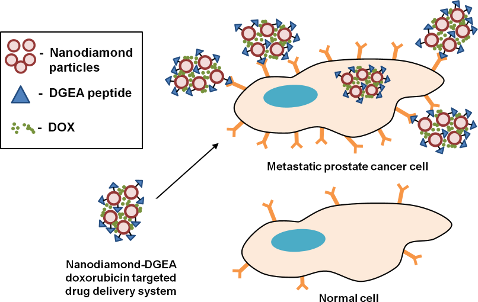
- Birmingham (UAB), 1530 3rd Avenue South, Birmingham, AL 35294, USA Department of Materials Science and Engineering, Tuskegee University (TU), 1200 W Montgomery Rd, Tuskegee, AL 36088, USA 10.3762/bjnano.5.107 Abstract The field of nanomedicine has emerged as an approach to enhance the specificity and
- toxicity by incorporating mechanisms for targeted delivery of chemotherapeutics. Nanomedicine has become a viable solution for the specificity and toxicity problems with current chemotherapy treatment regimens [6][7][8][9]. Nanoparticles have facilitated tumor targeting and drug delivery in a variety of


Morphological characterization of fullerene–androsterone conjugates
Beilstein J. Nanotechnol. 2014, 5, 374–379, doi:10.3762/bjnano.5.43

- Madrid, Spain Institute for Research in Biomedicine, Barcelona Science Park, Baldiri Reixac 10, 08028-Barcelona, Spain Centre on Bioengineering, Biomaterials and Nanomedicine, PCB, 08028-Barcelona, Spain Department of Organic Chemistry, University of Barcelona, 08028-Barcelona, Spain School of Chemistry


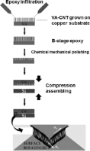
Functionalization of vertically aligned carbon nanotubes
Beilstein J. Nanotechnol. 2013, 4, 129–152, doi:10.3762/bjnano.4.14
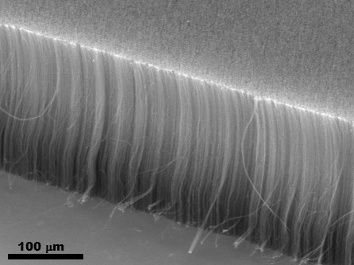
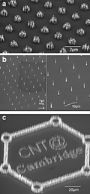
- tensile strength [9] and elastic modulus [10], CNTs form the strongest and stiffest material that humans have created. These properties offer a wide range of potential applications [11][12], for electronic devices, energy storage and transport, nanocomposite materials, and nanomedicine. The as-synthesized

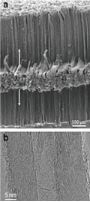







Dynamics of capillary infiltration of liquids into a highly aligned multi-walled carbon nanotube film
Beilstein J. Nanotechnol. 2011, 2, 311–317, doi:10.3762/bjnano.2.36

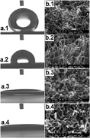
- for non-polar liquids [5]. One of the cutting edge areas of research exploiting CNTs is nanomedicine where the interface of CNTs with a liquid environment is essential, e.g., subcutaneous glucose sensors [6], microcatheters [7] or tissue engineering materials [8]. Until now, physical compatibility of


Magnetic coupling mechanisms in particle/thin film composite systems
Beilstein J. Nanotechnol. 2010, 1, 101–107, doi:10.3762/bjnano.1.12

- nanoparticles (NPs) represent at least one of the constituent materials [3] have generated much attention. A large number of investigations can be found that address potential technological applications, preparation methods and fundamental properties of magnetic NPs, such as in photonics [6][7], nanomedicine [8





