


Search results
Search for "temperature dependent" in Full Text gives 134 result(s) in Beilstein Journal of Nanotechnology.
Nanostructured, mesoporous Au/TiO2 model catalysts – structure, stability and catalytic properties
Beilstein J. Nanotechnol. 2011, 2, 593–606, doi:10.3762/bjnano.2.63

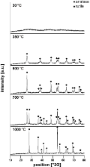
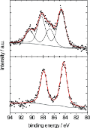
- the CO oxidation reaction, performed with a scanning mass spectrometer directly above the film, yielded reaction characteristics that are very close to those of highly dispersed Au/TiO2 catalysts at comparable reaction conditions, with an activation energy of 23.9 kJ·mol−1 and temperature-dependent






Simple theoretical analysis of the photoemission from quantum confined effective mass superlattices of optoelectronic materials
Beilstein J. Nanotechnol. 2011, 2, 339–362, doi:10.3762/bjnano.2.40
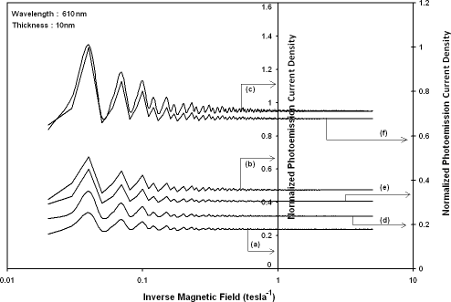
- properties, are based on the temperature-dependent carrier statistics in such materials. Plot of the normalized photoemission current density from QW effective mass superlattices of HgTe/Hg1−xCdxTe as a function of inverse magnetic field, in which the curves (a), (b) and (c) represent the perturbed three and


Dense lying self-organized GaAsSb quantum dots on GaAs for efficient lasers
Beilstein J. Nanotechnol. 2011, 2, 333–338, doi:10.3762/bjnano.2.39

- sample temperature TPL, giving a value of 0.08 nm/K for the temperature dependent peak shift. The FWHM is almost constant at 18 ± 3 nm. The peak of the larger dots shifts from 1.034 up to 1.059 µm, giving 0.14 nm/K, with a FWHM of 75 ± 16 nm. The weaker quantization in the larger dots leads to a stronger
- wavelength of λLaser = 0.909 µm (at j = 1.22 × jth) is very close to the expected wavelength. From temperature dependent threshold current measurements, characteristic temperatures of T0 = 476.8 K for the temperature range below 140 K, and T0 = 63.2 K above 140 K, were extracted. In principle, for different


Effect of large mechanical stress on the magnetic properties of embedded Fe nanoparticles
Beilstein J. Nanotechnol. 2011, 2, 268–275, doi:10.3762/bjnano.2.31
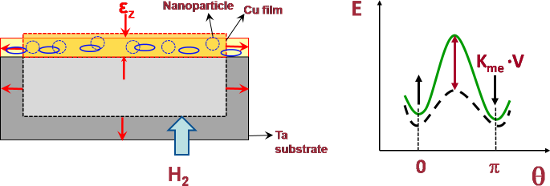
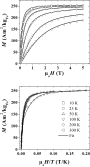
- . The stress is applied to the nanoparticles through expansion of the substrate during hydrogen loading. Experimental evidence for stress induced magnetic effects is presented based on temperature-dependent magnetization curves of superparamagnetic Fe particles. The results show the potential of the
- of static magnetization measurements have been presented showing large increases of the Mr/Ms ratio and a reduction of the saturation field of the nanoparticles. The temperature dependent magnetization curves obtained after field cooling are also influenced by the applied stress. The results may be


Manipulation of gold colloidal nanoparticles with atomic force microscopy in dynamic mode: influence of particle–substrate chemistry and morphology, and of operating conditions
Beilstein J. Nanotechnol. 2011, 2, 85–98, doi:10.3762/bjnano.2.10
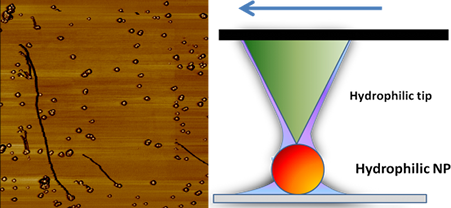
- adhesion between them. Similar thermal effects have been recognized in friction on hydrophilic surfaces measured with different scan velocities [42]. It is worth noting that during this temperature dependent manipulation no evident damage was observed on working areas. Figure 5b shows a logarithmic plot of
- similar behavior in, both, trend and activation barrier of the temperature-dependent mobility is observed for the hydrophilic OH-coated NPs. An explanation for this result may come at least partly from the complex behavior of the adsorbed (structural) water depending on temperature in the hydrophilic


Kinetic lattice Monte-Carlo simulations on the ordering kinetics of free and supported FePt L10-nanoparticles
Beilstein J. Nanotechnol. 2011, 2, 40–46, doi:10.3762/bjnano.2.5

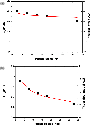
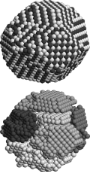
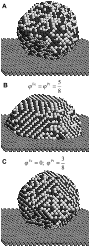
- for simulating the dynamics of ordering. In the simulation of a bulk material, the vacancy concentration is fixed at while in a real system, a temperature dependent vacancy concentration of would be observed. In the latter case, the average vacancy formation energy in FePt alloys predicted by the




Magnetic interactions between nanoparticles
Beilstein J. Nanotechnol. 2010, 1, 182–190, doi:10.3762/bjnano.1.22

- close to θ = 0° and θ = 180°. The superparamagnetic relaxation time is given by the Néel–Brown expression [7][8] where kB is Boltzmann’s constant and T is the temperature. τ0 is on the order of 10−13–10−9 s and is weakly temperature dependent. In experimental studies of magnetic nanoparticles, the



Ultrafine metallic Fe nanoparticles: synthesis, structure and magnetism
Beilstein J. Nanotechnol. 2010, 1, 108–118, doi:10.3762/bjnano.1.13

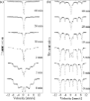
- ], respectively. Interestingly, in low fields, for such an assembly of NPs, the susceptibility (χ = m/H) versus temperature follows a Curie law independent of the anisotropy [40]. It should be noted that this expression depends on MS and Keff which are both temperature dependent. The static ZFC-FC curves can be





Preparation and characterization of supported magnetic nanoparticles prepared by reverse micelles
Beilstein J. Nanotechnol. 2010, 1, 24–47, doi:10.3762/bjnano.1.5






Other Beilstein-Institut Open Science Activities



