


Search results
Search for "thermal conductivity" in Full Text gives 132 result(s) in Beilstein Journal of Nanotechnology.
Micro- and nanoscale electrical characterization of large-area graphene transferred to functional substrates
Beilstein J. Nanotechnol. 2013, 4, 234–242, doi:10.3762/bjnano.4.24
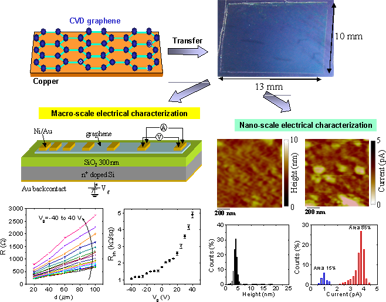
- neutral (undoped) graphene the Fermi level is coincident with the Dirac point, that is, the intersection point between the valence and the conduction band. From these properties originate the high intrinsic field-effect mobility [2][3][4] of graphene, its high thermal conductivity [5], and its optical

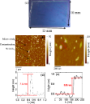


Photoresponse from single upright-standing ZnO nanorods explored by photoconductive AFM
Beilstein J. Nanotechnol. 2013, 4, 208–217, doi:10.3762/bjnano.4.21

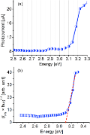
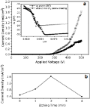
- ) = 195 K [54], with the thermal conductivity of ZnO, kth(ZnO) ≈ 100 W·m−1·K−1 [51]. The factor 0.5 was introduced to take into account that a part of the energy dissipated at the contact is conducted via the tip. This means that local NR temperatures of at least 495 K can be expected. Further evidence



Functionalization of vertically aligned carbon nanotubes
Beilstein J. Nanotechnol. 2013, 4, 129–152, doi:10.3762/bjnano.4.14
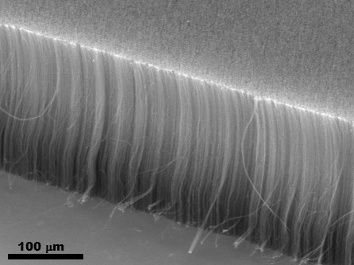
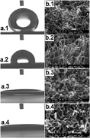
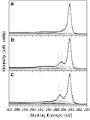
- applications such as field-emission displays, chemical or biological sensors, or polymer fillers. The advantages of using VA-CNTs include an excellent alignment of the nanotubes, a good electrical and thermal conductivity, and uniform length. Nevertheless, a key challenge to be overcome for achieving actual
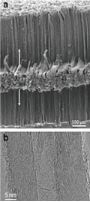
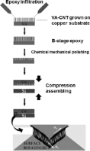
- nanoscale roughness inherent to the sample (Figure 16). The enhancement of the thermal conductivity of a composite enclosure in the direction of its thickness is another illustration of the application of VA-CNT polymer functionalization. Sihn et al. [133] embedded VA-MWCNTs in an adhesive medium (epoxy
- -thickness thermal conductivity of the composite sample. They reported that the key components influencing the thermal conductivity are, on the one hand, the thermal conductivity and the size of the metallic transition zone and, on the other hand, the use of highly conductive vertically aligned nanotubes. A








Characterization and properties of micro- and nanowires of controlled size, composition, and geometry fabricated by electrodeposition and ion-track technology
Beilstein J. Nanotechnol. 2012, 3, 860–883, doi:10.3762/bjnano.3.97
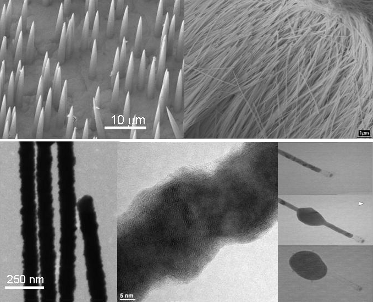
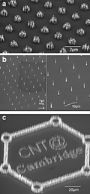
- due to theoretical studies predicting a large enhancement of the thermoelectric efficiency, given by the so-called figure of merit ZT, ZT = S2·σ·T/κ, where S is the Seebeck coefficient, σ is the electrical conductivity, κ is the thermal conductivity and T is the temperature. The power factor (S2σ) of
- these thermoelectric nanomaterials should increase due to quantum size effects and the thermal conductivity should decrease due to enhanced phonon surface scattering [85][86][87][88]. The thermoelectric properties of these Bi-compound materials are anisotropic and are extremely sensitive not only to
- . Hochbaum et al. and Boukai et al. recently reported that rough Si nanowires exhibit a thermal conductivity up to 100 times smaller than their smooth counterparts, becoming promising objects to be implemented in thermoelectric devices [87][88]. In addition, a larger roughness effectively increases the








Nanotribology at high temperatures
Beilstein J. Nanotechnol. 2012, 3, 586–588, doi:10.3762/bjnano.3.68
- of diamond originates from its unique features such as high thermal conductivity, high wear resistance and its ability to form extremely sharp cutting edges [13]. Moreover, both diamond and silicon are known to be hard and brittle [14][15] in their sp3-bonded state. Two commercially available

Forming nanoparticles of water-soluble ionic molecules and embedding them into polymer and glass substrates
Beilstein J. Nanotechnol. 2012, 3, 267–276, doi:10.3762/bjnano.3.30

- high-pressure injection was reported by Parfen’eva et al. [5], and a change of the thermal conductivity of the substrate was demonstrated. The embedding of NaCl nanoparticles into a polymeric film was recently realized by the use of an electromagnetic field [8]. According to this method, the




Substrate-mediated effects in photothermal patterning of alkanethiol self-assembled monolayers with microfocused continuous-wave lasers
Beilstein J. Nanotechnol. 2012, 3, 65–74, doi:10.3762/bjnano.3.8

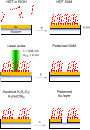
- patterning technique. Because of the strongly temperature-dependent thermal conductivity of Si, surface-temperature profiles on Au/Si substrates are very narrow ensuring a particularly high lateral resolution. At a 1/e spot diameter of 2 µm, fabrication of subwavelength structures with diameters of 300–400
- demonstrate a strong dependence of the patterning process on the support material, i.e., on its thermal conductivity. Comparative experiments with Au-coated glass substrates also show a strong impact of the Au layer thickness. Results and Discussion General approach The general experimental approach is
- absorption [11][12]: with and Note, I0, here and in the following, denotes the modified Bessel function of order zero. Moreover, Equation 3 takes into account the temperature-dependent thermal conductivity of Si. In the case of Au/glass substrates laser absorption is strictly limited to the thin Au layer




Other Beilstein-Institut Open Science Activities



