


Search results
Search for "Young’s modulus" in Full Text gives 155 result(s) in Beilstein Journal of Nanotechnology.
Direct monitoring of opto-mechanical switching of self-assembled monolayer films containing the azobenzene group
Beilstein J. Nanotechnol. 2011, 2, 834–844, doi:10.3762/bjnano.2.93
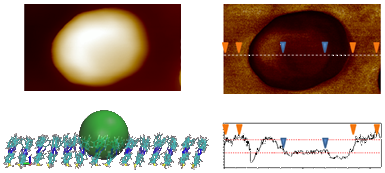
- F (Figure 10), the SAM thickness changes by Δl = l0 − l, where l0 is the initial equilibrium thickness and l the compressed thickness. If the material is assumed to be homogeneous and isotropic, its Young’s modulus E is given by We assume the molecules to behave as ideal (harmonic) springs



Mechanical characterization of carbon nanomembranes from self-assembled monolayers
Beilstein J. Nanotechnol. 2011, 2, 826–833, doi:10.3762/bjnano.2.92

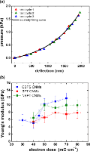
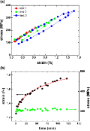
- one side. The Young’s modulus and the prestress are then calculated from the obtained pressure–deflection relationship. The deflection is usually monitored with an optical microscope, either by viewing the membrane from the side [12] or by using a laser interferometer [13]. Both methods have a
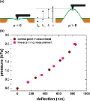
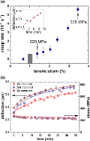
- the center of the membrane and measuring the corresponding deflection (the central-point method). These techniques can be used to determine Young’s modulus and the prestress. They also allow us to investigate the viscoelastic behavior and thus generate insights into the mechanics of CNMs. Results and
- pressure. The change of the indentation depth Δδ is given by [10] where δ0 is the step height in topographic AFM images of the nonpressurized membrane, E is the Young’s modulus, σ0 is the residual stress, ν is the Poisson’s ratio and 2a is the length of the short edge of the membrane. The corrected

Plasmonic nanostructures fabricated using nanosphere-lithography, soft-lithography and plasma etching
Beilstein J. Nanotechnol. 2011, 2, 448–458, doi:10.3762/bjnano.2.49

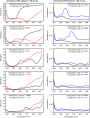
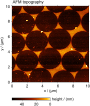
- low Young’s modulus of PDMS used in the fabrication of the stamp, deformed hemispheres may occur for very small PS beads. The zeroth-order reflectance and transmittance of gold films evaporated onto the hemispheres was measured. The low reflectance bands found on coated hemispheres, when compared to





Infrared receptors in pyrophilous (“fire loving”) insects as model for new un-cooled infrared sensors
Beilstein J. Nanotechnol. 2011, 2, 186–197, doi:10.3762/bjnano.2.22

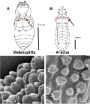
- deflection y of this membrane caused by a pressure difference can be calculated as a function of the radial distance r with the shell theory [26] with R: radius of the membrane, D: flexural stiffness of the membrane, E: Young’s modulus, tP: thickness of the membrane, ν: Poisson’s ratio. Equation 2 is a good


Capillary origami: superhydrophobic ribbon surfaces and liquid marbles
Beilstein J. Nanotechnol. 2011, 2, 145–151, doi:10.3762/bjnano.2.18
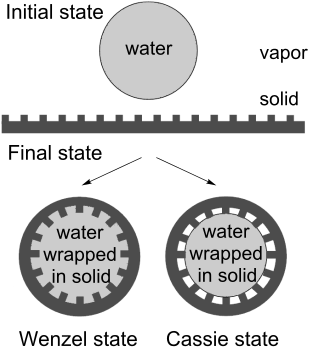
- stretching a thin membrane substrate is related to the principal radii of curvatures of the substrate, where κb is the elastic bending rigidity and κG is the Gaussian bending modulus [20]. For a film of thickness h, the bending rigidity is given by κb = Eh3/12(1−ν2), where E is Young’s modulus and ν is



Other Beilstein-Institut Open Science Activities



