


Search results
Search for "ZnO" in Full Text gives 270 result(s) in Beilstein Journal of Nanotechnology. Showing first 200.
The longstanding challenge of the nanocrystallization of 1,3,5-trinitroperhydro-1,3,5-triazine (RDX)
Beilstein J. Nanotechnol. 2017, 8, 452–466, doi:10.3762/bjnano.8.49

- wide range of organic compounds. In particular, cocrystals of medical materials are of interest for drug enhancement and were successfully processed through SFE at the nanoscale [118]. Inorganic nanoparticles were also produced on the nanoscale through SFE by Klaumuenzer et al. [119]. ZnO was


Study of the surface properties of ZnO nanocolumns used for thin-film solar cells
Beilstein J. Nanotechnol. 2017, 8, 446–451, doi:10.3762/bjnano.8.48
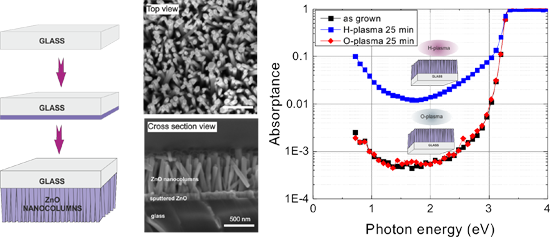
- Densely packed ZnO nanocolumns (NCs), perpendicularly oriented to the fused-silica substrates were directly grown under hydrothermal conditions at 90 °C, with a growth rate of around 0.2 μm/h. The morphology of the nanostructures was visualized and analyzed by scanning electron microscopy (SEM). The
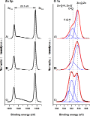
- surface properties of ZnO NCs and the binding state of present elements were investigated before and after different plasma treatments, typically used in plasma-enhanced CVD solar cell deposition processes, by X-ray photoelectron spectroscopy (XPS). Photothermal deflection spectroscopy (PDS) was used to
- investigate the optical and photoelectrical characteristics of the ZnO NCs, and the changes induced to the absorptance by the plasma treatments. A strong impact of hydrogen plasma treatment on the free-carrier and defect absorption of ZnO NCs has been directly detected in the PDS spectra. Although oxygen



Template-controlled piezoactivity of ZnO thin films grown via a bioinspired approach
Beilstein J. Nanotechnol. 2017, 8, 296–303, doi:10.3762/bjnano.8.32

- of functional inorganic materials under mild reaction conditions where organic templates direct the deposition process. In this study, this principle was adapted for the formation of piezoelectric ZnO thin films. The influence of two different organic templates (namely, a carboxylate-terminated self
- polyelectrolyte leads to texturing of the ZnO film. This texture enables a piezoelectric performance of the material which was measured by piezoresponse force microscopy. This study shows that it is possible to tune the piezoelectric properties of ZnO by applying templates with different functionalities
- . Keywords: piezoresponse force microscopy; template-controlled deposition; ZnO; Introduction Zinc oxide is a wide band gap semiconductor. Thin films of it can be applied in, e.g., LEDs [1][2][3] or transistors [4][5][6]. Furthermore, due to its piezoelectricity, it can be incorporated in actuators [7] or


Performance of natural-dye-sensitized solar cells by ZnO nanorod and nanowall enhanced photoelectrodes
Beilstein J. Nanotechnol. 2017, 8, 287–295, doi:10.3762/bjnano.8.31

- cells (DSSCs). Fourier transform infrared (FTIR) spectra of the extract revealed the presence of anchoring groups and coloring constituents. Two different structures were prepared by chemical bath deposition (CBD) using zinc oxide (ZnO) layers to obtain ZnO nanowall (NW) or nanorod (NR) layers employed
- as a thin film at the photoanode side of the DSSC. The ZnO layers were annealed at different temperatures under various gas sources. Indeed, the forming gas (FG) (N2/H2 95:5) was found to enhance the conductivity by a factor of 103 compared to nitrogen (N2) or oxygen (O2) annealing gas. The NR width
- varied between 40 and 100 nm and the length from 500 to 1000 nm, depending on the growth time. The obtained NWs had a length of 850 nm. The properties of the developed ZnO NW and NR layers with different thicknesses and their effect on the photovoltaic parameters were studied. An internal coverage of the


Photocatalysis applications of some hybrid polymeric composites incorporating TiO2 nanoparticles and their combinations with SiO2/Fe2O3
Beilstein J. Nanotechnol. 2017, 8, 272–286, doi:10.3762/bjnano.8.30
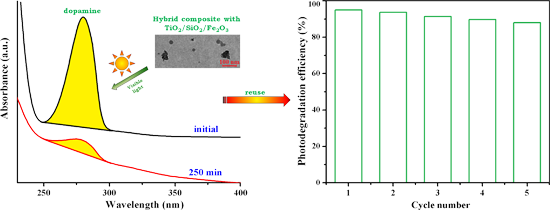
- than the other catalysts studied in literature (ZnO, SnO2, WO3, CdS) because of their superior redox ability and photoelectric properties, the long-term stability, the nontoxicity, and the low cost [10][11][12][13][14][15]. Nevertheless, the practical applications of TiO2 have a major drawback, namely



Performance of colloidal CdS sensitized solar cells with ZnO nanorods/nanoparticles
Beilstein J. Nanotechnol. 2017, 8, 210–221, doi:10.3762/bjnano.8.23

- to replace the commonly used N719 dye molecule. Various nanostructured forms of ZnO, namely, nanorod and nanoparticle-based photoanodes, have been sensitized with colloidal CdS NPs to evaluate their effective performance towards quantum dot sensitized solar cells (QDSSCs). A polysulphide (Sx2−)-based
- voltage (VOC) of 0.67 V was achieved for the ZnO nanorod/nanoparticle assembled structure. The introduction of ZnO nanorods over the nanoparticle led to a significant enhancement of the overall efficiency compared to the corresponding bare nanoparticles. Keywords: DSSC; QDSSC; quantum dot; solar cells
- ; ZnO; Introduction Dye-sensitized solar cells (DSSCs) using inorganic semiconductors are being investigated as a cost-effective and alternative energy source. In DSSCs, a porous electrode made of a wide band gap semiconductor is required for anchoring dye molecules and transporting photo-injected


Ordering of Zn-centered porphyrin and phthalocyanine on TiO2(011): STM studies
Beilstein J. Nanotechnol. 2017, 8, 99–107, doi:10.3762/bjnano.8.11

- grown on ZnO [27]. The dominant structure within the islands, however, appears as wider, slightly meandering rows of tilted brick-like units, each one large enough to contain a pair of ZnPc molecules in an upright position (the phase I in the terminology of [5]). The corresponding structure is marked in


Sensitive detection of hydrocarbon gases using electrochemically Pd-modified ZnO chemiresistors
Beilstein J. Nanotechnol. 2017, 8, 82–90, doi:10.3762/bjnano.8.9

- Agency for New Technologies, Energy and Sustainable Economic Development (ENEA), Laboratory Functional Materials and Technologies for Sustainable Applications - Brindisi Research Center, Brindisi, Italy CNR-IFN Bari, Bari, Italy 10.3762/bjnano.8.9 Abstract Pristine and electrochemically Pd-modified ZnO
- nanorods (ZnO NRs) were proposed as active sensing layers in chemiresistive gas sensors for hydrocarbon (HC) gas detection (e.g., CH4, C3H8, C4H10). The presence of Pd nanoparticles (NPs) on the surface of ZnO NRs, obtained after the thermal treatment at 550 °C, was revealed by morphological and surface
- chemical analyses, using scanning electron microscopy and X-ray photoelectron spectroscopy, respectively. The effect of the Pd catalyst on the performance of the ZnO-based gas sensor was evaluated by comparing the sensing results with those of pristine ZnO NRs, at an operating temperature of 300 °C and for


Nanostructured SnO2–ZnO composite gas sensors for selective detection of carbon monoxide
Beilstein J. Nanotechnol. 2016, 7, 2045–2056, doi:10.3762/bjnano.7.195
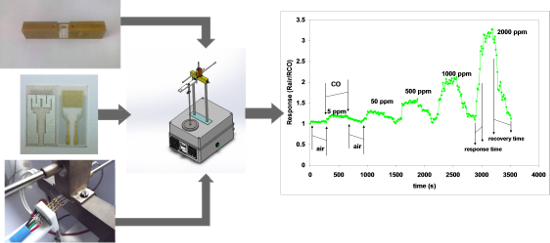
- , 060021 Bucharest, Romania National Institute for Research and Development in Micro-technologies, 077190 Bucharest, Romania, Romelgen SRL, Bucharest, Romania 10.3762/bjnano.7.195 Abstract A series of SnO2–ZnO composite nanostructured (thin) films with different amounts of SnO2 (from 0 to 50 wt %) was
- . It was found that the sensing performance was influenced by the amount of oxide components present in the composite material. Improved sensing performance was achieved for the ZnO (98 wt %)–SnO2 (2 wt %) composite as compared to the sensors containing only the pristine oxides. The sensor response
- , cross-response and recovery characteristics of the analyzed materials are reported. The high sensitivity (RS = 1.21) to low amounts of CO (5 ppm) was reported for the sensor containing a composite sensitive film with ZnO (98 wt %)–SnO2 (2 wt %). This sensor response to CO was five times higher as





The difference in the thermal conductivity of nanofluids measured by different methods and its rationalization
Beilstein J. Nanotechnol. 2016, 7, 2037–2044, doi:10.3762/bjnano.7.194

- Al2O3 nanoparticle loading and particle size. Lee et al. [25] have investigated the thermal conductivity of Al2O3, SiC, Ni, ZnO and multiwalled carbon nanotubes (MWCNTs) in liquid gallium using LFM. They reported that the thermal conductivity measured by LFM was not accurate because of the uncertainty


Organoclay hybrid materials as precursors of porous ZnO/silica-clay heterostructures for photocatalytic applications
Beilstein J. Nanotechnol. 2016, 7, 1971–1982, doi:10.3762/bjnano.7.188

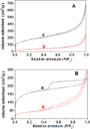
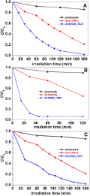
- Bizerte, University of Carthage, 7021 Zarzouna, Tunisia 10.3762/bjnano.7.188 Abstract In this study, ZnO/SiO2-clay heterostructures were successfully synthesized by a facile two-step process applied to two types of clays: montmorillonite layered silicate and sepiolite microfibrous clay mineral. In the
- first step, intermediate silica–organoclay hybrid heterostructures were prepared following a colloidal route based on the controlled hydrolysis of tetramethoxysilane in the presence of the starting organoclay. Later on, pre-formed ZnO nanoparticles (NP) dispersed in 2-propanol were incorporated under
- ultrasound irradiation to the silica–organoclay hybrid heterostructures dispersed in 2-propanol, and finally, the resulting solids were calcinated to eliminate the organic matter and to produce ZnO nanoparticles (NP) homogeneously assembled to the clay–SiO2 framework. In the case of montmorillonite the





Effect of nanostructured carbon coatings on the electrochemical performance of Li1.4Ni0.5Mn0.5O2+x-based cathode materials
Beilstein J. Nanotechnol. 2016, 7, 1960–1970, doi:10.3762/bjnano.7.187

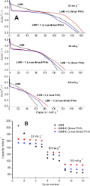
- modification, namely other cathode materials (LiMnPO4 [11], LiMn2O4 [12], LiCoO2 [13], LiNiO2 [14]) or simple binary compounds such as CaF2 [15], TiO2 [16], ZnO [17] and Al2O3 [18]. During the assembly of the lithium-ion cells, the cathode materials are always mechanically mixed with carbon black in order to




Ferromagnetic behaviour of ZnO: the role of grain boundaries
Beilstein J. Nanotechnol. 2016, 7, 1936–1947, doi:10.3762/bjnano.7.185

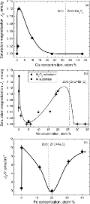
- Materials Science, Russian Academy of Sciences, Leninsky prospect 49, 117991 Moscow, Russia 10.3762/bjnano.7.185 Abstract The possibility to attain ferromagnetic properties in transparent semiconductor oxides such as ZnO is very promising for future spintronic applications. We demonstrate in this review
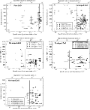
- that ferromagnetism is not an intrinsic property of the ZnO crystalline lattice but is that of ZnO/ZnO grain boundaries. If a ZnO polycrystal contains enough grain boundaries, it can transform into the ferromagnetic state even without doping with “magnetic atoms” such as Mn, Co, Fe or Ni. However, such
- doping facilitates the appearance of ferromagnetism in ZnO. It increases the saturation magnetisation and decreases the critical amount of grain boundaries needed for FM. A drastic increase of the total solubility of dopants in ZnO with decreasing grain size has been also observed. It is explained by the




A new approach to grain boundary engineering for nanocrystalline materials
Beilstein J. Nanotechnol. 2016, 7, 1829–1849, doi:10.3762/bjnano.7.176
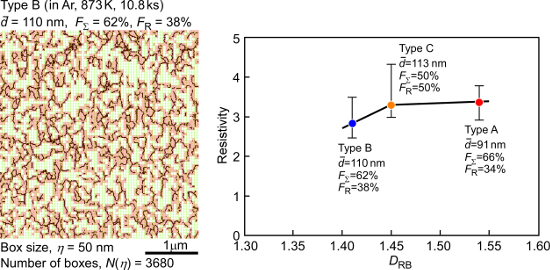
- revealed that the electrical resistivity of individual grain boundaries strongly depends on the grain boundary character and structure from fundamental studies with orientation-controlled bicrystalline or coarse-grained metallic (Al) [123][124], semiconductor (Si) [125][126], and ceramic materials (ZnO


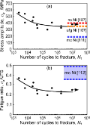
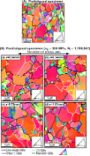


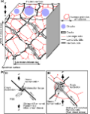




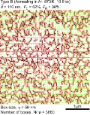

Role of RGO support and irradiation source on the photocatalytic activity of CdS–ZnO semiconductor nanostructures
Beilstein J. Nanotechnol. 2016, 7, 1684–1697, doi:10.3762/bjnano.7.161

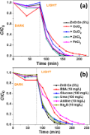
- the photocatalysts. In this work, we have investigated the role of reduced graphene oxide (RGO) support and the irradiation source on mixed metal chalcogenide semiconductor (CdS–ZnO) nanostructures. The photocatalyst material was synthesized using a facile hydrothermal method and thoroughly
- characterized using different spectroscopic and microscopic techniques. The photocatalytic activity was evaluated by studying the degradation of a model dye (methyl orange, MO) under visible light (only) irradiation and under natural sunlight. The results reveal that the RGO-supported CdS–ZnO photocatalyst
- performs considerably better than the unsupported CdS–ZnO nanostructures. In addition, both the catalysts perform significantly better under natural sunlight than under visible light (only) irradiation. In essence, this work paves way for tailoring the photocatalytic activity of semiconductor
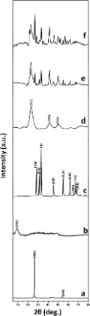





Sb2S3 grown by ultrasonic spray pyrolysis and its application in a hybrid solar cell
Beilstein J. Nanotechnol. 2016, 7, 1662–1673, doi:10.3762/bjnano.7.158
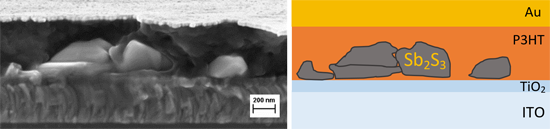
- mesoporous TiO2 as the electron conductor, or when compared to a planar cell based on ALD-grown Sb2S3 [5]. The latter corroborates the benefit of a conformal coating and controlled thickness that is characteristic for ALD. As we have previously shown, the use of ZnO nanorods as the structured substrate and
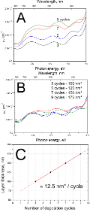
- previous section. To further boost the current density, one is likely to benefit from the use of a stuctured electron-conducting substrate such as a layer of ZnO nanorods. Conclusion We focused on the optimization of the properties of Sb2S3 grown by chemical spray pyrolysis (CSP) of an ultrasonically
- to grow the Sb2S3 layer onto a structured substrate such as a ZnO nanorod layer. Experimental Technology of layers and solar cells We used a commercial 300 nm indium tin oxide (ITO) coated 1.1 mm glass with a sheet resistance of 10 Ω·sq.−1 from Zentrum für Sonnenenergie- und Wasserstoff-Forschung




Nanostructured germanium deposited on heated substrates with enhanced photoelectric properties
Beilstein J. Nanotechnol. 2016, 7, 1492–1500, doi:10.3762/bjnano.7.142
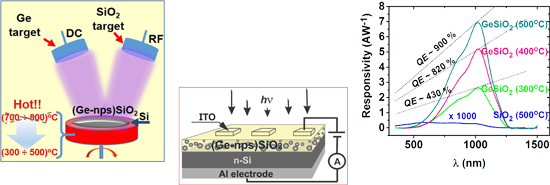
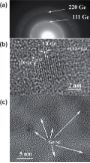
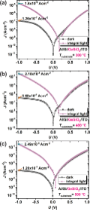
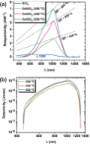
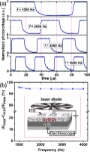
- dark current and dark current density, respectively. The detectivity (D*) value is estimated in the range of 1015 Jones at about 1040 nm, which is comparable with that of ZnO nanoparticles-based photodetectors (D* ≈ 3.4 × 10¹⁵ Jones at 360 nm) [47]. The broad wavelength range (from about 450 to 1300 nm
- ≈ 42 µs) [49] or Ge–graphene–ZnO heterostructure infrared photodetectors (tr ≈ 40 µs and tf ≈ 90 µs) [50]. More importantly, these are the best results reported so far for photodetectors based on Ge-nps. We attribute this relatively fast response to the extremely high carrier mobility resulting from




A composite structure based on reduced graphene oxide and metal oxide nanomaterials for chemical sensors
Beilstein J. Nanotechnol. 2016, 7, 1421–1427, doi:10.3762/bjnano.7.133
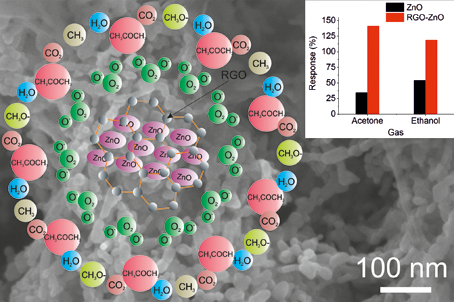
- , Via Valotti 9, 25133 Brescia, Italy Department of Mechanical Engineering, The University of Texas at Austin, Austin, TX 78712, USA 10.3762/bjnano.7.133 Abstract A hybrid nanostructure based on reduced graphene oxide and ZnO has been obtained for the detection of volatile organic compounds. The
- sensing properties of the hybrid structure have been studied for different concentrations of ethanol and acetone. The response of the hybrid material is significantly higher compared to pristine ZnO nanostructures. The obtained results have shown that the nanohybrid is a promising structure for the
- monitoring of environmental pollutants and for the application of breath tests in assessment of exposure to volatile organic compounds. Keywords: chemical sensors; reduced graphene oxide (RGO); volatile organic compounds; zinc oxide (ZnO); Introduction Hazard analysis of critical control point (HACCP


High performance Ce-doped ZnO nanorods for sunlight-driven photocatalysis
Beilstein J. Nanotechnol. 2016, 7, 1338–1349, doi:10.3762/bjnano.7.125
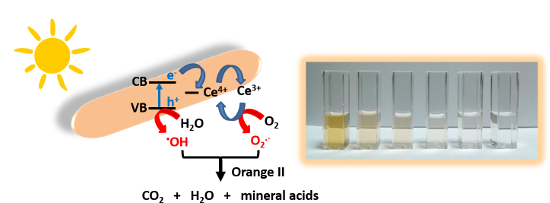
- , BP 70239, 54506 Vandoeuvre-lès-Nancy Cedex, France 10.3762/bjnano.7.125 Abstract Ce-doped ZnO (ZnO:Ce) nanorods have been prepared through a solvothermal method and the effects of Ce-doping on the structural, optical and electronic properties of ZnO rods were studied. ZnO:Ce rods were characterized
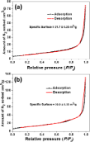
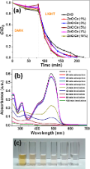
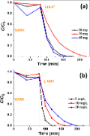
- by XRD, SEM, TEM, XPS, BET, DRS and Raman spectroscopy. 5% Ce-doped ZnO rods with an average length of 130 nm and a diameter of 23 nm exhibit the highest photocatalytic activity for the degradation of the Orange II dye under solar light irradiation. The high photocatalytic activity is ascribed to the
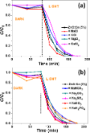
- no marked detrimental effect on the photocatalytic activity was observed. Finally, recyclability experiments demonstrate that ZnO:Ce rods are a stable solar-light photocatalyst. Keywords: Ce doping; photocatalysis; solvothermal synthesis; ZnO rods; Introduction Due to the increasing pollution of






Viability and proliferation of endothelial cells upon exposure to GaN nanoparticles
Beilstein J. Nanotechnol. 2016, 7, 1330–1337, doi:10.3762/bjnano.7.124
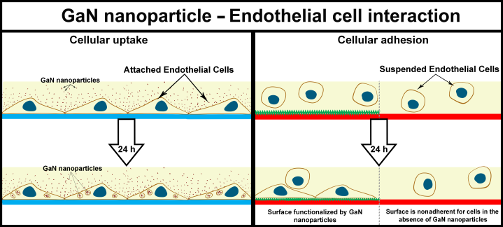
- nanoparticles were synthesized on a sacrificial layer of zinc oxide (ZnO) nanoparticles using hydride vapor phase epitaxy. The uptake of GaN nanoparticles by porcine endothelial cells was strongly dependent upon whether they were fixed to the substrate surface or free floating in the medium. The endothelial
- cultivation process [19]. There is, however, limited knowledge about the biocompatibility of nanostructured GaN and the impact of GaN nanoparticles on living cells. Results GaN nanoparticles with diameters ranging from 50 to 100 nm were synthesized on a sacrificial layer of ZnO nanoparticles, as depicted in
- Figure 1. According to energy dispersive X-ray (EDX) measurements, approximately 2% of ZnO remained on the GaN nanoparticles after thermal treatment in hydrogen flow (Supporting Information File 1, Figure S1). The further removal of ZnO was not possible despite higher temperatures and longer incubation



Ammonia gas sensors based on In2O3/PANI hetero-nanofibers operating at room temperature
Beilstein J. Nanotechnol. 2016, 7, 1312–1321, doi:10.3762/bjnano.7.122

- even death [5][6][7]. So, there is an urgent need to develop a kind of gas sensor with high sensitivity and selectivity to detect NH3 at room temperature. Metal oxide semiconductors can be applied as sensing materials for monitoring NH3. Ammonia sensors based on In2O3 [8], TiO2 [9], SnO2 [10], ZnO [11




Photocurrent generation in carbon nanotube/cubic-phase HfO2 nanoparticle hybrid nanocomposites
Beilstein J. Nanotechnol. 2016, 7, 1075–1085, doi:10.3762/bjnano.7.101
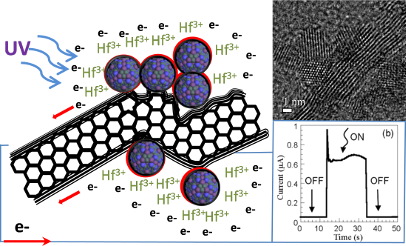
- conduction via the CNT. To date, numerous studies have been reported on the decoration of CNTs with metal oxides including TiO2 [7][8] and ZnO [9] for solar cell applications and SnO2 for gas sensors. Reports on the fabrication of an all carbon nanocomposite combining CNTs, graphene and carbon quantum dots
- including Hf and O vacancies [21]. The motivation of the present work is different from other well-studied luminescent nanocomposites containing TiO2 and ZnO that are investigated around band gap excitation. Here, contrary to the previous two semiconductors, novel optical properties and photocurrent


NO gas sensing at room temperature using single titanium oxide nanodot sensors created by atomic force microscopy nanolithography
Beilstein J. Nanotechnol. 2016, 7, 1044–1051, doi:10.3762/bjnano.7.97

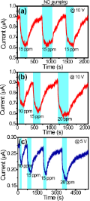
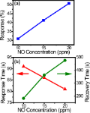
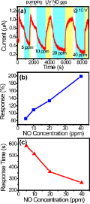
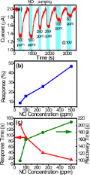
- fabrication of titanium oxide nanowire (NW) gas sensors [25][26]. NO gas sensing at low concentrations is beneficial for human health [1][2] and environmental monitoring [3]. Various types of metal oxide nanomaterials have been utilized for NO or NO2 gas sensing, e.g., SnO2 [12][15][16][17], ZnO [13][14][17

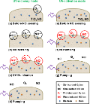
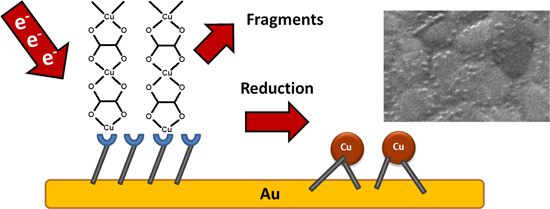
Efficient electron-induced removal of oxalate ions and formation of copper nanoparticles from copper(II) oxalate precursor layers
Beilstein J. Nanotechnol. 2016, 7, 852–861, doi:10.3762/bjnano.7.77
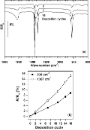
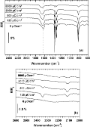
- chemisorbed species, two possibilities arise. The first is a dissociative adsorption of CO2 on the copper nanoparticles that are formed under electron exposure. This process is important for the chemical understanding of the industrial methanol synthesis with Cu–ZnO–Al2O3 catalysts [48] and has been observed


Selective photocatalytic reduction of CO2 to methanol in CuO-loaded NaTaO3 nanocubes in isopropanol
Beilstein J. Nanotechnol. 2016, 7, 776–783, doi:10.3762/bjnano.7.69

- can be solved simultaneously [3][4][5][6][7]. For this purpose, the photocatalytic conversion of CO2 to fuel is particularly emphasized. In 1979, Inoue et al. [8] first reported the photocatalytic reduction of CO2 in aqueous solution using several semiconductor materials (WO3, TiO2, ZnO, CdS, GaP and





