


Search results
Search for "charge density" in Full Text gives 154 result(s) in Beilstein Journal of Nanotechnology.
Influence of water on the properties of an Au/Mpy/Pd metal/molecule/metal junction
Beilstein J. Nanotechnol. 2011, 2, 384–393, doi:10.3762/bjnano.2.44

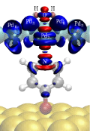
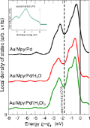
- of the Pdb LDOS is shifted to about −2.35 eV below Ef. Such a strong change of the density of states also indicates a substantial charge transfer between the involved constituents. This is illustrated by the charge density difference isodensity surfaces shown in Figure 5, which correspond to the
- difference between the charge density of the interacting Au/Mpy/Pd/H2O complex and the sum of the charge densities of the isolated Au/Mpy, Pd, and H2O subsystems in the same configuration. There is a strong charge rearrangement along both the N–Pdb and Pdb–O bonds indicative of the covalent character of the
- are marked with arrows. Charge density difference in an isodensity representation calculated as the difference between the charge density of the Au/Mpy/Pd/H2O complex and the sum of the charge densities of the Au/Mpy, Pd, and H2O subsystems. Blue and red surfaces depict the region of charge

![[Graphic 1]](/bjnano/content/inline/2190-4286-2-44-i1.png?max-width=637&scale=0.945456) )R3...
)R3...


![[Graphic 2]](/bjnano/content/inline/2190-4286-2-44-i2.png?max-width=637&scale=1.18182) = 1/3 ML. Plott...
= 1/3 ML. Plott...
The role of the cantilever in Kelvin probe force microscopy measurements
Beilstein J. Nanotechnol. 2011, 2, 252–260, doi:10.3762/bjnano.2.29

- inhomogeneous sample surface potential. Both the probe and the sample were divided into boundary elements in order to calculate their surface charge density. Unlike our previous work [7], where the probe was divided into conical and spherical elements, here we used commercial software (MSC/Patran®) in order to
- perform fast automatic meshing of an arbitrary probe geometry, including the cantilever as required in this work. The probe charge density was used as the unknown quantity to be determined in order to calculate subsequently the PSF. We use the following notations: (a) A matrix G which is a discrete
- Cinh represents the mutual capacitance density between every pair of surface and probe elements. By inserting the charge density distribution into the Maxwell stress tensor, replacing the probe potential with Vdc(r) + Vac sin(ωt), and extracting the force, we obtained the following expression for the


Defects in oxide surfaces studied by atomic force and scanning tunneling microscopy
Beilstein J. Nanotechnol. 2011, 2, 1–14, doi:10.3762/bjnano.2.1
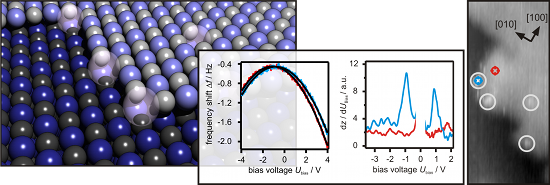
- imaged by NC-AFM [25][30] since a color center is a hole in the MgO lattice [22]. The observed attraction of F0 centers originates from the charge density of the two trapped electrons, which are located in the center of the defect site. Due to Coulomb repulsion, the trapped electrons repel each other and
- spill out of the defect site into the vacuum [31]. Therefore, a considerably large charge density is situated above the surface. This charge density is supposed to interact with the tip resulting in a strong attraction, as presented in Figure 7. Since the doubly occupied F0 state is close to the Fermi
- level of the MgO/Ag(001) system [32], the charge density is also responsible for the strong peak in the tunneling current signal. Further insights into the interaction of tip and color center are obtained by periodic supercell DFT calculations at the level of the generalized gradient approximation as


On the reticular construction concept of covalent organic frameworks
Beilstein J. Nanotechnol. 2010, 1, 60–70, doi:10.3762/bjnano.1.8

- total energy in the Density-Functional Theory (DFT) with respect to charge density fluctuations. This can be considered as a non-orthogonal tight-binding method parameterized from DFT, which does not require large amounts of empirical parameters, however, maintains all the qualities of DFT. The main




Other Beilstein-Institut Open Science Activities



