Search results
Search for "crystallites" in Full Text gives 202 result(s) in Beilstein Journal of Nanotechnology. Showing first 200.
Size-dependent density of zirconia nanoparticles
Beilstein J. Nanotechnol. 2015, 6, 27–35, doi:10.3762/bjnano.6.4
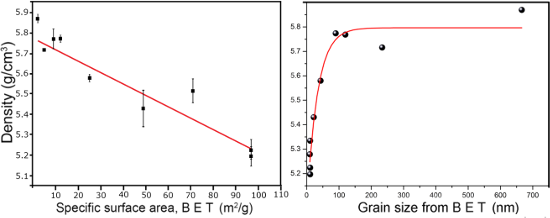
- . Annealing the powders at a temperature lower than 500 °C did not result in an increase in the crystallite size, where the crystallites remained approximately 11 nm in diameter. As the annealing temperature of the nano-ZrO2 was increased, the average crystallite and grain size of the powder increased. The
- diameter to increase to 72 nm (according to the Scherrer equation). The much larger apparent particle size indicated by the specific surface area measurements is the result of particle sintering. That is, the width of the XRD peaks depends on the size of the crystallites, while the specific surface area


Silicon and germanium nanocrystals: properties and characterization
Beilstein J. Nanotechnol. 2014, 5, 1787–1794, doi:10.3762/bjnano.5.189
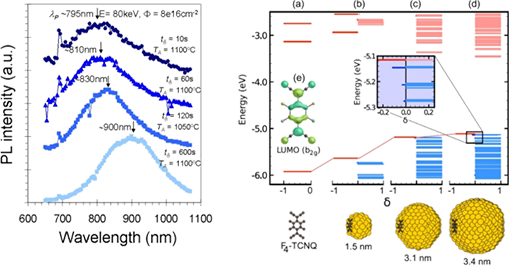
- Ossicini [52] showed that while radiative recombination of H-saturated Si NC is strongly dependent on the size of the crystallites, in hydroxy-terminated or SiO2-embedded NCs the optical yield is mostly determined by the fraction of oxygen termination. First-principles modeling has also been insightful in


Experimental techniques for the characterization of carbon nanoparticles – a brief overview
Beilstein J. Nanotechnol. 2014, 5, 1760–1766, doi:10.3762/bjnano.5.186
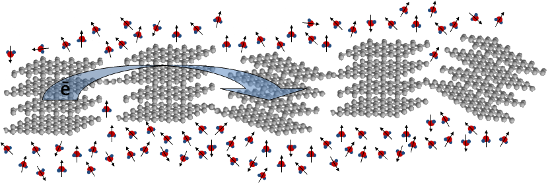
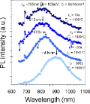
- of controlled charge and spin localization within different systems based on nano-graphite or nano-graphene crystallites can be approached. Individual carbon nanoparticles – the structure Graphite crystals are layered materials with the strong carbon bonding within the atomic sheets and weak
- order of the crystallites can be calculated from the powder XRD data. The diffractograms presented in Figure 1 show a progressive decrease in the peak intensity as well as broadening of the linewidth. The most prominent peak of the hexagonal structure, (002), undergoes the strongest alteration. The
- first order spectra can be correlated with the in-plane size of the crystallites. The D peak intensity depends on the defect concentration and indicates the presence of a crystalline border [26]. It is suppressed by the perfectly organized carbon layer since it is a hexagonal ring breathing mode [14


Controlling the dispersion of supported polyoxometalate heterogeneous catalysts: impact of hybridization and the role of hydrophilicity–hydrophobicity balance and supramolecularity
Beilstein J. Nanotechnol. 2014, 5, 1749–1759, doi:10.3762/bjnano.5.185
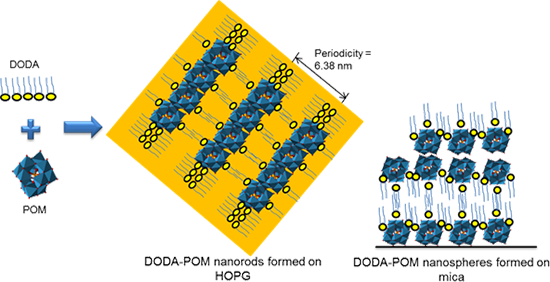
- design heterogeneous catalyst design, in which the classical wet impregnation technique often leads to the formation of large crystallites, particularly at high POM loadings, on various inorganic and/or on hydrophobic supports [28]. The demonstrated hybridization strategy of POMs with DODA and the


On the structure of grain/interphase boundaries and interfaces
Beilstein J. Nanotechnol. 2014, 5, 1603–1615, doi:10.3762/bjnano.5.172

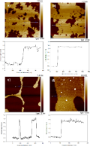
- Figure 2, one finds that they are comparable. Both phases (glassy component and the interfacial component) fluctuate structurally within a specimen by the same amount. In contrast, in a poly-crystalline or nano-grained material, the component of the spectrum associated with the crystallites is very


Ionic liquid-assisted formation of cellulose/calcium phosphate hybrid materials
Beilstein J. Nanotechnol. 2014, 5, 1553–1568, doi:10.3762/bjnano.5.167
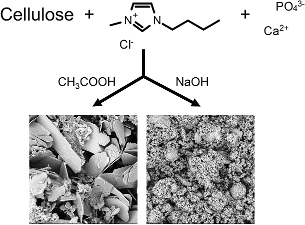
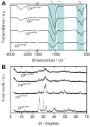
- small crystallites, poor crystallinity, and poor crystallographic correlation, Figure 8. Patterns of neat microcrystalline cellulose show reflections at 15.1 and 22.8° 2θ; these can be attributed to the crystalline structure of the cellulose. XRD patterns of all samples show that the order of the


Magnesium batteries: Current state of the art, issues and future perspectives
Beilstein J. Nanotechnol. 2014, 5, 1291–1311, doi:10.3762/bjnano.5.143
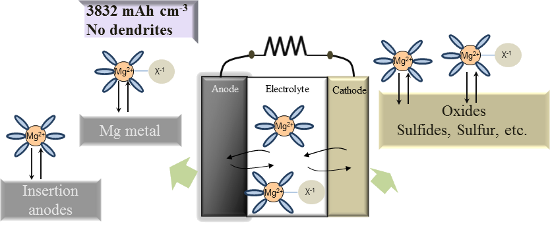
- MOF’s crystallites, addition of Mg(TFSI)2 (i.e., weakly coordinating anion) was necessary to achieve a good conductivity (0.25 vs 0.0006 mS cm−1 in just phenolates/MOF). No results addressing the compatibility with magnesium metal or oxidative stability were provided. It may be possible that this system


Electron-beam induced deposition and autocatalytic decomposition of Co(CO)3NO
Beilstein J. Nanotechnol. 2014, 5, 1175–1185, doi:10.3762/bjnano.5.129
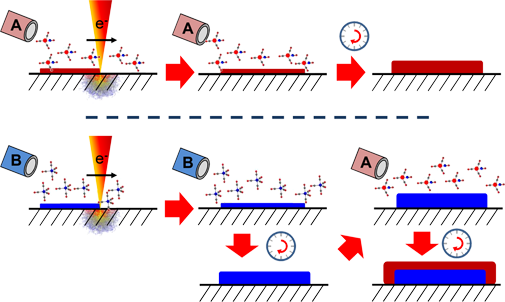
- deposits (such as the EBID deposits discussed before), but also on high purity Fe nanostructures. The latter can be prepared from Fe(CO)5 by EBID or EBISA, plus successive autocatalytic growth. The iron structures are typically composed of very pure (>90–95 atom %) cubic crystallites, as a result of the
- autocatalytic growth process [7][8][16][17][18][19]. The morphology ranges from scattered clusters for low electron doses and shorter growth times, to fused, polycrystalline patches of cubic crystallites for high electron doses and long growth times [7][8][16][17][18][19]. After preparation of the Fe deposits
- are composed of cubic crystallites of α-Fe(bcc). These crystallites are quite regular, and their vacuum interfaces consist mainly of low index {100} faces of these cubes. A representative structure is presented in Figure S2 of Supporting Information File 1. In the case of Co(CO)3NO, not very well




Optical and structural characterization of oleic acid-stabilized CdTe nanocrystals for solution thin film processing
Beilstein J. Nanotechnol. 2014, 5, 881–886, doi:10.3762/bjnano.5.100

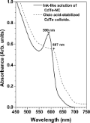
- . Interestingly, the CdTe crystallites preserve their size when deposited in the glass substrate, so testifying the suitable oleic acid stabilization. In regarding the Cd3P2 formation, it is thought that it was originated by reacting cadmium and phosphor ions, with the latter being provided by the TOP


Enhanced photocatalytic activity of Ag–ZnO hybrid plasmonic nanostructures prepared by a facile wet chemical method
Beilstein J. Nanotechnol. 2014, 5, 639–650, doi:10.3762/bjnano.5.75
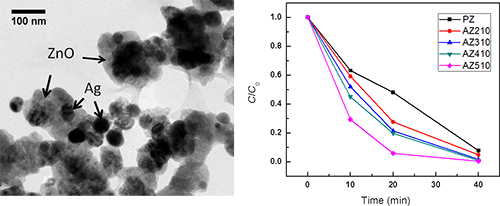
- and prevent the accumulation of growth units on the (0001) surface. Because of this the growth of ZnO crystallites occurs along the six symmetric directions, producing ZnO nanodisks [38]. Thus the morphology of ZnO nanostructures can be easily altered by using trisodium citrate [39]. Detailed studies


Biocalcite, a multifunctional inorganic polymer: Building block for calcareous sponge spicules and bioseed for the synthesis of calcium phosphate-based bone
Beilstein J. Nanotechnol. 2014, 5, 610–621, doi:10.3762/bjnano.5.72

- formation [56]. Our EDX mapping studies [20] indicate that the crystallites initially formed onto SaOS-2 cells are not only rich in the elements calcium and phosphorous but also in carbon. We have taken this observation as a further indication that carbonate and phosphate deposits are co- or sequentially
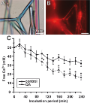
- cells retain their capacity to synthesize HA crystallites. Furthermore, the mechanical properties, including surface roughness and hardness, of the hydrogel were determined. If silica is included in the hydrogel matrix, the encapsulated SaOS-2 cells were found to increasingly express the gene encoding
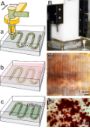
- SaOS-2 cells into the Na alginate, with the indicated supplements, and allowed the matrix to be passed through the capillary of the 3D printer (Figure 6). The arrays of strands were computed to 4 mm high blocks into which the cells remained viable and retained the capacity to form mineral crystallites



Plasma-assisted synthesis and high-resolution characterization of anisotropic elemental and bimetallic core–shell magnetic nanoparticles
Beilstein J. Nanotechnol. 2014, 5, 466–475, doi:10.3762/bjnano.5.54

- crystallites with typical sizes of a few nm (Figure 7). A FFT of the grains yields lattice spacings that were attributed to Cu2O (JCPDS: 05-0667 a = 0.4252 nm), although the analysis is seriously impeded by pronounced distortions, small grain sizes and boundaries as well as surface effects. Conclusive evidence


Nanoscale particles in technological processes of beneficiation
Beilstein J. Nanotechnol. 2014, 5, 458–465, doi:10.3762/bjnano.5.53

- microsize structures. For example, more than thirty years ago, Galimov [5] predicted the possibility of diamond synthesis through a cavitation process. In 2003, this possibility was confirmed in experiments [6]. The particles formed in the cavitation process were an aggregation of nanosize crystallites. The


Oriented attachment explains cobalt ferrite nanoparticle growth in bioinspired syntheses
Beilstein J. Nanotechnol. 2014, 5, 210–218, doi:10.3762/bjnano.5.23

- oriented substructures within the disc exist. EELS measurements show that incomplete discs, such as the diamond-shaped particle in Figure 3d, are of various non-stoichiometric phases with a compositional gradient. Non-aggregated areas, such as region 1, where crystallites are still visible, are of an iron
- representations of the reciprocal lattice of the nanoparticles. Sharp rings in the pattern as observed in the nanoparticle diffraction pattern after 5 minutes are caused by randomly oriented crystallites within the nanoparticle that lie in the same zone axis. The observed ring is diminished after 1 day showing
- that the crystallites start to orient along the same axis and that an increase in orientation with time occurs. Furthermore, a change in the zone axis and therefore top/bottom crystal face from [112] to [111] occurs after 2 days which indicates that a reorientation process takes place. In addition, the


3D-nanoarchitectured Pd/Ni catalysts prepared by atomic layer deposition for the electrooxidation of formic acid
Beilstein J. Nanotechnol. 2014, 5, 162–172, doi:10.3762/bjnano.5.16

- cannot be attributed to the supporting NiO crystallites since their average size is in the range of 10–15 nm according to TEM cross section shown as supplemental material (Figure S2, Supporting Information File 1). The QCM, XPS and XRD measurements also attest the deposition of Pd onto the NiO layers


Study of mesoporous CdS-quantum-dot-sensitized TiO2 films by using X-ray photoelectron spectroscopy and AFM
Beilstein J. Nanotechnol. 2014, 5, 68–76, doi:10.3762/bjnano.5.6

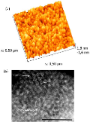
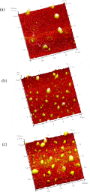
- sizes. AFM analysis shows that the growth of the CdS particles is a two-step process. The first step is the formation of new crystallites at each deposition cycle. In the next step the pre-deposited crystallites grow to form larger aggregates. Special attention is paid to the estimation of the CdS
- presence of few isolated crystallites (5 nm high), the lateral size of the crystals after 15 deposition cycles was remarkably larger than after 7 deposition cycles. This shows that increasing the number of deposition cycles leads to the growth of CdS nanocrytals in two forms; 1) the formation of new
- crystallites at each depositing cycle, and 2) the growth of pre-deposited crystallites into large aggregates. TEM analysis was performed for the 15×CdS/TiO2 sample (Figure 3). It was found that the majority of CdS nanoparticles have a nearly spherical shape with an average particle size of about 10 nm. The TEM


In situ growth optimization in focused electron-beam induced deposition
Beilstein J. Nanotechnol. 2013, 4, 919–926, doi:10.3762/bjnano.4.103

- small Pt-crystallites between existing Pt-crystals in the nanogranular structure of Pt–C or to a growth of the previously present Pt-crystallites that leads to a reduction of the intergrain distance and therefore to a decreasing resistivity [33]. We found that, as already shown in previous experiments


Template based precursor route for the synthesis of CuInSe2 nanorod arrays for potential solar cell applications
Beilstein J. Nanotechnol. 2013, 4, 868–874, doi:10.3762/bjnano.4.98
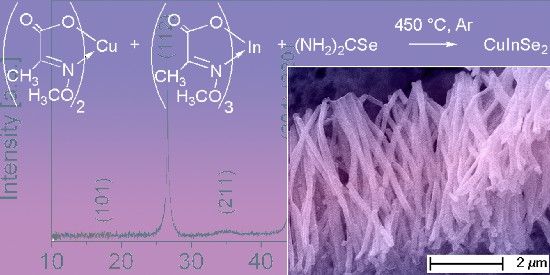
- rods are composed of nanocrystals of approximately 5–10 nm in size, which is in contrast to the determined mean crystallite size as obtained from the Scherrer equation. However, it can be seen that if one moves across an individual rod, the individual crystallites mostly overlap, thus their exact
- individual size cannot be determined. Possibly, smaller crystallites are distributed at the surface, and a crystal size enlargement takes place near the rod core, so that the average size equals to 30 nm. It has to be mentioned that the samples for TEM/SAED were dispersed in ethanol by ultrasonication before
- and TEM examination, smaller 5–10 nm crystallites are mainly concentrated on the surface and in the surface region of the rods, while the rod core presumably consists of larger nanocrystals. The crystalline chalcopyrite phase was also confirmed by Raman spectroscopy, which suggested that there are no


Controlled synthesis and tunable properties of ultrathin silica nanotubes through spontaneous polycondensation on polyamine fibrils
Beilstein J. Nanotechnol. 2013, 4, 793–804, doi:10.3762/bjnano.4.90

- -concentration of oligomer methoxysilane also accelerates the collapse of the LPEI crystallites. Effect of the alkali basicity. We also tried to use different alkalies to induce the room-temperature self-assembly of LPEI from the protonated state. The synthesis conditions are similar to that used for the silica


Simulation of electron transport during electron-beam-induced deposition of nanostructures
Beilstein J. Nanotechnol. 2013, 4, 781–792, doi:10.3762/bjnano.4.89
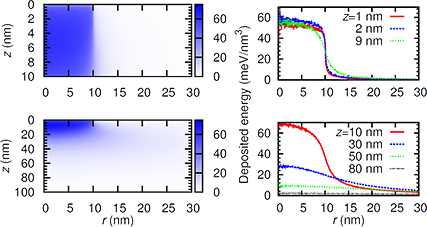
- nanostructure at the focus of the beam. In general, the obtained deposits exhibit a granular structure that consists of nanometer-sized metal crystallites, which are embedded in an insulating matrix. There are three main interactions that determine the growth of nanostructures in the EBID process: (1) the



Influence of particle size and fluorination ratio of CFx precursor compounds on the electrochemical performance of C–FeF2 nanocomposites for reversible lithium storage
Beilstein J. Nanotechnol. 2013, 4, 705–713, doi:10.3762/bjnano.4.80
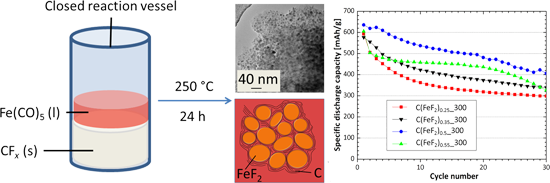
- matrix and produce FeF2 nanoparticles by reducing the CFx carbon backbone to graphitic carbon in a reactive intercalation process. The final material contains crystallites of FeF2 with diameters of a few nanometers, which are closely packed and embedded between graphitic carbon sheets. The graphitic




A facile synthesis of a carbon-encapsulated Fe3O4 nanocomposite and its performance as anode in lithium-ion batteries
Beilstein J. Nanotechnol. 2013, 4, 699–704, doi:10.3762/bjnano.4.79

- bare Fe3O4 nanoparticles could also be observed (Figure S2 in Supporting Information File 1). Fast Fourier transform (FFT) analysis of various HRTEM images (of crystallites located inside or outside of carbon shells, see Figure S3 in Supporting Information File 1) reveal that the observed lattice


Evolution of microstructure and related optical properties of ZnO grown by atomic layer deposition
Beilstein J. Nanotechnol. 2013, 4, 690–698, doi:10.3762/bjnano.4.78
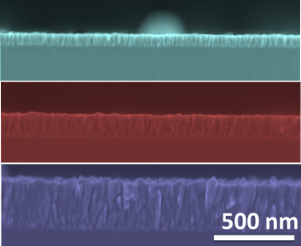
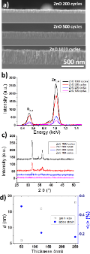
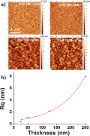
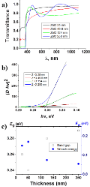
- improvement of the crystalline structure of deposited samples. The structure of 25 nm thick films is amorphous. The films might contain crystallites with a size of less than 3 nm which are difficult to detect by XRD. In this case, a band gap broadening due to the quantum confinement effect would be expected
- . However, results obtained from 25 nm films do not show any significant increase of the band gap value. This hints at an absence of small crystallites in the amorphous structure of the films. Because of the disorder in amorphous and highly doped semiconductors, the absorption or the optical density D near
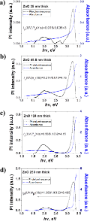
- the UV–vis PL bands [20]. In the present study the calculated UV–vis ratio of the PL band intensities of ZnO increase with the growth of film thickness. This may be associated with: improvement of the stoichiometry and the structure of ZnO crystallites grain growth and decreasing number of point

Site-selective growth of surface-anchored metal-organic frameworks on self-assembled monolayer patterns prepared by AFM nanografting
Beilstein J. Nanotechnol. 2013, 4, 638–648, doi:10.3762/bjnano.4.71
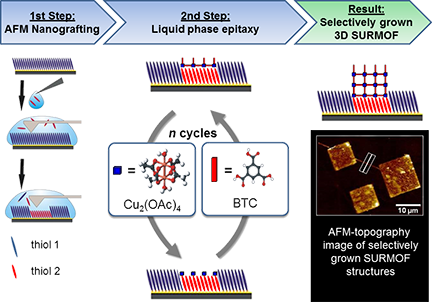
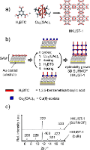
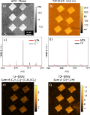
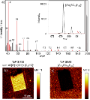
- , grafted areas and the matrix SAM. A higher density of crystallites can be found at the MHDA terminated surface areas. This is in contrast to the findings for the selective SURMOF grown on the MPA-terminated areas grafted in the DT SAM where no particulate material can be detected on the OD SAM (Figure 5
- growth and thiols that set up the matrix must be figured out, in order to avoid an undesirable and uncontrolled growth of SURMOF crystallites on the non-grafted areas. (This was observed for the SURMOFs based on MHDA grafted into an ODT matrix SAM.) Nevertheless the availability of such MOF-structures





AFM as an analysis tool for high-capacity sulfur cathodes for Li–S batteries
Beilstein J. Nanotechnol. 2013, 4, 611–624, doi:10.3762/bjnano.4.68
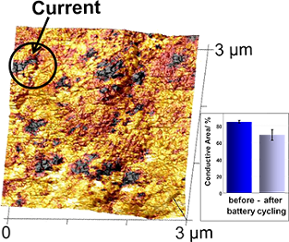
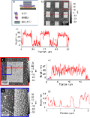
- approximately 2–3 μm are visible, which possess a high hardness, no conductivity, and show low deformation and energy dissipation. The region in between these crystallites exhibits a finite but very small conductivity, one order of magnitude smaller than before cycling. Here, several small conductive soft