


Search results
Search for "grain boundaries" in Full Text gives 158 result(s) in Beilstein Journal of Nanotechnology.
Reversible mechano-electrochemical writing of metallic nanostructures with the tip of an atomic force microscope
Beilstein J. Nanotechnol. 2012, 3, 824–830, doi:10.3762/bjnano.3.92

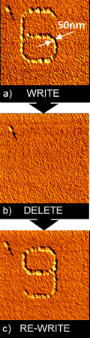
- defects and grain boundaries. The deposited metal in the beginning of the deposition process thus forms a chain of islands along the path of the AFM tip. These islands finally touch and overgrow each other, in this way forming a continuous wire in the shape of the digit “6”. The line width of the


Dimer/tetramer motifs determine amphiphilic hydrazine fibril structures on graphite
Beilstein J. Nanotechnol. 2012, 3, 658–666, doi:10.3762/bjnano.3.75
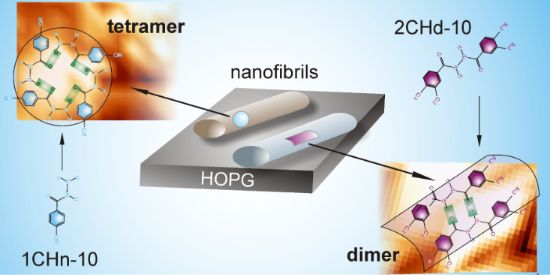
- 1CHn-10 and 2CHd-10 to produce fibrils (as evident from the AFM images), the absence of grain boundaries and single/multiple steps near the molecular wires [25] (which are the two most important causes for their appearance), and the discrepancy in periodicities between molecular structures and reported




Effect of deposition temperature on the structural and optical properties of chemically prepared nanocrystalline lead selenide thin films
Beilstein J. Nanotechnol. 2012, 3, 438–443, doi:10.3762/bjnano.3.50

- due to a decrease in the occurrence of grain boundaries because of an increase in the crystallite size of the film with increasing temperature. Surface morphology Scanning electron microscopy gives valuable information regarding the shape and size of the grains on the surface of the deposited thin




Junction formation of Cu3BiS3 investigated by Kelvin probe force microscopy and surface photovoltage measurements
Beilstein J. Nanotechnol. 2012, 3, 277–284, doi:10.3762/bjnano.3.31

- distribution for In2S3 compared to that of CdS and ZnS. For In2S3 and CdS buffer layers the KPFM experiments indicate negatively charged Cu3BiS3 grain boundaries resulting from the deposition of the buffer layer. Macroscopic measurements of the surface photovoltage at variable excitation wavelength indicate
- , such as chemical bath deposition, atomic layer deposition, ion layer gas reaction (ILGAR) deposition, evaporation, and spray deposition [9]. One interesting aspect of the above mentioned solar cell materials CdTe and Cu(In,Ga)Se2 is their high efficiency despite the abundance of grain boundaries (GBs
- ). Scanning probe microscopy experiments have provided significant insight into the physics of grain boundaries on these materials [10]. Specifically, recent experiments provided evidence for the benign properties of the GBs [11][12], in agreement with previous theoretical work [13][14]. Also the influence of


Nanoscaled alloy formation from self-assembled elemental Co nanoparticles on top of Pt films
Beilstein J. Nanotechnol. 2011, 2, 473–485, doi:10.3762/bjnano.2.51

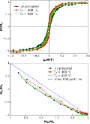
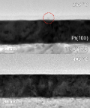
- exhibiting grain sizes (20–30 nm) smaller than the particle spacing (100 nm), the formation of local nanoalloys at the surface is strongly suppressed and Co incorporation into the film via grain boundaries is favoured. In contrast, due to the absence of grain boundaries on high quality epitaxial Pt(100
- restricted by a photoelectron mean free path of about 1.6 nm [27]. Rather, diffusion along the large number of grain boundaries in the Pt(111) film on MgO(100) is expected. On Pt(100) films with micron-sized, atomically-flat surfaces this diffusion channel does not exist for most of the NPs, thus markedly
- reduced Co content after annealing suggests that Co atoms diffuse away from the surface along grain boundaries at elevated temperature. Thus, we speculate that after annealing the size-reduced NPs on Pt(111) remain in a pure Co, or at least Co-rich, phase having a rather low orbital moment. Nevertheless




Formation of precise 2D Au particle arrays via thermally induced dewetting on pre-patterned substrates
Beilstein J. Nanotechnol. 2011, 2, 318–326, doi:10.3762/bjnano.2.37

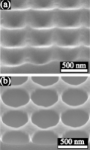
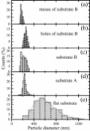
- agglomeration [32][33], voids can nucleate due to periodic film thickness fluctuations (spinodal dewetting), or at defects, which is then followed by void growth and particle formation [31]. For polycrystalline metallic films, dewetting is also affected by the character of grain boundaries [33]. Altogether
- , and then proceeds with void growth and particle formation. For polycrystalline films on the flat substrates, void nucleation is generally thought to occur due to grain boundary grooving, via surface diffusion at the grain boundaries, and grain boundary triple junctions which intersect the substrate
- surface [39][40]. Recently, Mueller and Spolenak have reported that holes (large substrate-exposing voids) were found to protrude into the film predominantly at high angle grain boundaries during dewetting [41]. During annealing, grain boundary grooving and grain growth are competing kinetic processes



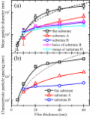


Schottky junction/ohmic contact behavior of a nanoporous TiO2 thin film photoanode in contact with redox electrolyte solutions
Beilstein J. Nanotechnol. 2011, 2, 127–134, doi:10.3762/bjnano.2.15
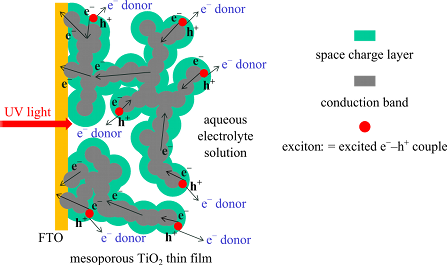
- are transported first to the fluorine-doped tin oxide (FTO, SnO2:F) conductive layer through TiO2 grain boundaries and then to the cathode reducing electron acceptor there (O2 in the present case). In a Schottky junction, under the conditions when the band structure is flat without any bending, the
- . The thin space charge layer is located at the interface between TiO2 and the liquid, and the band structure (CB and VB) in the TiO2 bulk is interconnected through the TiO2 grain boundaries forming continuous CB electron-transporting channels from the space charge layer to reach the conductive layer on
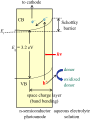
- separated into electrons and holes due to the slope of the VB and CB bands, the h+ then being reduced by MeOH present in the liquid, and the e− being transported in the CB through TiO2 grain boundaries to the counter cathode via the FTO. As reported earlier by us [13], resistances at the grain boundaries




Defects in oxide surfaces studied by atomic force and scanning tunneling microscopy
Beilstein J. Nanotechnol. 2011, 2, 1–14, doi:10.3762/bjnano.2.1
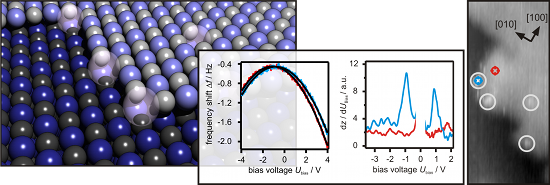
- trapped charge on the surface dipole. This demonstrates the great benefit of NC-AFM and KPFM in combination with STM and STS. Line defects Apart from point defects more complex structures like line defects are found on oxide surfaces. Line defects can be caused by step edges or grain boundaries that


Other Beilstein-Institut Open Science Activities



