

Search results
Search for "anode" in Full Text gives 183 result(s) in Beilstein Journal of Nanotechnology.
Characterization and properties of micro- and nanowires of controlled size, composition, and geometry fabricated by electrodeposition and ion-track technology
Beilstein J. Nanotechnol. 2012, 3, 860–883, doi:10.3762/bjnano.3.97
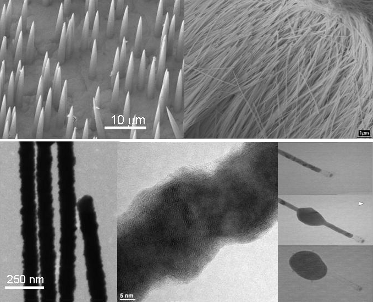
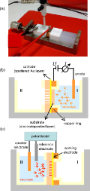
- other half-cell contains either water or an acidic stopping medium that neutralizes the etchant as soon as the pore opens. In both cases, further etching is extensively slowed down or entirely stopped (Figure 4c). In addition, by immersing the positive anode in the etching solution, the negative ions in
- monitored by chronoamperometric current–time (I–t) curves. In the two-electrode arrangement the potential Uc is applied between cathode and anode. In the three-electrode arrangement, reference electrodes such as saturated silver/silver chloride (Ag/AgCl/sat. KCl) and saturated calomel electrodes (SCE) are
- the deposition. Addition of sulphuric acid increases the conductivity of the solution and lowers the cathode overvoltage. Electrodeposition is typically performed potentiostatically in a two-electrode arrangement by using a copper anode, at temperatures between 25 and 70 °C. By applying low








Low-temperature synthesis of carbon nanotubes on indium tin oxide electrodes for organic solar cells
Beilstein J. Nanotechnol. 2012, 3, 524–532, doi:10.3762/bjnano.3.60

- -modified ITO surfaces was measured by the Kelvin probe method to be 4.95 eV, resulting in an improved matching to the highest occupied molecular orbital level of the P3HT. This is in turn expected to increase the hole transport and collection at the anode, contributing to the significant increase of
- the fullerene derivative acts as an electron acceptor [6]. The holes move in the polymeric phase towards the anode, while the electrons hop along the fullerenes and eventually reach the cathode. Since the diffusion length of the exciton in the polymers is very low, recombination is highly probable
- the ITO–CNT electrode (as depicted in Figure 4). Nevertheless, this increase in WF is strongly beneficial because it brings the electrode WF closer to that of the photoactive blend. Thus we anticipate a reduction in the hole–injection barrier at the anode interface, as a result of the highest occupied




A facile approach to nanoarchitectured three-dimensional graphene-based Li–Mn–O composite as high-power cathodes for Li-ion batteries
Beilstein J. Nanotechnol. 2012, 3, 513–523, doi:10.3762/bjnano.3.59

- . As a material with high electrical conductivity and large surface area [19][20][21][22], graphene has attracted much attention for battery electrode applications. The hybrids of transition-metal-oxide nanocrystals attached onto graphene sheets have shown much improvement of LIB anode performance [23
- ][24][25][26], in which charge transfer is improved and the agglomeration of the metal oxide nanocrystals is prevented. Moreover, a recent report [27] indicated that by combining nanolayer carbon (e.g., graphene or nanoporous carbon) with sulfide anode may help to solve the issue of the dissolution of




Ultraviolet photodetection of flexible ZnO nanowire sheets in polydimethylsiloxane polymer
Beilstein J. Nanotechnol. 2012, 3, 353–359, doi:10.3762/bjnano.3.41

- suspension was vacuum filtered through a porous anode aluminum oxide (AAO) membrane, diameter of 4.3 cm and pore size of 200 nm, purchased from Whatman Co. Then the network film of ZnO nanowires on an AAO membrane was dried in air at 100 °C for 1 h. Finally, the thin sheet of ZnO nanowires was detached from


Parallel- and serial-contact electrochemical metallization of monolayer nanopatterns: A versatile synthetic tool en route to bottom-up assembly of electric nanocircuits
Beilstein J. Nanotechnol. 2012, 3, 134–143, doi:10.3762/bjnano.3.14

- electrooxidation of the target monolayer (CEP step), the target is biased positively (anode) with respect to the patterning electrode, whereas for metal transfer (CET step), the polarity of the applied bias voltage is reversed so that the stamp or the SFM probe now acts as the anode and the target monolayer as the
- lines surrounded by the unmodified OTS monolayer. As discussed in the following, the selectivity of silver deposition on the OTSeo lines follows from the fact that Ag+ ions generated electrochemically at the metal stamp (anode) are transported through the adsorbed water film, acting as an electrolyte
- electrochemical rather than adhesion-promoted [32][33][34][35], involving dissolution of stamp-metal grains (anode), ionic transport through an ultrathin water film adsorbed on the metal grains, and subsequent nucleation and growth of new metal grains at the target monolayer (cathode); (ii) metal grains can


Mesoporous MgTa2O6 thin films with enhanced photocatalytic activity: On the interplay between crystallinity and mesostructure
Beilstein J. Nanotechnol. 2012, 3, 123–133, doi:10.3762/bjnano.3.13
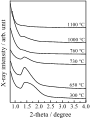
- diffraction (XRD) measurements were performed in a Bruker D8 diffractometer with an accelerating voltage of 40 kV and a current of 40 mA, with Cu Kα radiation. The 2-D-SAXS measurements were carried out by using a Nonius rotating anode setup (Cu Kα radiation with λ = 0.154 nm) featuring a three-pinhole






Microfluidic anodization of aluminum films for the fabrication of nanoporous lipid bilayer support structures
Beilstein J. Nanotechnol. 2011, 2, 104–109, doi:10.3762/bjnano.2.12

- aluminum was then anodized under constant voltage conditions. Thus, 40 V were applied between the aluminum and a platinum counter electrode, which was inserted in the flow cell, approximately 2 cm upstream of the substrate. The aluminum anode was directly contacted outside of the flow cell. Completion of


Low-temperature solution growth of ZnO nanotube arrays
Beilstein J. Nanotechnol. 2010, 1, 128–134, doi:10.3762/bjnano.1.15

- V was applied to the ITO substrate as cathode and a platinum plate was used as the anode. The deposition time was about 5 min. The substrate was subsequently heat-treated at 500 °C for 30 min to improve the crystallinity of the film of ZnO nanocrystallites. For the growth of ZnO nanorods, the ZnO


Other Beilstein-Institut Open Science Activities