Search results
Search for "bilayer" in Full Text gives 188 result(s) in Beilstein Journal of Nanotechnology.
Ultramicrosensors based on transition metal hexacyanoferrates for scanning electrochemical microscopy
Beilstein J. Nanotechnol. 2013, 4, 649–654, doi:10.3762/bjnano.4.72

- were followed by 2 cycles of Ni–HCF deposition forming one “bilayer”. AFM images of Prussian blue and Ni–HCF deposited on top are shown in Figure 1. After the last deposition step the electrodes were activated by CV as described in the Experimental section of this manuscript. Increasing the number of


Routes to rupture and folding of graphene on rough 6H-SiC(0001) and their identification
Beilstein J. Nanotechnol. 2013, 4, 625–631, doi:10.3762/bjnano.4.69
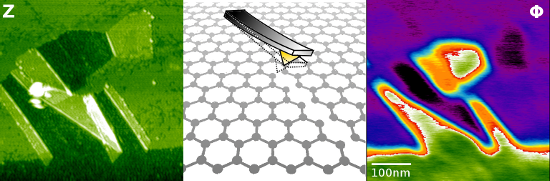
- Kelvin probe force microscopy (KPFM). SHI irradiation results in rupture of the SLG sheets, thereby creating foldings and bilayer graphene (BLG). Applying the other modification methods creates enlarged (twisted) graphene foldings that show rupture along preferential edges of zigzag and armchair type
- microelectronics technology [3], in which especially bilayer graphene (BLG) is of interest, as its band gap can be tuned [4]. Although the electronic properties of AB-stacked (Bernal) BLG is of special interest due to its tunable bandgap, rotationally stacked or twisted BLG is more attractive from an application
- carpet [32]. The Kelvin-compensated NC-AFM topography measurements taken on SLG reflect the substrate step structure with its bilayer step height of 0.33 ± 0.10 nm [13]. A representative line profile is shown in the inset of Figure 2. To determine whether the roughness on the SLG reflects the contours of


Characterization of electroforming-free titanium dioxide memristors
Beilstein J. Nanotechnol. 2013, 4, 467–473, doi:10.3762/bjnano.4.55
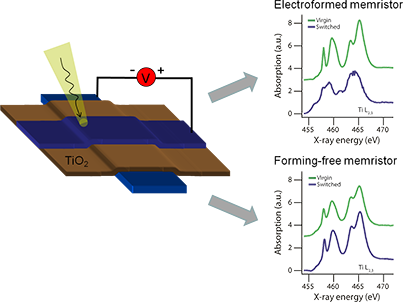
- single layer TiO2 (30 nm) was sputter-deposited from a titania source. For electroforming-free devices (described below), a bilayer was used consisting of TiO2−x (30 nm) and TiO2 (5 nm), where the thicker oxygen deficient layer was sputter deposited from a Ti4O7 Magnéli phase target and the thinner
- stoichiometric TiO2 film is predominantly amorphous with some small (<10 nm) anatase grains, while the bilayer film is amorphous with no observed structural ordering. Electrical measurements of both types of devices are shown in Figure 1. Both showed reversible bipolar resistance switching. The standard device
- electroforming step is irreversible. In contrast, the bilayer device, Figure 1b, did not require such an electroforming step and subsequent bipolar resistance switching showed that the initial conductive state of the device (“Virgin”) is nearly equivalent to the subsequent OFF state. Thus, this bilayer device



Nanoscopic surfactant behavior of the porin MspA in aqueous media
Beilstein J. Nanotechnol. 2013, 4, 278–284, doi:10.3762/bjnano.4.30

- hydrophilic vestibule (the “head” of the surfactant) can potentially be deformed when single MspA proteins aggregate. Protein deformation is often observed during crystallization [26]. The formation of a bilayer is evidence for attractive interactions between MspA units. Predicting the geometry of
- formation. Then the change in the chemical potential (Δμ°) during supramolecular aggregation is dependent on the transfer of MspA from the aqueous phase into the MspA-bilayer and the interaction of the head groups. The term (Δµº/kBT)transfer is negative, because the solvation of extended hydrophobic
- describes the energetic contribution arising from the interactions of the vestibules of MspA in the bilayer. Due to the presence of polar amino-acid side-chains at the exterior of the MspA’s “head”, hydrogen bonding [29] is most likely responsible for the discrepancy of the calculated packing parameter P




Growth behaviour and mechanical properties of PLL/HA multilayer films studied by AFM
Beilstein J. Nanotechnol. 2012, 3, 778–788, doi:10.3762/bjnano.3.87

- . It was found that the film thickness increases linearly with the bilayer number n, ranging between 400 and 7500 nm for n = 12 and 96, respectively. The apparent Young’s modulus E ranges between 15 and 40 kPa and does not depend on the indenter size or the film bilayer number n. Stress relaxation
- Bilayer number n versus film thickness h The thickness h of (PLL/HA)n films with n = 12, 24, 36, 48, 60, 72, 84, 96 was measured both to determine the growth regime and to be able to study the mechanical properties. Two methods were used to determine the thickness. The first one is the scratch-and-scan
- and full-indentation is presented in Figure 3. The results of the two completely independent methods coincide very well within the experimental errors. Film thickness increases linearly with increasing bilayer number n (with an exception of n = 48) and ranges from about 0.4 to 7 μm for n = 12 and n


Large-scale analysis of high-speed atomic force microscopy data sets using adaptive image processing
Beilstein J. Nanotechnol. 2012, 3, 747–758, doi:10.3762/bjnano.3.84

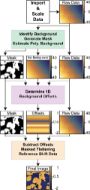
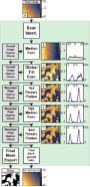
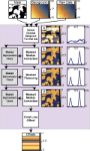
- bilayer of mixed composition. Figure 2A and Figure 2E show the starting data. If present, the 1-D errors must be corrected first because any attempts to correct for the 2-D distortions will be biased by these 1-D offsets. To do this, the offset caused by the 1-D distortions is removed from each line
- routine on an example lipid bilayer of mixed composition are shown as the inputs and outputs of each major block. Each block will be discussed separately in detail. 1.1 Identify the background, generate a mask, estimate the polynomial background The purpose of this section is to identify the background
- in the image. Panel E shows the raw data of a mixed lipid bilayer on mica. Panel F shows the results of line-by-line second-order polynomial subtraction. Panel G shows 1-D artifact correction followed by 2-D second-order polynomial subtraction. Panel H shows the results of 1-D artifact correction




Ordered arrays of nanoporous gold nanoparticles
Beilstein J. Nanotechnol. 2012, 3, 651–657, doi:10.3762/bjnano.3.74

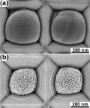
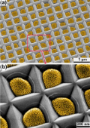
- <λp>, and the characteristic particle spacing s increase with increasing film thickness for the dewetted nanoparticles on flat substrates [19]. However, the prepatterned substrates with nanostructures lead to an obvious reduction of the particle size and spacing [19]. Although the total bilayer



Horizontal versus vertical charge and energy transfer in hybrid assemblies of semiconductor nanoparticles
Beilstein J. Nanotechnol. 2012, 3, 629–636, doi:10.3762/bjnano.3.72

- ]. In the present study, we applied PL and PL-lifetime measurements to investigate charge and energy transfer processes in hybrid self-assembled bilayer structures of donor and acceptor semiconductor NPs bound through organic linkers (Figure 1a). This system is different from the QDS, LB and LBL systems
- enable charge transfer processes within the first layer. This coupling is dependent on the linker length and it may affect dramatically the energy transfer processes in the bilayer system containing donors and acceptors. We suggest a model that provides a possible explanation for the observed results
- by Equation 4. Figure 3 presents the PL-lifetime from the acceptor and the donor NPs in the bilayer samples as compared with a monolayer of acceptor or donor NPs only. The adsorption of the donor NP layer hardly changed the PL-lifetime of the acceptors for the bilayers with C3DT linkers (Figure 3a


An NC-AFM and KPFM study of the adsorption of a triphenylene derivative on KBr(001)
Beilstein J. Nanotechnol. 2012, 3, 221–229, doi:10.3762/bjnano.3.25
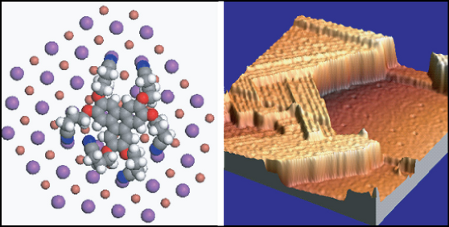
- room for progress as shown by the impressive submolecular resolution that has been demonstrated in recent works on the adsorption of pentacene [14] or decastarphene [15] molecules on Cu(111) and on a NaCl(001) bilayer on Cu(111). During the same period, Kelvin probe force microscopy (KPFM) has been




Quantitative multichannel NC-AFM data analysis of graphene growth on SiC(0001)
Beilstein J. Nanotechnol. 2012, 3, 179–185, doi:10.3762/bjnano.3.19
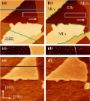
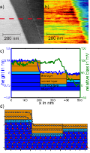
- terraces have a typical height of 1.5 nm, whereas the smaller steps towards the depressed islands have a height of roughly 0.25 nm (Table 1). The step heights match the height of the SiC unit cell of 1.52 nm [21] and the SiC bilayer height of 1.52 nm/6 = 0.253 nm, respectively. The surface oxide was
- the surface is now atomically smooth. Step heights between the smooth terraces are mostly 0.25 nm, 0.5 nm and 0.75 nm, which again correspond to multiples of the SiC(0001) bilayer height (Table 1). The step height between rough spots and adjacent smooth terraces was found to be approximately 0.17 nm
- bilayers. The right step is a substrate bilayer step combined with a change in graphene coverage from single to double layer. The resulting topographic step height is 0.09 nm, the change in contact potential 130 mV. Such analysis is supported by the fact that steps with a height that is a multiple of the



Self-assembled monolayers and titanium dioxide: From surface patterning to potential applications
Beilstein J. Nanotechnol. 2011, 2, 845–861, doi:10.3762/bjnano.2.94

- significantly improve the solubility and dispersibility of the nanocrystals in aprotic solvents, upon coating with thin films of oleic acid (CH3(CH2)7CH=CH(CH2)7COOH) [31]. The aggregation on undoped particles was explained by the oleic acid forming a bilayer, with the carboxylic groups located at the solvent
- nanoparticles the formed monolayer was denser than on undoped examples, thus preventing the interpenetration of hydrophobic chains that could have formed the bilayer structure. Another functional headgroup used for the formation of SAMs on titanium dioxide is isocyanate (CH3(CH2)nN=C=O), which forms a



Influence of water on the properties of an Au/Mpy/Pd metal/molecule/metal junction
Beilstein J. Nanotechnol. 2011, 2, 384–393, doi:10.3762/bjnano.2.44

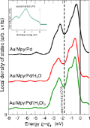
- electronic structure of these Pd atoms is considerably modified which is reflected in a reduced local density of states at the Fermi energy. At higher coverages, water can be arranged in a hexagonal ice-like bilayer structure in analogy to water on bulk metal surfaces, but with a much stronger binding which
- eV [18]. Single H2O molecules on metal surfaces preferentially occupy top site positions creating a one-fold oxygen–metal bond, with O–H bonds oriented parallel to the surface [25]. Layers of water on (111) metal surfaces are traditionally assumed to be arranged in an ice-like hexagonal bilayer
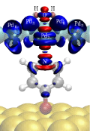
- isolated water molecule, as well as of a water layer arranged in a hexagonal bilayer, at the preferential adsorption sites on the densely packed palladium monolayer of the Au/Mpy/Pd system. In addition, we concentrate on the structural and electronic modification of the Au/Mpy/Pd complex upon water

![[Graphic 1]](/bjnano/content/inline/2190-4286-2-44-i1.png?max-width=637&scale=0.945456) )R3...
)R3...


![[Graphic 2]](/bjnano/content/inline/2190-4286-2-44-i2.png?max-width=637&scale=1.18182) = 1/3 ML. Plott...
= 1/3 ML. Plott...
Microfluidic anodization of aluminum films for the fabrication of nanoporous lipid bilayer support structures
Beilstein J. Nanotechnol. 2011, 2, 104–109, doi:10.3762/bjnano.2.12

- setup for performing biological experiments without the need to transfer the brittle nanoporous material. We demonstrate this technique by using the same microfluidic system for membrane fabrication and subsequent liposome fusion onto the nanoporous support structure. The resulting bilayer formation is
- monitored by impedance spectroscopy across the nanoporous alumina membrane in real-time. Our approach offers a simple and efficient methodology to investigate the activity of transmembrane proteins or ion diffusion across membrane bilayers. Keywords: anodization; lipid bilayer; microfluidics
- nanoporous membrane for lipid bilayer formation, the nanoporous alumina surface was first subjected to silanization. The silanization was carried out in the solution phase according to the method described by Steinle and coworkers [37][38] with slight modifications. Briefly, a 10% (v/v) solution of (3